Department of Anesthesiology and Operative Intensive Care Medicine CCM/CVK, Charité - Universitätsmedizin Berlin, corporate member of Freie Universität Berlin, Humboldt-Universität zu Berlin, and Berlin Institute of Health.
ARDS/ECMO Centrum Charité, Charité - Universitätsmedizin Berlin, Berlin, Germany.
Int J Med Sci. 2021 Feb 18;18(8):1730-1738. doi: 10.7150/ijms.50217. eCollection 2021.
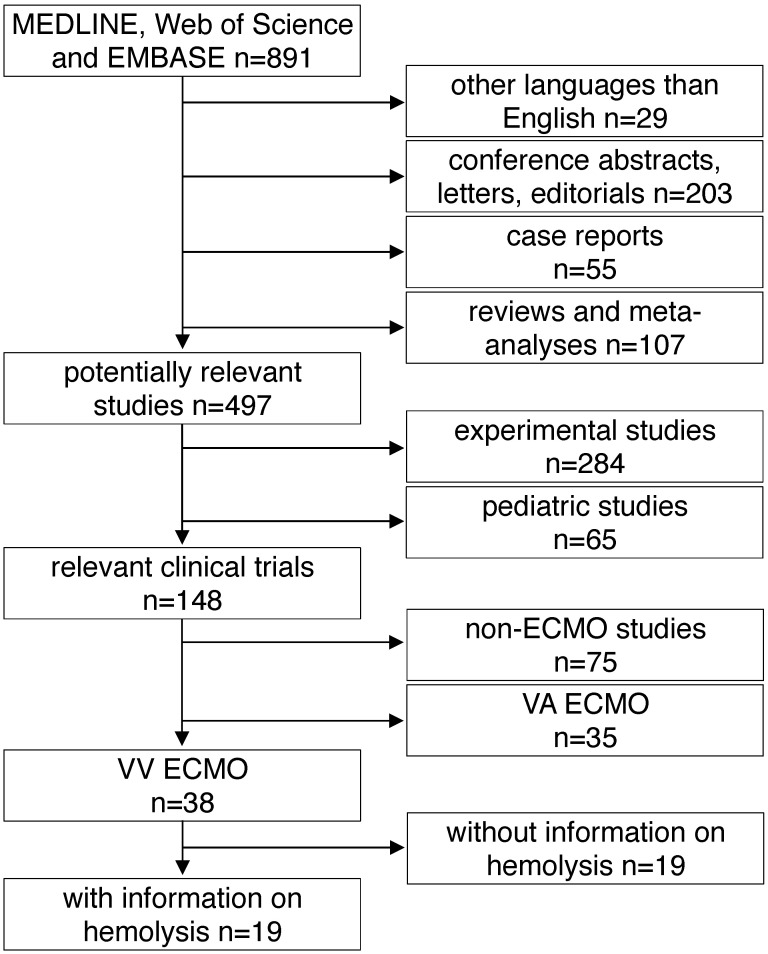
The Acute Respiratory Distress Syndrome (ARDS) is common in patients on the Intensive Care Unit and associated with significant mortality rates. In situations of severe respiratory insufficiency and failure of all possible conservative therapeutic approaches, veno-venous extracorporeal membrane oxygenation (VV ECMO) is used as a final option for temporary replacement of pulmonary function. ARDS as well as sepsis and VV ECMO treatment are all associated with intravascular hemolysis. The extent and relevance of intravascular hemolysis in the context of ARDS therapy is unclear. This systematic review aims to summarize the current evidence on the incidence and associated complications of intravascular hemolysis in adult patients with ARDS and treatment with VV ECMO. The databases MEDLINE, EMBASE and Web of Science were systematically searched and 19 publications fulfilled inclusion criteria. The incidence of hemolysis in patients with ARDS and treatment with VV ECMO ranged from 0 to 41% with survivors showing lower incidences and less severe hemolysis. A pump head thrombosis and high blood flows (≥3 l/min) as well as use of dual-lumen cannulas but not different pump models were associated with increased hemolysis. In conclusion, intravascular hemolysis in patients with ARDS and treatment with VV ECMO is a common and relevant complication that appears associated with increased mortality. Apart from ECMO hardware-settings, no additional possible causes for increased red cell breakdown such as disease severity, duration of ECMO therapy, or number and quality of red blood cell transfusions were investigated. Further research is needed to determine the origin and relevance of intravascular hemolysis in patients with ARDS and treatment with VV ECMO.
急性呼吸窘迫综合征(ARDS)在重症监护病房(ICU)患者中很常见,与高死亡率相关。在严重呼吸功能不全和所有可能的保守治疗方法均失败的情况下,静脉-静脉体外膜肺氧合(VV ECMO)被用作暂时替代肺功能的最后手段。ARDS、败血症和 VV ECMO 治疗均与血管内溶血有关。ARDS 治疗中血管内溶血的程度和相关性尚不清楚。本系统综述旨在总结成人 ARDS 患者接受 VV ECMO 治疗时血管内溶血的发生率和相关并发症的现有证据。系统检索了 MEDLINE、EMBASE 和 Web of Science 数据库,有 19 篇文献符合纳入标准。ARDS 患者接受 VV ECMO 治疗时溶血的发生率为 0 至 41%,存活者的发生率较低,溶血程度较轻。泵头血栓形成和较高的血流量(≥3 l/min)以及使用双腔导管但不使用不同的泵模型与溶血增加有关。总之,ARDS 患者接受 VV ECMO 治疗时的血管内溶血是一种常见且相关的并发症,似乎与死亡率增加有关。除了 ECMO 硬件设置外,没有进一步研究其他可能导致红细胞破坏增加的原因,如疾病严重程度、ECMO 治疗持续时间或红细胞输注的数量和质量。需要进一步研究以确定 ARDS 患者接受 VV ECMO 治疗时血管内溶血的来源和相关性。