Department of Cardiology, Renmin Hospital of Wuhan University, Wuhan 430060, China.
Cardiovascular Research Institute, Wuhan University, Wuhan, China.
Int J Med Sci. 2021 Feb 18;18(8):1768-1777. doi: 10.7150/ijms.54655. eCollection 2021.
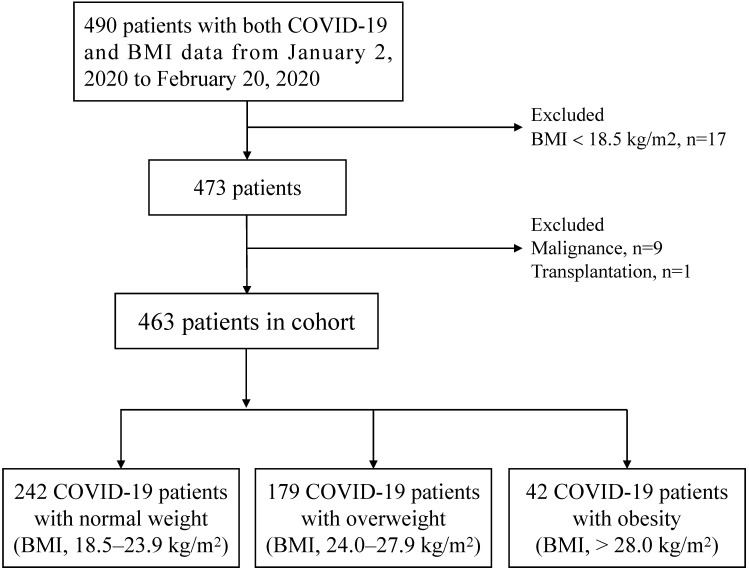
In other respiratory infectious diseases, obesity may be associated with a poor outcome. For coronavirus disease 2019 (COVID-19), the association between obesity and severity or prognosis requires further analysis. This was a retrospective, single-center study. Hospitalized patients were recruited in Renmin Hospital of Wuhan University from January 2, 2020 to February 20, 2020. The data of body mass index (BMI) was obtained from follow-up of surviving patients. According to BMI, normal weight was defined as 18.5-23.9 kg/m, overweight as 24.0-27.9 kg/m and obesity as > 28.0 kg/m. A total of 463 patients were enrolled, of which 242 (52.3%) patients were in the normal weight group; 179 (38.7%) were in the overweight group; and 42 (9.1%) were in the obesity group. Compared to the normal group, obese patients were more likely to have a higher heart rate; lower finger oxygen saturation; higher levels of white blood cells, neutrophil counts, basophil counts, intravenous glucose, triacylglycerol, uric acid, alanine aminotransferase, creatine kinase-MB, CD19+ cell counts and percentage; and lower levels of monocyte percentage, high density lipoprotein and CD3+ cell percentage. In addition, the proportions of hypertension (21.5% vs. 42.6%) and severe+critical illness (47.8 vs. 81.0 %) were significantly higher in the obesity group than those in normal group. However, no significant differences were observed between the normal and obesity groups in critical illness, organ damage and defined endpoint (mechanical ventilation or intensive care unit). Multiple logistic regression showed that obesity increased the risk of developing severe+critical illness (Odd ratio 3.586, 95% CI 1.550-8.298, P=0.003) in patients with COVID-19, and did not affect the risk of critical illness, organ damage and endpoints. Overweight did not affect the risk of severity, organ damage or endpoint in patients with COVID-19. Obesity may be a risk factor for developing severity in patients with COVID-19.
在其他呼吸道传染病中,肥胖可能与不良预后有关。对于 2019 年冠状病毒病(COVID-19),肥胖与严重程度或预后之间的关系需要进一步分析。这是一项回顾性、单中心研究。2020 年 1 月 2 日至 2 月 20 日,在武汉大学人民医院招募住院患者。从存活患者的随访中获得体重指数(BMI)数据。根据 BMI,正常体重定义为 18.5-23.9kg/m,超重定义为 24.0-27.9kg/m,肥胖定义为>28.0kg/m。共纳入 463 例患者,其中 242 例(52.3%)为正常体重组;179 例(38.7%)为超重组;42 例(9.1%)为肥胖组。与正常组相比,肥胖组患者的心率更高,指氧饱和度更低,白细胞、中性粒细胞计数、嗜碱性粒细胞计数、静脉血糖、三酰甘油、尿酸、丙氨酸氨基转移酶、肌酸激酶-MB、CD19+细胞计数和百分比更高,单核细胞百分比、高密度脂蛋白和 CD3+细胞百分比更低。此外,肥胖组高血压(21.5%比 42.6%)和重症+危重症(47.8%比 81.0%)的比例明显高于正常组。然而,肥胖组与正常组在危重症、器官损伤和定义的终点(机械通气或重症监护病房)方面无显著差异。多因素逻辑回归显示,肥胖使 COVID-19 患者发生重症+危重症的风险增加(比值比 3.586,95%可信区间 1.550-8.298,P=0.003),但不影响危重症、器官损伤和终点的风险。超重不影响 COVID-19 患者的严重程度、器官损伤或终点的风险。肥胖可能是 COVID-19 患者发生严重程度的危险因素。