Cravello Luca, Martini Eleonora, Viti Niccolò, Campanello Cristina, Assogna Francesca, Perotta Daniele
Alzheimer Center ASST Rhodense, Rho, Italy.
Fondazione Santa Lucia, Istituto di Ricovero e Cura a Carattere Scientifico (IRCCS), Rome, Italy.
Front Psychiatry. 2021 Mar 4;12:590104. doi: 10.3389/fpsyt.2021.590104. eCollection 2021.
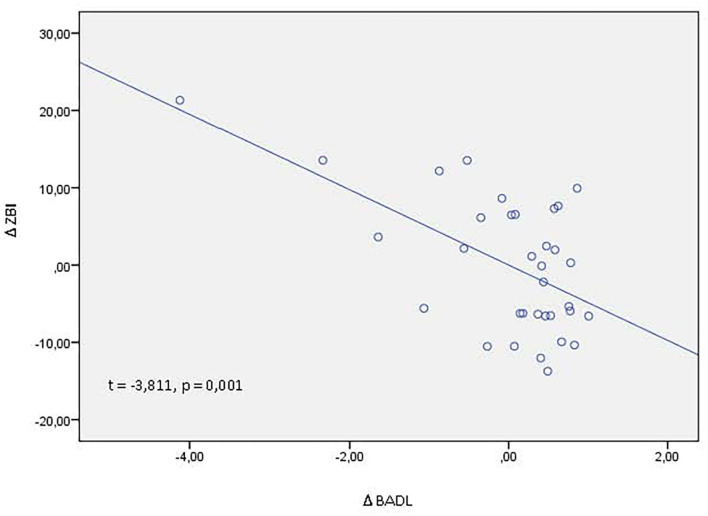
The coronavirus disease 2019 (COVID-19) pandemic had a great impact on patients with cognitive decline or dementia. The lockdown period may exacerbate behavioral disorders and worsen distress of caregivers. The aim of this study is to evaluate the effectiveness of a family support intervention on the negative effects that the COVID-19 lockdown may have on patients and related caregivers. We recruited patients whose related caregivers had attended a family support course before the COVID-19 lockdown. The course was for family members of patients with cognitive decline or dementia and consisted in eight meetings during which the participants received information about the disease, the management of neuropsychiatric symptoms, and community resources and services available for patients with dementia. Data on cognitive decline, neuropsychiatric symptoms, and functional status had been collected before the course with the Mini-Mental State Examination (MMSE), the Neuropsychiatric Inventory (NPI), and the Instrumental (IADL) and Basic (BADL) Activities of Daily Living scales, respectively. The caregiving burden had been evaluated at the end of the course by means of the Zarit Burden Interview (ZBI). After the COVID-19 lockdown, a phone interview was made to compare neuropsychiatric symptoms, functional status, and caregiver's burden with the previous evaluation. There were no significant changes before and after the COVID-19 lockdown in the mean NPI score. The IADL, BADL, and ZBI scores were significantly lower after lockdown than before. The BADL scores were inversely associated with ZBI scores. Thus, despite a worsening of patients' functional status, the caregivers' burden decreased significantly probably due to the positive effect of the family support intervention. Our study demonstrated that a complete family support intervention for caregivers of patients with cognitive decline or dementia can reduce the burden of care even in a particular negative period, such as the COVID-19 lockdown.
2019年冠状病毒病(COVID-19)大流行对认知功能减退或痴呆患者产生了重大影响。封锁期可能会加剧行为障碍,并加重照护者的痛苦。本研究的目的是评估家庭支持干预对COVID-19封锁可能给患者及相关照护者带来的负面影响的有效性。我们招募了其相关照护者在COVID-19封锁之前参加过家庭支持课程的患者。该课程面向认知功能减退或痴呆患者的家庭成员,共包括八次会议,期间参与者获得了有关该疾病、神经精神症状管理以及痴呆患者可利用的社区资源和服务的信息。在课程开始前,分别使用简易精神状态检查表(MMSE)、神经精神科问卷(NPI)以及工具性日常生活活动量表(IADL)和基本日常生活活动量表(BADL)收集了有关认知功能减退、神经精神症状和功能状态的数据。在课程结束时,通过Zarit照护负担访谈量表(ZBI)评估了照护负担。在COVID-19封锁之后,进行了电话访谈,以将神经精神症状、功能状态和照护者负担与之前的评估进行比较。COVID-19封锁前后,NPI平均得分没有显著变化。封锁后,IADL、BADL和ZBI得分均显著低于之前。BADL得分与ZBI得分呈负相关。因此,尽管患者的功能状态有所恶化,但照护者的负担可能由于家庭支持干预的积极作用而显著减轻。我们的研究表明,针对认知功能减退或痴呆患者照护者的全面家庭支持干预即使在像COVID-19封锁这样的特殊消极时期也可以减轻照护负担。