Aguglia Andrea, Giacomini Gabriele, Montagna Elisa, Amerio Andrea, Escelsior Andrea, Capello Marco, Cutroneo Laura, Ferretti Gabriele, Scafidi Davide, Costanza Alessandra, Serafini Gianluca, Amore Mario
Section of Psychiatry, Department of Neuroscience, Rehabilitation, Ophthalmology, Genetics, Maternal, and Child Health, University of Genoa, Genoa, Italy.
Istituto di Ricovero e Cura a Carattere Scientifico Ospedale Policlinico San Martino, Genoa, Italy.
Front Psychiatry. 2021 Mar 5;12:653390. doi: 10.3389/fpsyt.2021.653390. eCollection 2021.
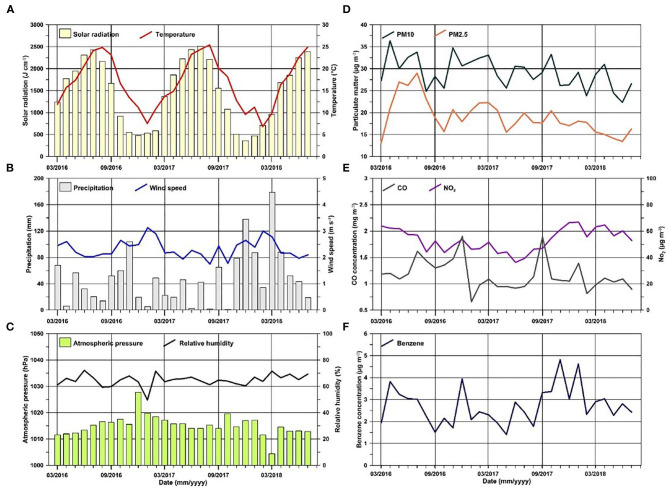
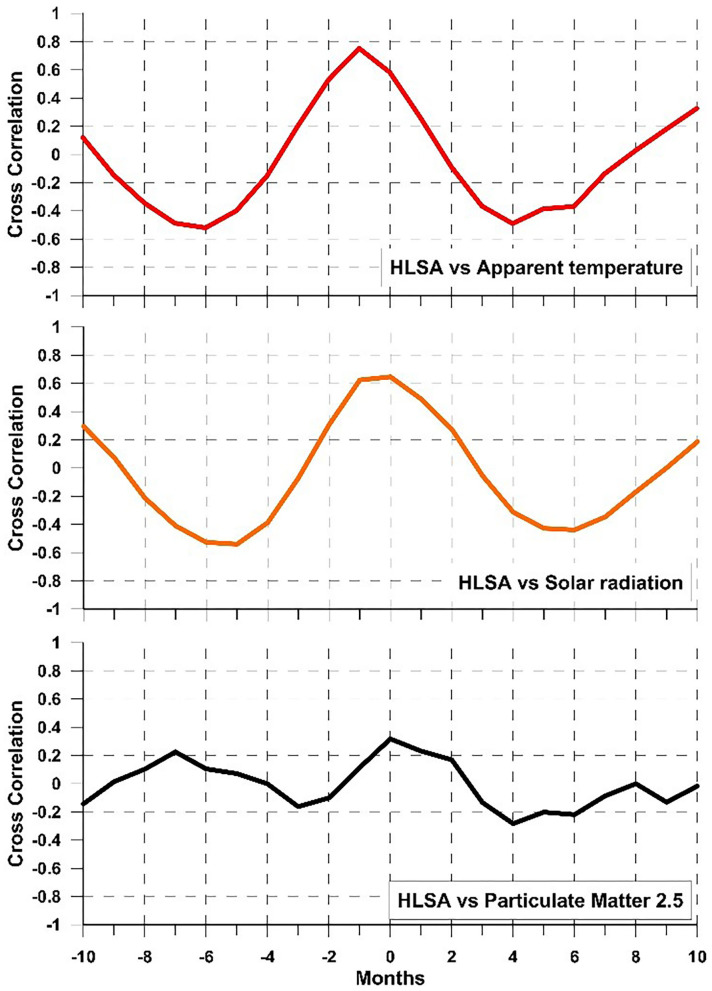
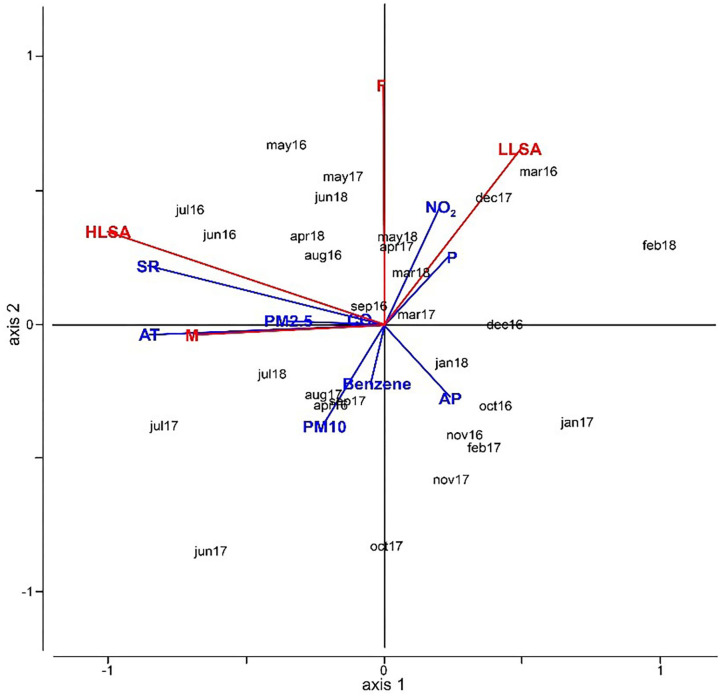
This study analyzed the impact of meteorological variables and high-lethality suicide attempts (HLSA) to assess a potential time shift of HLSA affected by climate evolution to predict the suicide attempt cases over different periods of the year. After attempting suicide, 225 subjects were admitted to the emergency ward of the IRCCS Ospedale Policlinico San Martino and later to the psychiatric unit from March 2016 to July 2018. Socio-demographic and clinical characteristics as well as the meteorological variables were collected. The Mann-Kendall test as well as redundancy and cross-correlation analyses were performed to analyze the trends, statistically correlations, and correspondence of the trends, respectively between suicidal behaviors and climatic factors. Sixty-seven (29.8%) committed a HLSA. Our findings indicate a significant association between HLSA and male gender and apparent temperature with a strong correlation of 75% with a phase shift of -1 month. Solar radiation and air pollution (PM) have a positive correlation of 65 and 32%, respectively, with a zero-time lag. Limitations include that the data are limited to a single hospital; psychological factors, or other clinical variables that could be ruled out as a trigger have not been considered. Meteorological variables may not mirror the temperature that the patient is exposed to due to the air conditioning systems. Exploring those environmental factors associated with HLSA in a more detailed manner could lead to early intervention and prevention strategies for such distressing admissions.
本研究分析了气象变量和高致死性自杀未遂(HLSA)的影响,以评估受气候演变影响的HLSA的潜在时间偏移,从而预测一年中不同时期的自杀未遂病例。2016年3月至2018年7月期间,225名自杀未遂者被收治于IRCCS圣马尔蒂诺综合医院急诊科,随后转入精神科。收集了社会人口统计学和临床特征以及气象变量。分别进行了曼-肯德尔检验以及冗余和互相关分析,以分析自杀行为与气候因素之间的趋势、统计相关性以及趋势的对应关系。67人(29.8%)实施了高致死性自杀未遂。我们的研究结果表明,HLSA与男性性别和体感温度之间存在显著关联,二者相关性很强,达75%,相位偏移为-1个月。太阳辐射和空气污染(PM)的正相关性分别为65%和32%,且无时滞。局限性在于数据仅限于一家医院;未考虑心理因素或其他可排除为触发因素的临床变量。由于空调系统的存在,气象变量可能无法反映患者实际接触到的温度。更详细地探究那些与HLSA相关的环境因素,可能会带来针对此类令人痛苦的入院情况的早期干预和预防策略。