Department of Immunology, QIMR Berghofer Medical Research Institute, Brisbane, QLD, Australia.
School of Veterinary Science, The University of Queensland, Gatton, QLD, Australia.
Front Immunol. 2021 Mar 5;12:599014. doi: 10.3389/fimmu.2021.599014. eCollection 2021.
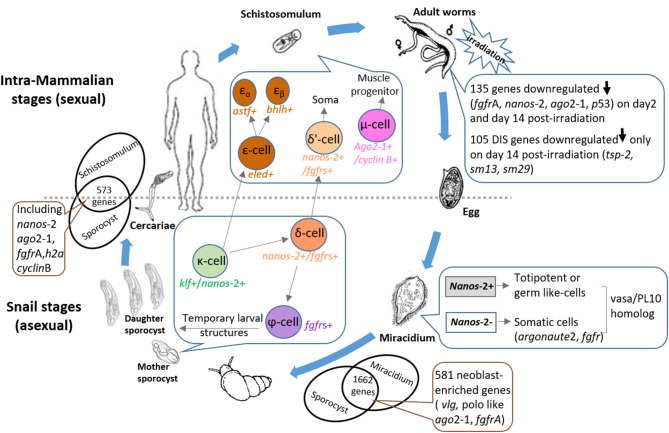
Schistosomes infect about 250 million people globally causing the devastating and persistent disease of schistosomiasis. These blood flukes have a complicated life cycle involving alternating infection of freshwater snail intermediate and definitive mammalian hosts. To survive and flourish in these diverse environments, schistosomes transition through a number of distinct life-cycle stages as a result of which they change their body plan in order to quickly adapt to each new environment. Current research suggests that stem cells, present in adults and larvae, are key in aiding schistosomes to facilitate these changes. Given the recent advances in our understanding of schistosome stem cell biology, we review the key roles that two major classes of cells play in the different life cycle stages during intramolluscan and intramammalian development; these include the germinal cells of sporocysts involved in asexual reproduction in molluscan hosts and the neoblasts of adult worms involved in sexual reproduction in human and other mammalian hosts. These studies shed considerable new light in revealing the stem cell heterogeneity driving the propagation of the schistosome life cycle. We also consider the possibility and value of establishing stem cell lines in schistosomes to advance schistosomiasis research. The availability of such self-renewable resources will provide new platforms to study stem cell behavior and regulation, and to address fundamental aspects of schistosome biology, reproductive development and survival. In turn, such studies will create new avenues to unravel individual gene function and to optimize genome-editing processes in blood flukes, which may lead to the design of novel intervention strategies for schistosomiasis.
血吸虫感染全球约 2.5 亿人,导致严重且持久的血吸虫病。这些血吸 虫具有复杂的生活史,涉及淡水螺中间宿主和最终哺乳动物宿主的交替感染。为了在这些多样化的环境中生存和繁衍,血吸虫经历了许多不同的生活 周期阶段,从而改变了它们的身体计划,以便快速适应每个新的环境。目前 的研究表明,成虫和幼虫中的干细胞在帮助血吸虫实现这些变化方面发挥 着关键作用。鉴于我们对血吸虫干细胞生物学理解的最新进展,我们回顾 了两类主要细胞在螺内和哺乳动物内发育的不同生命周期阶段中所起的关键 作用;这些包括参与在软体动物宿主中无性繁殖的孢子生殖细胞和参与人 类和其他哺乳动物宿主中有性繁殖的成虫中的成体干细胞。这些研究揭示了 驱动血吸虫生命周期传播的干细胞异质性。我们还考虑了在血吸虫中建立 干细胞系以推进血吸虫病研究的可能性和价值。这些自我更新资源的可用性 将为研究干细胞行为和调控提供新的平台,并解决血吸虫生物学、生殖发 育和生存的基本方面。反过来,这些研究将为揭示单个基因功能和优化血吸 虫基因组编辑过程开辟新途径,这可能为血吸虫病的设计带来新的干预策略。