Sankaranarayanan Geetha, Coghlan Avril, Driguez Patrick, Lotkowska Magda E, Sanders Mandy, Holroyd Nancy, Tracey Alan, Berriman Matthew, Rinaldi Gabriel
Wellcome Sanger Institute, Hinxton, CB10 1SA, UK.
Wellcome Open Res. 2021 Jan 20;5:178. doi: 10.12688/wellcomeopenres.16031.2. eCollection 2020.
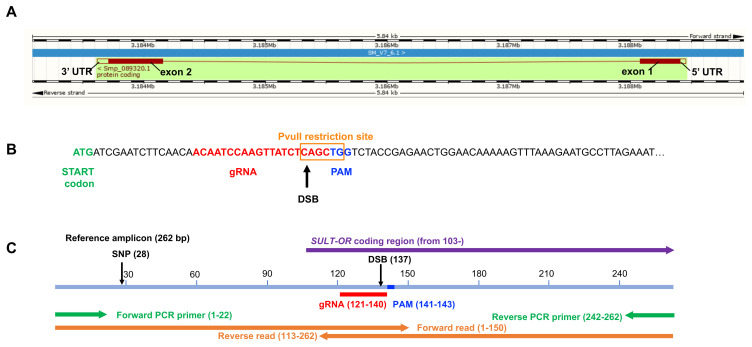
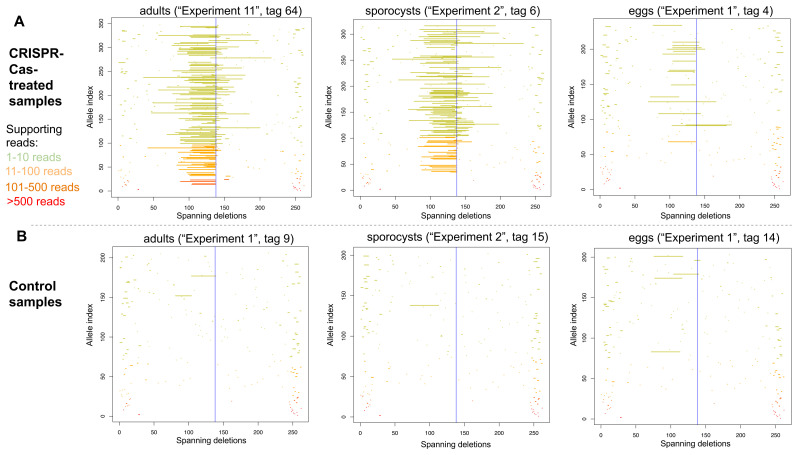
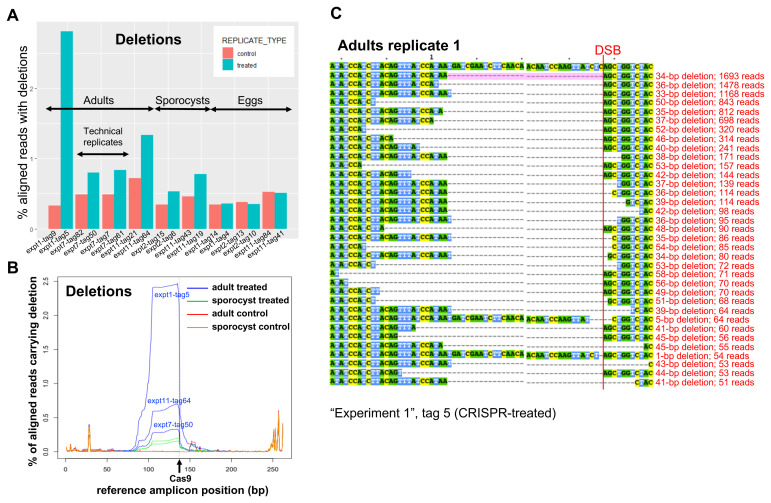
At least 250 million people worldwide suffer from schistosomiasis, caused by worms. Genome sequences for several species are available, including a high-quality annotated reference for . There is a pressing need to develop a reliable functional toolkit to translate these data into new biological insights and targets for intervention. CRISPR-Cas9 was recently demonstrated for the first time in , to produce somatic mutations in the ( ) gene. We employed CRISPR-Cas9 to introduce somatic mutations in a second gene, , a sulfotransferase expressed in the parasitic stages of , in which mutations confer resistance to the drug oxamniquine. A 262-bp PCR product spanning the region targeted by the gRNA against was amplified, and mutations identified in it by high-throughput sequencing. We found that 0.3-2.0% of aligned reads from CRISPR-Cas9-treated adult worms showed deletions spanning the predicted Cas9 cut site, compared to 0.1-0.2% for sporocysts, while deletions were extremely rare in eggs. The most common deletion observed in adults and sporocysts was a 34 bp-deletion directly upstream of the predicted cut site, but rarer deletions reaching as far as 102 bp upstream of the cut site were also detected. The CRISPR-Cas9-induced deletions, if homozygous, are predicted to cause resistance to oxamniquine by producing frameshifts, ablating transcription, or leading to mRNA degradation the nonsense-mediated mRNA decay pathway. However, no knock down at the mRNA level was observed, presumably because the cells in which CRISPR-Cas9 did induce mutations represented a small fraction of all cells expressing . Further optimisation of CRISPR-Cas protocols for different developmental stages and particular cell types, including germline cells, will contribute to the generation of a homozygous knock-out in any gene of interest, and in particular the gene to derive an oxamniquine-resistant stable transgenic line.
全球至少有2.5亿人感染由蠕虫引起的血吸虫病。已有几种血吸虫的基因组序列,包括高质量注释的参考序列。迫切需要开发一种可靠的功能工具包,将这些数据转化为新的生物学见解和干预靶点。最近首次在血吸虫中证明了CRISPR-Cas9可在血吸虫的丙酮酸激酶(PK)基因中产生体细胞突变。我们利用CRISPR-Cas9在第二个基因——血吸虫寄生阶段表达的磺基转移酶(SULT1)中引入体细胞突变,该基因中的突变可赋予对奥沙尼喹药物的抗性。扩增了一个262bp的PCR产物,该产物跨越针对SULT1的gRNA靶向区域,并通过高通量测序在其中鉴定突变。我们发现,与子胞蚴的0.1%-0.2%相比,CRISPR-Cas9处理的成虫中0.3%-2.0%的比对读数显示出跨越预测的Cas9切割位点的缺失,而卵中的缺失极为罕见。在成虫和子胞蚴中观察到的最常见缺失是预测切割位点上游34bp的缺失,但也检测到了更罕见的、延伸至切割位点上游102bp的缺失。如果纯合,CRISPR-Cas9诱导的缺失预计会通过产生移码、消除SULT1转录或导致mRNA通过无义介导的mRNA降解途径降解,从而导致对奥沙尼喹产生抗性。然而,未观察到SULT1在mRNA水平上的敲低,推测是因为CRISPR-Cas9确实诱导突变的细胞仅占所有表达SULT1细胞的一小部分。针对不同发育阶段和特定细胞类型(包括生殖细胞)进一步优化CRISPR-Cas方案,将有助于在任何感兴趣的基因中产生纯合敲除,特别是在SULT1基因中产生抗奥沙尼喹稳定转基因系。