Amsterdam UMC, Department of Rheumatology and Clinical Immunology, Amsterdam Institute for Infection and Immunity, University of Amsterdam, Amsterdam, Netherlands.
Amsterdam UMC, Department of Experimental Immunology, Amsterdam Institute for Infection and Immunity, University of Amsterdam, Amsterdam, Netherlands.
Front Immunol. 2021 Mar 4;12:611656. doi: 10.3389/fimmu.2021.611656. eCollection 2021.
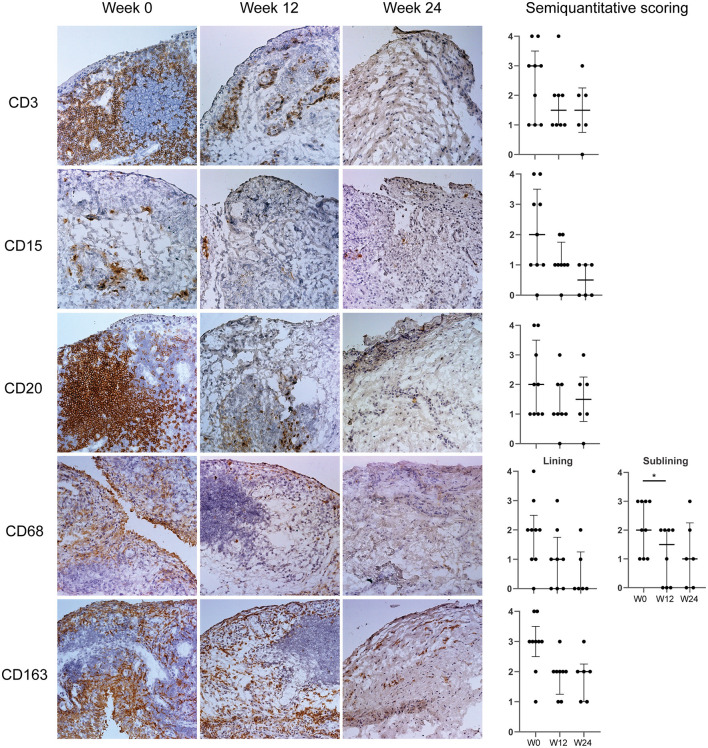
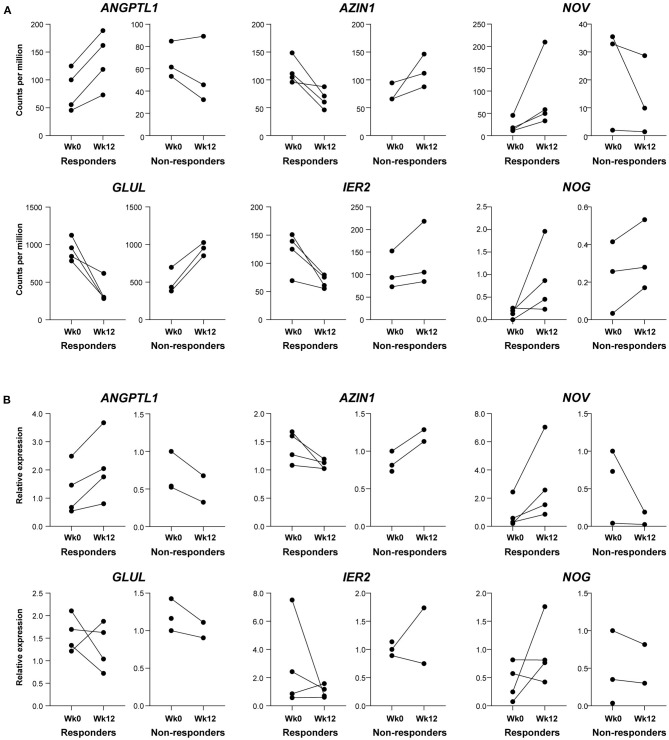
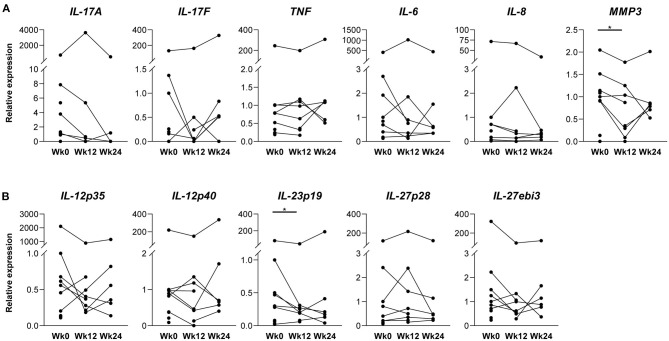
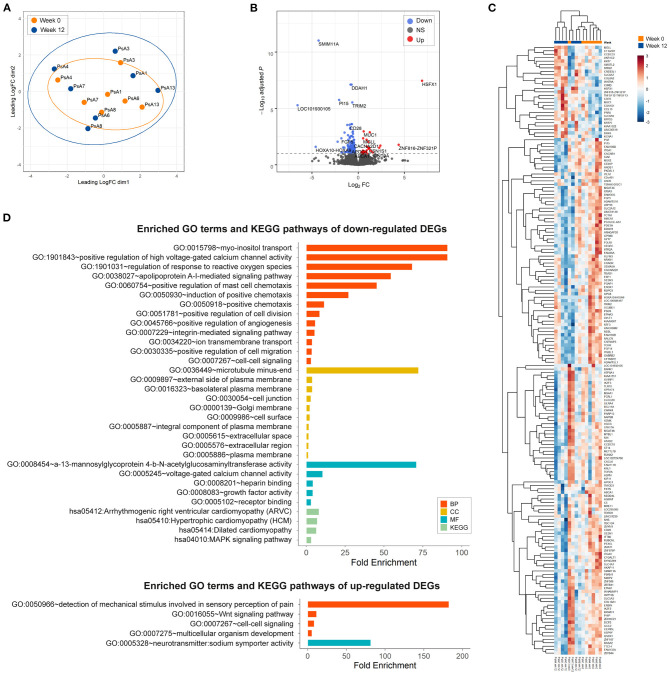
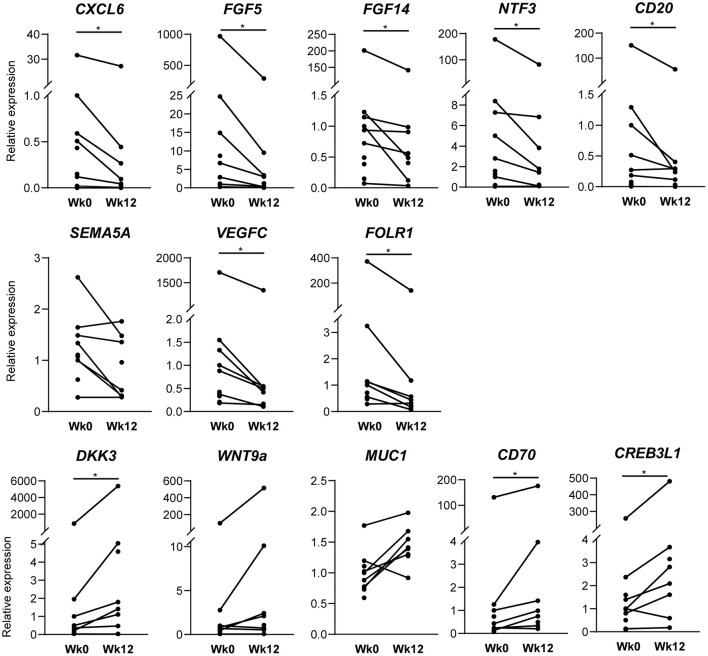
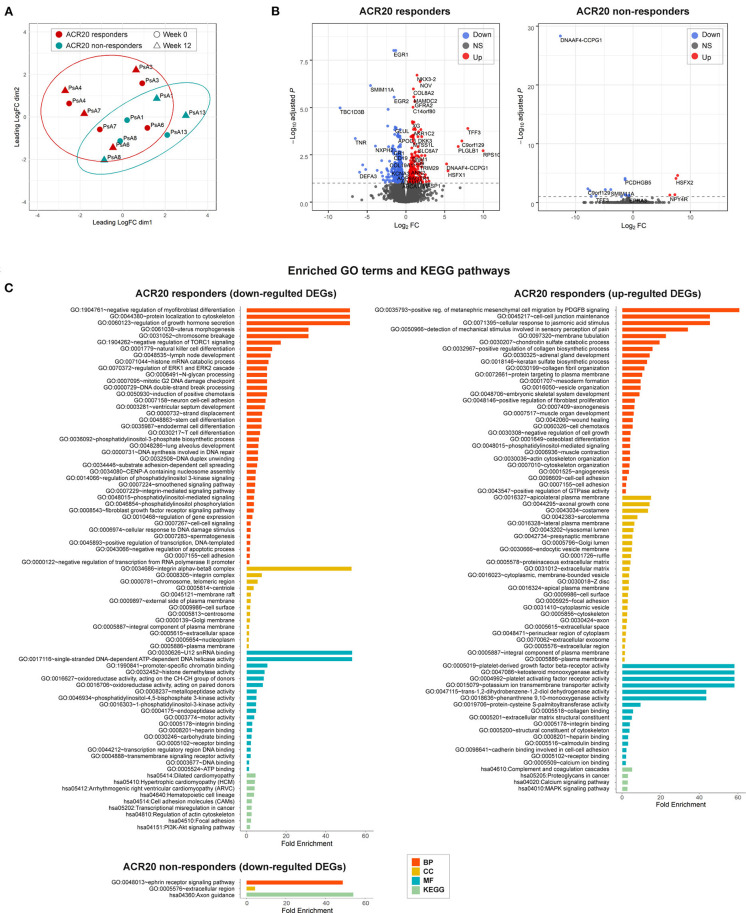
Psoriatic arthritis (PsA) is a chronic inflammatory joint disease within the spondyloarthritis spectrum. IL-12p40/IL-23p40 blockade reduces PsA disease activity, but its impact on synovial inflammation remains unclear. To investigate the cellular and molecular pathways affected by IL-12p40/IL-23p40 blockade with ustekinumab in the synovium of PsA patients. Eleven PsA patients with at least one inflamed knee or ankle joint were included in a 24-week single-center open-label study and received ustekinumab 45 mg/sc according to standard care at week 0, 4, and 16. Besides clinical outcomes, synovial tissue (ST) samples were obtained by needle arthroscopy from an inflamed knee or ankle joint at baseline, week 12 and 24 and analyzed by immunohistochemistry, RNA-sequencing and real-time quantitative polymerase chain reaction (qPCR). We obtained paired baseline and week 12, and paired baseline, week 12 and 24 ST samples from nine and six patients, respectively. Eight patients completed 24 weeks of clinical follow-up. At 12 weeks 6/11 patients met ACR20, 2/11 met ACR50 and 1/11 met ACR70 improvement criteria, at 24 weeks this was 3/8, 2/8 and 1/8 patients, respectively. Clinical and serological markers improved significantly. No serious adverse events occurred. We observed numerical decreases of all infiltrating cell subtypes at week 12, reaching statistical significance for CD68+ sublining macrophages. For some cell types this was even more pronounced at week 24, but clearly synovial inflammation was incompletely resolved. IL-17A and F, TNF, IL-6, IL-8, and IL-12p40 were not significantly downregulated in qPCR analysis of W12 total biopsies, only MMP3 and IL-23p19 were significantly decreased. RNA-seq analysis revealed 178 significantly differentially expressed genes between baseline and 12 weeks (FDR 0.1). Gene Ontology and KEGG terms enrichment analyses identified overrepresentation of biological processes as response to reactive oxygen species, chemotaxis, migration and angiogenesis as well as MAPK-ERK and PI3K-Akt signaling pathways among the downregulated genes and of Wnt signaling pathway among the upregulated genes. Furthermore, ACR20 responders and non-responders differed strikingly in gene expression profiles in a exploratory analysis. Ustekinumab suppresses PsA synovial inflammation through modulation of multiple signal transduction pathways, including MAPK-ERK, Wnt and potentially PI3K-Akt signaling rather than by directly impacting the IL-17 pathway.
银屑病关节炎(PsA)是一种慢性炎症性关节病,属于脊柱关节炎谱。IL-12p40/IL-23p40 阻断可降低 PsA 疾病活动度,但对滑膜炎症的影响尚不清楚。本研究旨在探讨乌司奴单抗阻断 IL-12p40/IL-23p40 对 PsA 患者滑膜中细胞和分子途径的影响。
11 例至少有一个炎症性膝关节或踝关节的 PsA 患者入组了一项 24 周的单中心开放性研究,在第 0、4 和 16 周根据标准护理接受乌司奴单抗 45mg/sc。除临床结局外,还通过关节镜从炎症性膝关节或踝关节获得滑膜组织(ST)样本,在基线、12 周和 24 周时通过免疫组化、RNA 测序和实时定量聚合酶链反应(qPCR)进行分析。
我们分别从 9 例和 6 例患者中获得了配对的基线和 12 周时、以及配对的基线、12 周和 24 周时的 ST 样本。8 例患者完成了 24 周的临床随访。在 12 周时,6/11 例患者符合 ACR20 标准,2/11 例患者符合 ACR50 标准,1/11 例患者符合 ACR70 改善标准,在 24 周时,这一比例分别为 3/8、2/8 和 1/8 例患者。临床和血清学标志物显著改善。未发生严重不良事件。我们观察到在第 12 周时所有浸润细胞亚型的数值下降,CD68+亚衬里巨噬细胞达到统计学意义。对于某些细胞类型,在第 24 周时更为明显,但显然滑膜炎症并未完全缓解。qPCR 分析显示,W12 总活检中 IL-17A 和 F、TNF、IL-6、IL-8 和 IL-12p40 并未显著下调,只有 MMP3 和 IL-23p19 显著下调。RNA 测序分析显示,在基线和 12 周之间有 178 个显著差异表达的基因(FDR 0.1)。GO 和 KEGG 术语富集分析发现,下调基因中生物学过程的代表性过度表达包括对活性氧的反应、趋化性、迁移和血管生成,以及 MAPK-ERK 和 PI3K-Akt 信号通路,而上调基因中 Wnt 信号通路的代表性过度表达。此外,在探索性分析中,ACR20 反应者和无反应者的基因表达谱存在显著差异。
乌司奴单抗通过调节多个信号转导通路,包括 MAPK-ERK、Wnt 和潜在的 PI3K-Akt 信号通路,而不是直接影响 IL-17 通路,抑制 PsA 滑膜炎症。