D'Elia Carolina, Folchini Decio M, Mian Christine, Hanspeter Esther, Schwienbacher Christine, Spedicato Giorgio Alfredo, Pycha Stefan, Vjaters Egils, Degener Stephan, Kafka Mona, Pycha Armin, Trenti Emanuela
Department of Urology, Hospital of Bolzano, Bolzano, Italy.
Department of Pathology, Hospital of Bolzano, Bolzano, Italy.
Ther Adv Urol. 2021 Mar 5;13:1756287221997183. doi: 10.1177/1756287221997183. eCollection 2021 Jan-Dec.
Xpert Bladder Cancer Monitor is a urinary marker based on the evaluation of five target mRNAs overexpressed in patients with bladder cancer (BC). The aim of our study is to update our results regarding the diagnostic accuracy of the Xpert Bladder Cancer Monitor test in the follow-up of patients with non-muscle invasive bladder cancer (NMIBC).
We conducted a prospective study on 1015 samples of 416 patients (mean age 72.2 ± 10.3 years) under follow-up for NMIBC. Patients underwent voided urinary cytology, the Xpert Bladder Cancer Monitor test and cystoscopy and, if positive, a transurethral resection of the bladder. Xpert Bladder Cancer Monitor was reported as negative or positive: cut-off total Linear Discriminant Analysis (LDA) = 0.5.
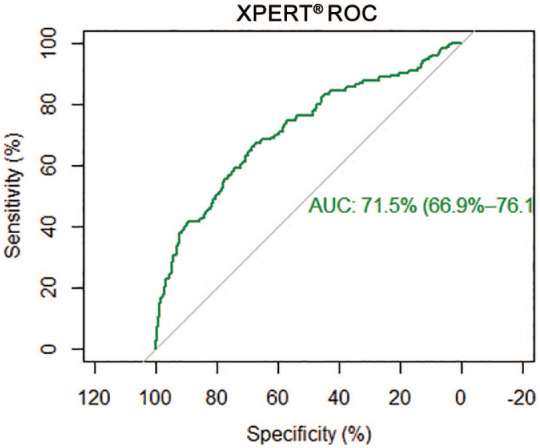
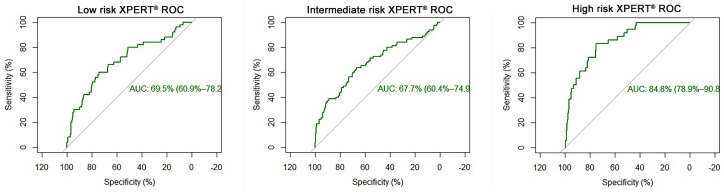
We identified 168 recurrent tumours: 126 (75%) were low-grade (LG) and 42 (25%) high-grade (HG). Overall sensitivity was 17.9% for cytology, 52.4% for Xpert Bladder Cancer Monitor and 54.2% for the two tests combined. The sensitivity of cytology increased from 6.3% in LG to 52.4% in HG tumours whereas Xpert Bladder Cancer Monitor showed a sensitivity ranging from 42.9% in LG to 80.9% in HG tumours. Combined cytology and Xpert Bladder Cancer Monitor yielded an overall sensitivity of 45.2% for LG and 80.9% for HG tumours. Overall specificity was 98.5% for cytology and 78.4% for Xpert Bladder Cancer Monitor and 78.2% for the two tests combined. The area under the curve (AUC) for Xpert Bladder Cancer Monitor was 0.71; stratifying the patients according to the European Association of Urology risk groups, the AUC was 0.69, 0.67 and 0.85 for low, intermediate and high risk, respectively ( = 0.0003).
Our data confirm a significantly higher sensitivity of Xpert Bladder Cancer Monitor than for cytology in a larger patient cohort. The test performed very well in terms of specificity but could not reach the high value of cytology. Along with voided urinary cytology the test could allow to reduce cystoscopies in follow-up patients, reducing discomfort to the patients and costs.
Xpert膀胱癌监测仪是一种基于对膀胱癌(BC)患者中过表达的5种靶标mRNA进行评估的尿液标志物。我们研究的目的是更新关于Xpert膀胱癌监测仪检测在非肌层浸润性膀胱癌(NMIBC)患者随访中诊断准确性的结果。
我们对416例NMIBC随访患者的1015份样本进行了一项前瞻性研究(平均年龄72.2±10.3岁)。患者接受了排尿细胞学检查、Xpert膀胱癌监测仪检测和膀胱镜检查,若结果为阳性,则进行经尿道膀胱肿瘤切除术。Xpert膀胱癌监测仪报告为阴性或阳性:截断值总线性判别分析(LDA)=0.5。
我们识别出168例复发性肿瘤:126例(75%)为低级别(LG),42例(25%)为高级别(HG)。细胞学检查的总体敏感性为17.9%,Xpert膀胱癌监测仪为52.4%,两种检测联合为54.2%。细胞学检查的敏感性从LG肿瘤中的6.3%增至HG肿瘤中的52.4%,而Xpert膀胱癌监测仪的敏感性在LG肿瘤中为42.9%,在HG肿瘤中为80.9%。细胞学检查与Xpert膀胱癌监测仪联合对LG肿瘤的总体敏感性为45.2%,对HG肿瘤为80.9%。细胞学检查的总体特异性为98.5%,Xpert膀胱癌监测仪为78.4%,两种检测联合为78.2%。Xpert膀胱癌监测仪的曲线下面积(AUC)为0.71;根据欧洲泌尿外科学会风险分组对患者进行分层,低、中、高风险组的AUC分别为0.69、0.67和0.85(P=0.0003)。
我们的数据证实,在更大的患者队列中,Xpert膀胱癌监测仪的敏感性显著高于细胞学检查。该检测在特异性方面表现良好,但未达到细胞学检查的高特异性值。与排尿细胞学检查一起,该检测可减少随访患者的膀胱镜检查次数,减轻患者不适并降低成本。