Zhang Ning, Xu Hongdan, Wang Yueying, Yao Yuan, Liu Guoliang, Lei Xia, Sun Huifeng, Wu Xiuhong, Li Jianmin
Jiamusi College, Heilongjiang University of Chinese Medicine, Harbin, China.
College of Pharmacy, Heilongjiang University of Chinese Medicine, Harbin, China.
Arch Med Sci. 2020 Aug 25;17(2):406-416. doi: 10.5114/aoms.2020.98199. eCollection 2021.
Progressive accumulation of amyloid-β (Aβ) is a pathological trait of Alzheimer's disease (AD). Amyloid-β increases free radical production in neuronal cells, leading to neuronal cell death. Hormone replacement therapy can reduce the incidence of AD, and oestrogen significantly improves the clinical signs in patients with AD. However, the long-term use of oestrogen causes a variety of diseases. Phytoestrogens have been reported to bind and activate oestrogen receptors in mammals and humans to produce oestrogen-like or anti-oestrogen-like effects. Kaempferol is a flavonoid phytoestrogen that can produce a certain protective effect in neurons. However, the molecular mechanism of kaempferol in AD is unclear.
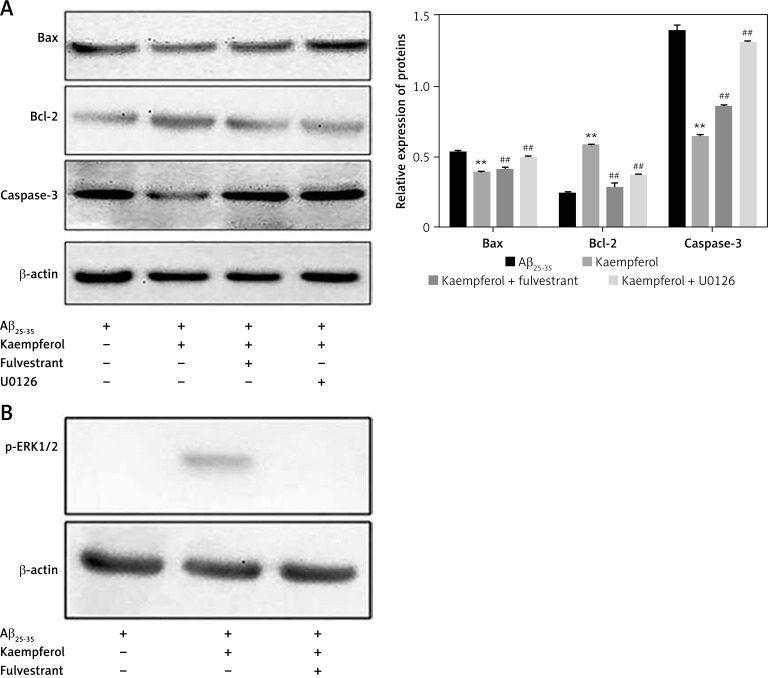
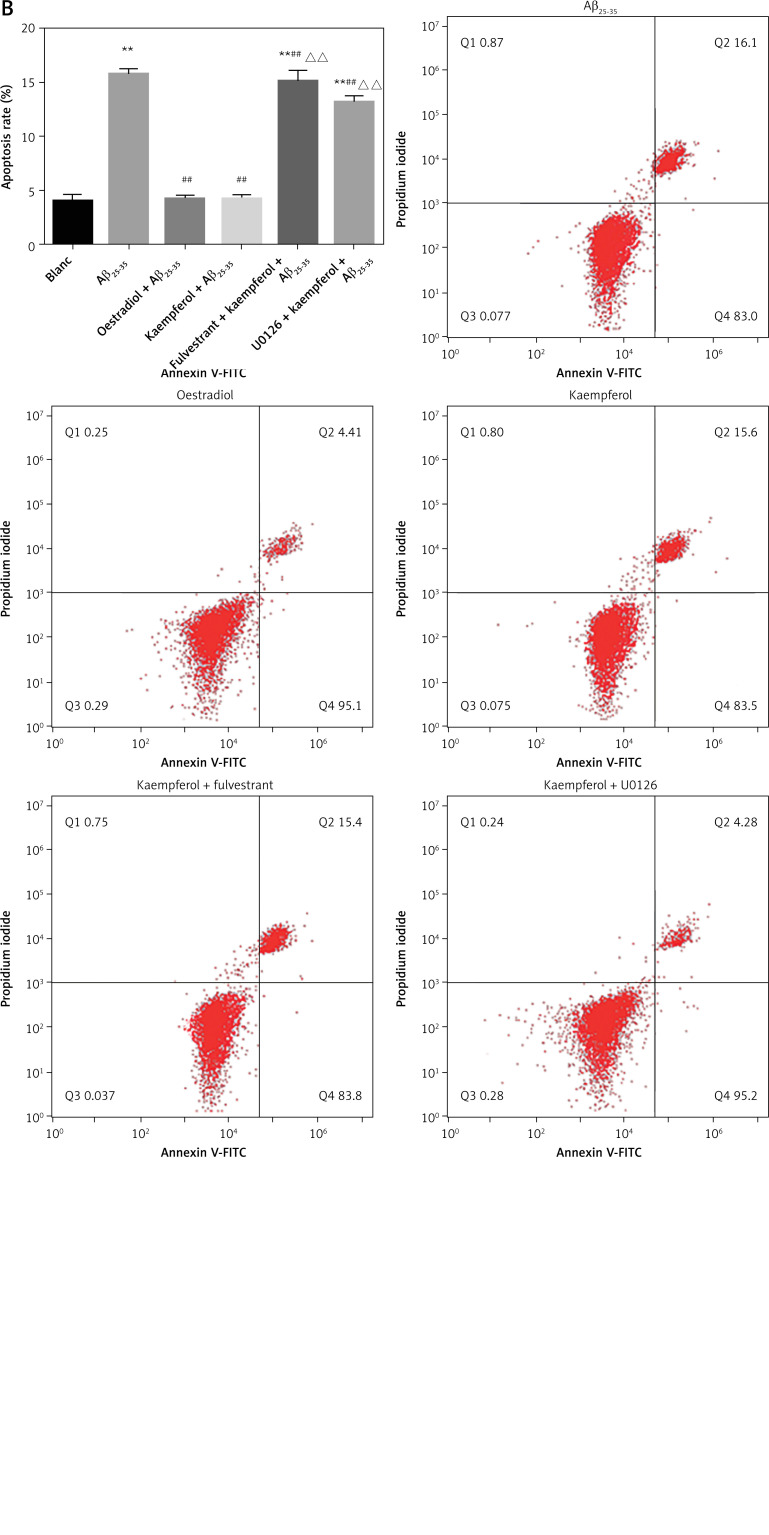
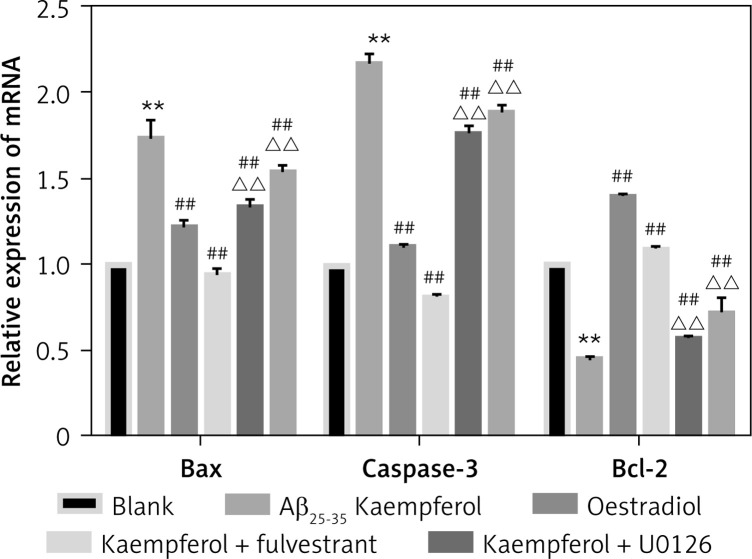
This study used pheochromocytoma (PC-12) cells that were damaged by Aβ as an model of AD, and oestradiol was a positive control. The cells were incubated with kaempferol alone or in combination with fulvestrant (an antagonist of ER) and U0126 (an inhibitor of ERK) in Aβ culture. Cell activity was measured by the MTT method. Cell apoptosis was evaluated by flow cytometry. Gene and protein expression levels were tested by qRT-PCR and Western blotting.
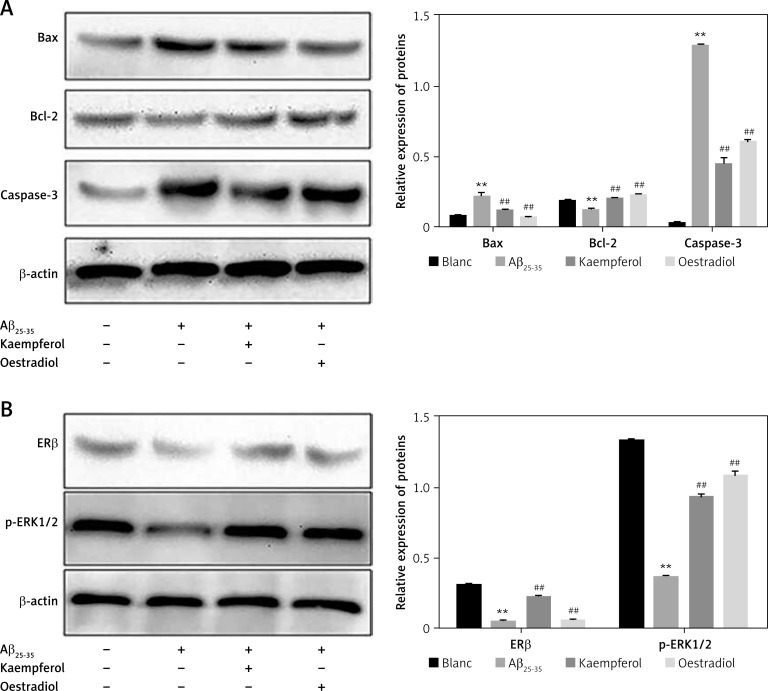
This study demonstrated that kaempferol protected PC-12 cells from Aβ-induced cell death and apoptosis in a dose-dependent manner. Treatment with fulvestrant (an antagonist of ER) and U0126 (an inhibitor of ERK) significantly increased the apoptosis of PC-12 cells. Moreover, kaempferol promoted the expression of anti-apoptotic molecules and inhibited the expression of pro-apoptotic molecules, which were blocked by fulvestrant and U0126.
Kaempferol protected PC-12 cells against Aβ-induced cell apoptosis through the ER/ERK/MAPK signalling pathway.
淀粉样β蛋白(Aβ)的渐进性积累是阿尔茨海默病(AD)的一个病理特征。淀粉样β蛋白会增加神经元细胞中自由基的产生,导致神经元细胞死亡。激素替代疗法可以降低AD的发病率,雌激素能显著改善AD患者的临床症状。然而,长期使用雌激素会引发多种疾病。据报道,植物雌激素可在哺乳动物和人类中结合并激活雌激素受体,产生类似雌激素或抗雌激素的作用。山奈酚是一种黄酮类植物雌激素,对神经元可产生一定的保护作用。然而,山奈酚在AD中的分子机制尚不清楚。
本研究使用被Aβ损伤的嗜铬细胞瘤(PC-12)细胞作为AD模型,雌二醇作为阳性对照。在Aβ培养环境中,将细胞单独用山奈酚处理,或与氟维司群(一种雌激素受体拮抗剂)和U0126(一种细胞外信号调节激酶抑制剂)联合处理。采用MTT法测定细胞活性。通过流式细胞术评估细胞凋亡。用qRT-PCR和蛋白质免疫印迹法检测基因和蛋白质表达水平。
本研究表明,山奈酚能以剂量依赖性方式保护PC-12细胞免受Aβ诱导的细胞死亡和凋亡。用氟维司群(一种雌激素受体拮抗剂)和U0126(一种细胞外信号调节激酶抑制剂)处理可显著增加PC-12细胞的凋亡。此外,山奈酚促进抗凋亡分子的表达并抑制促凋亡分子的表达,而这一作用被氟维司群和U0126阻断。
山奈酚通过雌激素受体/细胞外信号调节激酶/丝裂原活化蛋白激酶信号通路保护PC-12细胞免受Aβ诱导的细胞凋亡。