Olufadeji Ayobami, Usoro Agnes, Akubueze Chukwudi E, Aiwonodagbon Benjamin O, Strong Jonathan, Kivlehan Sean M, Akodu Babatunde
Department of Emergency Medicine, Beth Israel Deaconess Medical Center, Boston, MA, United States of America.
Department of Emergency Medicine, Johns Hopkins Howard Country General Medical Center, Columbia, MD, United States of America.
Afr J Emerg Med. 2021 Jun;11(2):231-236. doi: 10.1016/j.afjem.2021.02.004. Epub 2021 Mar 10.
The emergency care of time-sensitive injuries and illnesses is increasingly recognized as an essential component of effective health care systems. However, many low- and middle-income countries (LMICs) lack healthcare providers formally trained in the care of emergency conditions. The Disease Control Priorities 3 project estimates that effective emergency care systems could avert up to half of all premature deaths in LMICs. Nigeria, a lower-middle income country of nearly 200 million people in Sub-Saharan Africa, could save approximately 100,000 lives per year with an effective emergency care system. The World Health Organization developed the Basic Emergency Care (BEC) course to train frontline healthcare workers in the management of emergency conditions in low resource settings. In this study we describe our work implementing the BEC course Nigeria.
This study was designed as a mixed methods research analysis comparing pre- and post- course examination results and surveys to evaluate participant knowledge acquisition and levels of confidence with management of various emergency conditions. Thirty-two participants were involved in the course which took place over four days at the Lagos University Teaching hospital. Quantitative data was analyzed using Stata 14.2 (College Station, TX). Paired data sets were analyzed using McNemar's chi-squared. Unpaired data sets were analyzed using a Wilcoxon signed-rank test.
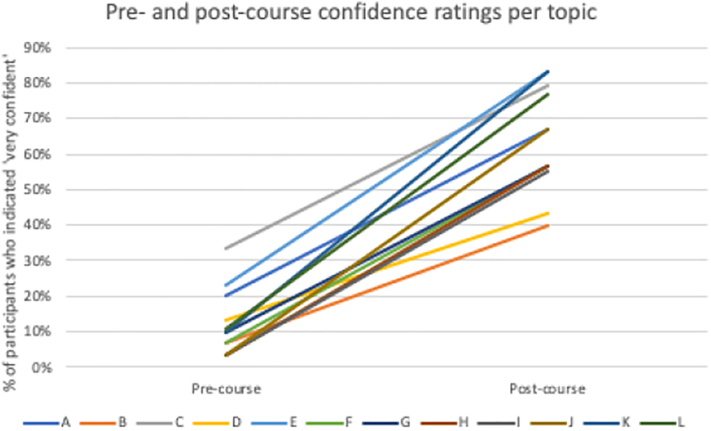
Post-course test scores showed significant improvement (p-value <0.001) as compared to pre-course. The average pre-course test score was 73% and average post-course score was 86.5%. Pre- and post-course questionnaires demonstrated significantly increased confidence in managing emergency conditions and agreement with course objectives.
The WHO Basic Emergency Care (BEC) course successfully increased the knowledge and confidence of frontline emergency care providers in Nigeria. The course was well received by participants. Future study should focus on BEC course scalability and long-term knowledge retention.
对时间敏感的伤病的紧急护理日益被视为有效医疗系统的重要组成部分。然而,许多低收入和中等收入国家(LMICs)缺乏接受过紧急情况护理正规培训的医疗服务提供者。《疾病控制优先事项3》项目估计,有效的紧急护理系统可避免LMICs中高达一半的过早死亡。尼日利亚是撒哈拉以南非洲一个人口近2亿的中低收入国家,有效的紧急护理系统每年可挽救约10万条生命。世界卫生组织开发了基础紧急护理(BEC)课程,以培训低资源环境下管理紧急情况的一线医护人员。在本研究中,我们描述了在尼日利亚实施BEC课程的工作。
本研究设计为混合方法研究分析,比较课程前后的考试成绩和调查,以评估参与者对各种紧急情况的知识掌握情况和信心水平。32名参与者参加了在拉各斯大学教学医院举行为期四天的课程。使用Stata 14.2(德克萨斯州大学站)分析定量数据。配对数据集使用McNemar卡方分析。非配对数据集使用Wilcoxon符号秩检验分析。
与课程前相比,课程后的测试成绩有显著提高(p值<0.001)。课程前测试平均成绩为73%,课程后平均成绩为86.5%。课程前后的问卷调查显示,在管理紧急情况方面的信心显著增强,并且对课程目标表示认同。
世界卫生组织的基础紧急护理(BEC)课程成功提高了尼日利亚一线紧急护理提供者的知识水平和信心。该课程受到参与者的好评。未来的研究应关注BEC课程的可扩展性和长期知识保持情况。