Park Kyoung Sik, Saindane Madhuri, Yang Eun Yeol, Jin TongYi, Rallabandi Harikrishna Reddy, Heil Alexander, Nam Sang Eun, Yoo Young Bum, Yang Jung-Hyun, Kim Jong Bin, Park Seo-Young, Park Won Seo, Youn Yeo-Kyu
Department of Surgery, Konkuk University School of Medicine, Seoul, Korea.
Department of Surgery, Konkuk University Medical Center, Seoul, Korea.
Ann Surg Treat Res. 2021 Mar;100(3):127-136. doi: 10.4174/astr.2021.100.3.127. Epub 2021 Feb 26.
Papillary thyroid cancer (PTC) has a high incidence of BRAF mutation. The purpose of this study was to evaluate the potential relationship between thyroiditis and BRAF mutation status in patients with PTC. We investigated how a selective inhibitor of BRAF PLX4032 affects the proliferation and inflammatory cytokine levels of thyroid cancer.
Two thyroid cancer cell lines TPC1 and 8505C were treated with PLX4032, an analysis was done on cell growth, cell cycle, the degree of apoptosis, and levels of inflammatory cytokines. To identify the functional links of BRAF, we used the STRING database.
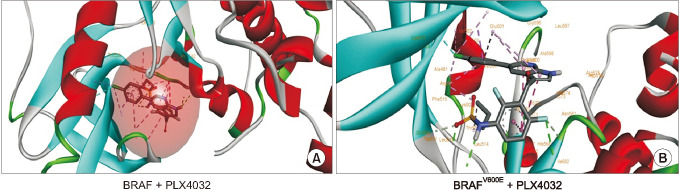
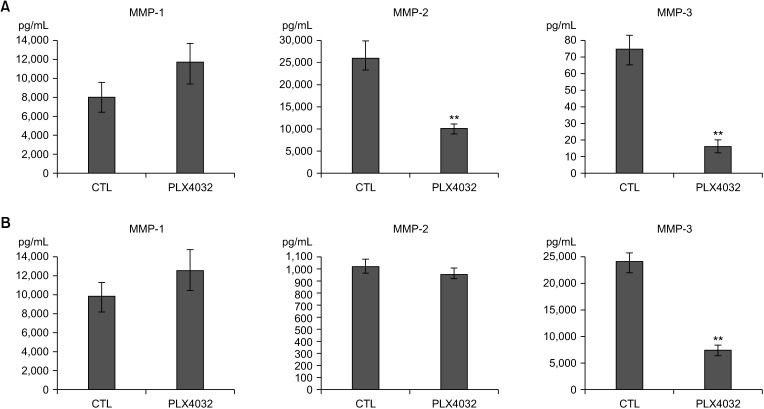
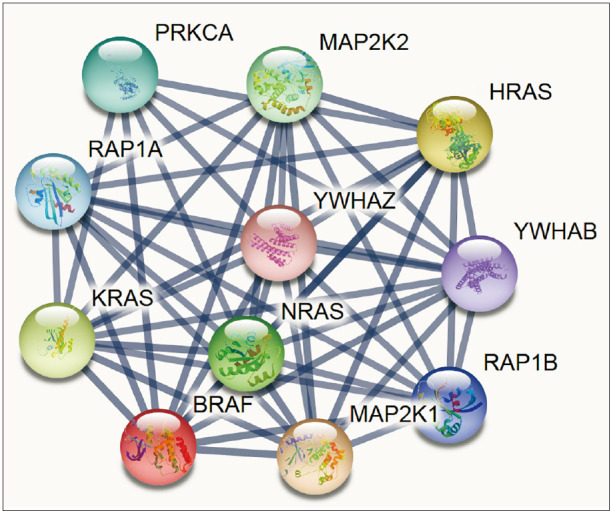
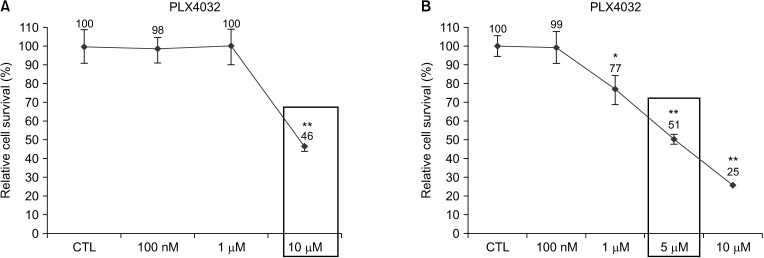
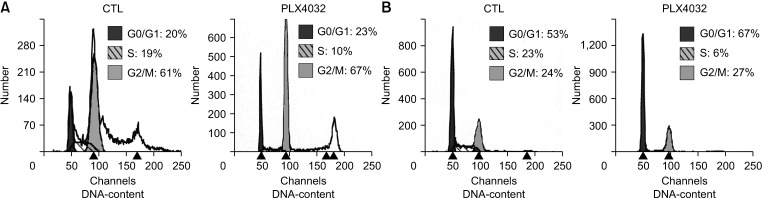
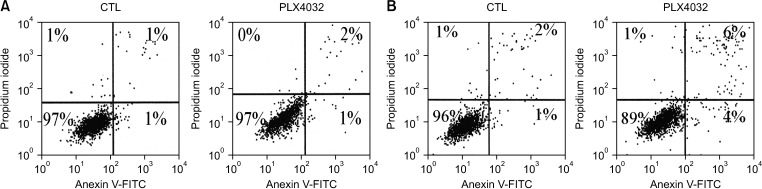
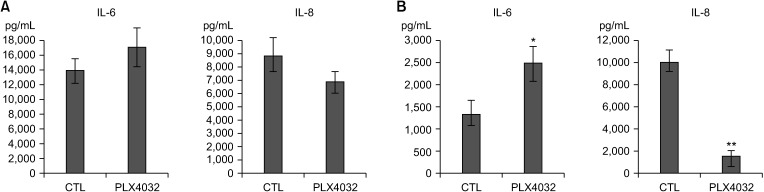
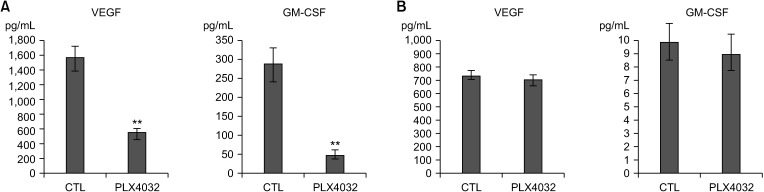
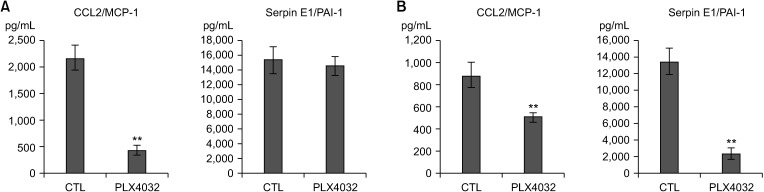
Docking results illustrated PLX4032 blocked the kinase activity by exclusively binding on the serine/threonine kinase domain. STRING results indicated BRAF is functionally linked to mitogen-activated protein kinase. Both cell lines showed a dose-dependent reduction in growth rate but had a different half maximal inhibitory concentration value for PLX4032. The reaction to PLX4032 was more sensitive in the 8505C cells than in the TPC1 cells. PLX4032 induced a G2/M phase arrest in the TPC1 cells and G0/G1 in the 8505C cells. PLX4032 induced apoptosis only in the 8505C cells. With PLX4032, the TPC1 cells showed decreased levels of vascular endothelial growth factor, granulocyte-macrophage colony-stimulating factor, chemokine (C-C motif) ligand 2/monocyte chemoattractant protein 1, whereas the 8505C cells showed significantly decreased levels of IL-8, serpin E1/plasminogen activator inhibitor-1, and matrix metalloproteinase (MMP)-3.
PLX4032 was cytotoxic in both TPC1 and 8505C cells and induced apoptosis. In the 8505C cells, inflammatory cytokines such as IL-8 and MMP-3 were down-regulated. These findings suggest the possibility that the BRAF mutation needs to target inflammatory signaling pathways in the treatment of thyroid cancer.
甲状腺乳头状癌(PTC)中BRAF突变发生率较高。本研究旨在评估PTC患者甲状腺炎与BRAF突变状态之间的潜在关系。我们研究了BRAF选择性抑制剂PLX4032如何影响甲状腺癌细胞的增殖和炎性细胞因子水平。
用PLX4032处理两种甲状腺癌细胞系TPC1和8505C,对细胞生长、细胞周期、凋亡程度和炎性细胞因子水平进行分析。为确定BRAF的功能联系,我们使用了STRING数据库。
对接结果表明PLX4032通过特异性结合丝氨酸/苏氨酸激酶结构域来阻断激酶活性。STRING结果表明BRAF在功能上与丝裂原活化蛋白激酶相关。两种细胞系的生长速率均呈剂量依赖性降低,但对PLX4032的半数最大抑制浓度值不同。8505C细胞对PLX4032的反应比TPC1细胞更敏感。PLX4032在TPC1细胞中诱导G2/M期阻滞,在8505C细胞中诱导G0/G1期阻滞。PLX4032仅在8505C细胞中诱导凋亡。使用PLX4032时,TPC1细胞中血管内皮生长因子、粒细胞-巨噬细胞集落刺激因子、趋化因子(C-C基序)配体2/单核细胞趋化蛋白1水平降低,而8505C细胞中白细胞介素-8、丝氨酸蛋白酶抑制剂E1/纤溶酶原激活物抑制剂-1和基质金属蛋白酶(MMP)-3水平显著降低。
PLX4032对TPC1和8505C细胞均具有细胞毒性并诱导凋亡。在8505C细胞中,白细胞介素-8和基质金属蛋白酶-3等炎性细胞因子下调。这些发现提示BRAF突变在甲状腺癌治疗中可能需要靶向炎性信号通路。