Landry Madeleine R, Walker Joshua M, Sun Conroy
Department of Pharmaceutical Sciences, College of Pharmacy, Oregon State University, Portland, OR, United States.
Department of Radiation Medicine, School of Medicine, Oregon Health & Science University, Portland, OR, United States.
Front Chem. 2021 Mar 3;9:642530. doi: 10.3389/fchem.2021.642530. eCollection 2021.
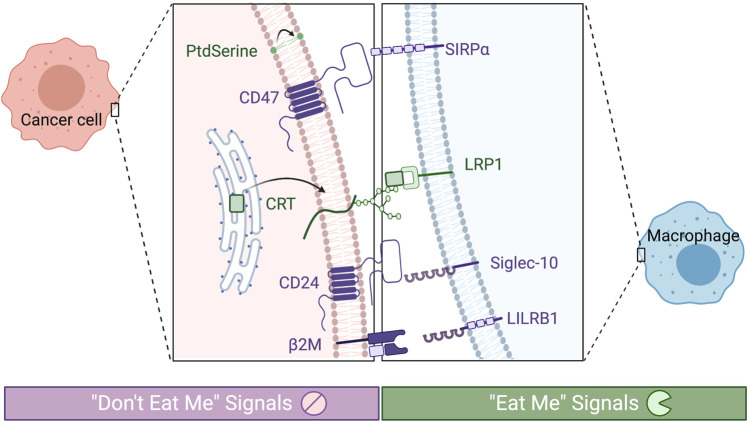
Recent interest in cancer immunotherapy has largely been focused on the adaptive immune system, particularly adoptive T-cell therapy and immune checkpoint blockade (ICB). Despite improvements in overall survival and progression-free survival across multiple cancer types, neither cell-based therapies nor ICB results in durable disease control in the majority of patients. A critical component of antitumor immunity is the mononuclear phagocyte system and its role in both innate and adaptive immunity. The phagocytic functions of these cells have been shown to be modulated through multiple pathways, including the CD47-SIRPα axis, which is manipulated by cancer cells for immune evasion. In addition to CD47, tumors express a variety of other "don't eat me" signals, including beta-2-microglobulin and CD24, and "eat me" signals, including calreticulin and phosphatidylserine. Therapies targeting these signals can lead to increased phagocytosis of cancer cells; however, because "don't eat me" signals are markers of "self" on normal cells, treatment can result in negative off-target effects, such as anemia and B-cell depletion. Recent preclinical research has demonstrated the potential of nanocarriers to synergize with prophagocytic therapies, address the off-target effects, improve pharmacokinetics, and codeliver chemotherapeutics. The high surface area-to-volume ratio of nanoparticles paired with preferential size for passive targeting allows for greater accumulation of therapeutic cargo. In addition, nanomaterials hold promise as molecular imaging agents for the detection of phagocytic markers. This mini review highlights the unique capabilities of nanotechnology to expand the application and efficacy of immunotherapy through recently discovered phagocytotic checkpoint therapies.
最近,癌症免疫疗法的研究主要集中在适应性免疫系统,特别是过继性T细胞疗法和免疫检查点阻断(ICB)。尽管多种癌症类型的总生存期和无进展生存期有所改善,但基于细胞的疗法和ICB在大多数患者中均未实现持久的疾病控制。抗肿瘤免疫的一个关键组成部分是单核吞噬细胞系统及其在先天免疫和适应性免疫中的作用。这些细胞的吞噬功能已被证明可通过多种途径调节,包括癌细胞用于免疫逃逸的CD47-SIRPα轴。除CD47外,肿瘤还表达多种其他“别吃我”信号,包括β2微球蛋白和CD24,以及“吃我”信号,包括钙网蛋白和磷脂酰丝氨酸。针对这些信号的疗法可导致癌细胞吞噬增加;然而,由于“别吃我”信号是正常细胞上“自身”的标志物,治疗可能会导致负面的脱靶效应,如贫血和B细胞耗竭。最近的临床前研究表明,纳米载体有潜力与促吞噬疗法协同作用,解决脱靶效应,改善药代动力学,并共同递送化疗药物。纳米颗粒的高表面积与体积比以及被动靶向的优先尺寸允许治疗药物有更大的积累。此外,纳米材料有望作为检测吞噬标志物分子成像剂。本综述强调了纳米技术通过最近发现的吞噬检查点疗法来扩大免疫疗法应用和疗效的独特能力。