Xue Haijie, Sun Wentao, Wang Ying, Li Chun
Institute of Biochemical Engineering, School of Chemistry and Chemical Engineering, Beijing Institute of Technology, Beijing, China.
Key Lab for Industrial Biocatalysis, Ministry of Education, Department of Chemical Engineering, Tsinghua University, Beijing, China.
Front Bioeng Biotechnol. 2021 Mar 5;9:633741. doi: 10.3389/fbioe.2021.633741. eCollection 2021.
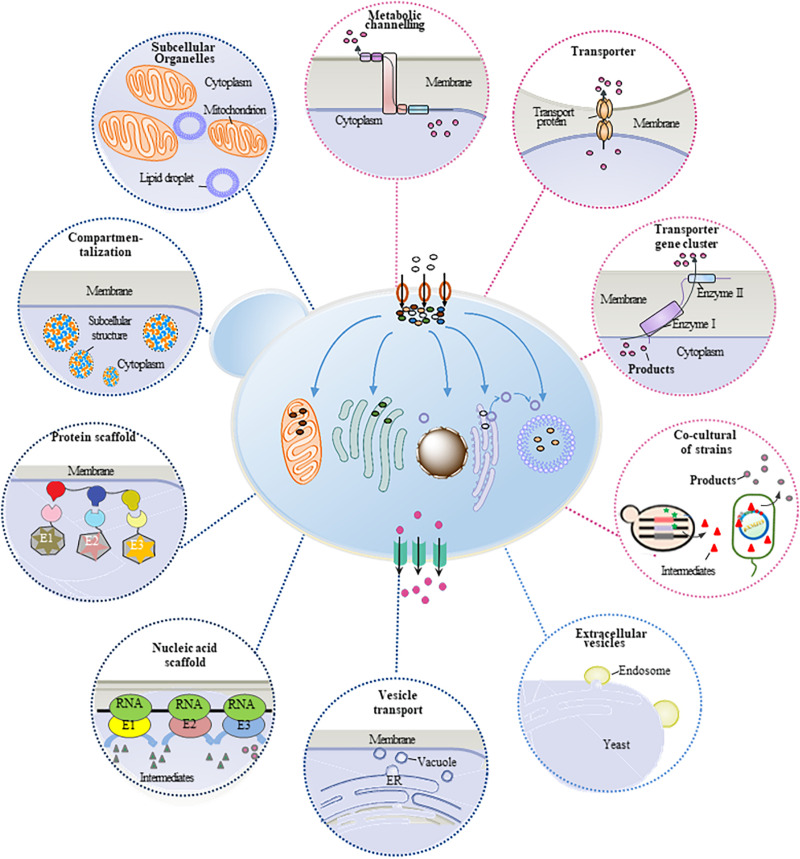
Plant natural products are important secondary metabolites with several special properties and pharmacological activities, which are widely used in pharmaceutical, food, perfume, cosmetic, and other fields. However, the production of these compounds mainly relies on phytoextraction from natural plants. Because of the low contents in plants, phytoextraction has disadvantages of low production efficiency and severe environmental and ecological problems, restricting its wide applications. Therefore, microbial cell factory, especially yeast cell factory, has become an alternative technology platform for heterologous synthesis of plant natural products. Many approaches and strategies have been developed to construct and engineer the yeast cells for efficient production of plant natural products. Meanwhile, metabolic mass transfer has been proven an important factor to improve the heterologous production. Mass transfer across plasma membrane (trans-plasma membrane mass transfer) and mass transfer within the cell (intracellular mass transfer) are two major forms of metabolic mass transfer in yeast, which can be modified and optimized to improve the production efficiency, reduce the consumption of intermediate, and eliminate the feedback inhibition. This review summarized different strategies of refining metabolic mass transfer process to enhance the production efficiency of yeast cell factory (Figure 1), providing approaches for further study on the synthesis of plant natural products in microbial cell factory.
植物天然产物是具有多种特殊性质和药理活性的重要次生代谢产物,广泛应用于制药、食品、香料、化妆品及其他领域。然而,这些化合物的生产主要依赖于从天然植物中进行植物提取。由于植物中含量较低,植物提取存在生产效率低以及严重的环境和生态问题等缺点,限制了其广泛应用。因此,微生物细胞工厂,尤其是酵母细胞工厂,已成为植物天然产物异源合成的替代技术平台。人们已经开发了许多方法和策略来构建和改造酵母细胞,以高效生产植物天然产物。同时,代谢传质已被证明是提高异源生产的一个重要因素。跨质膜传质(跨质膜质量传递)和细胞内传质(细胞内质量传递)是酵母中代谢传质的两种主要形式,可以对其进行修饰和优化,以提高生产效率、减少中间体消耗并消除反馈抑制。本文综述了优化代谢传质过程以提高酵母细胞工厂生产效率的不同策略(图1),为进一步研究微生物细胞工厂中植物天然产物的合成提供了途径。