Fu Leming, Li Ya, Yao Shun, Guo Qingge, You Ya, Zhu Xianjun, Lei Bo
Henan University People's Hospital, Henan Provincial People's Hospital, Zhengzhou, China.
Henan Branch of National Clinical Research Center for Ocular Diseases, Henan Eye Institute/Henan Eye Hospital, People's Hospital of Zhengzhou University, Henan Provincial People's Hospital, Zhengzhou, China.
Front Cell Dev Biol. 2021 Mar 4;9:635424. doi: 10.3389/fcell.2021.635424. eCollection 2021.
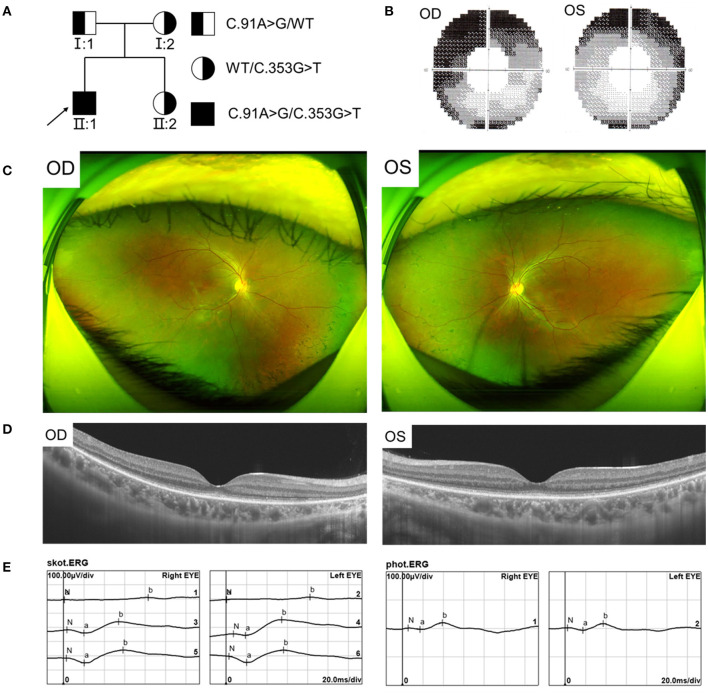
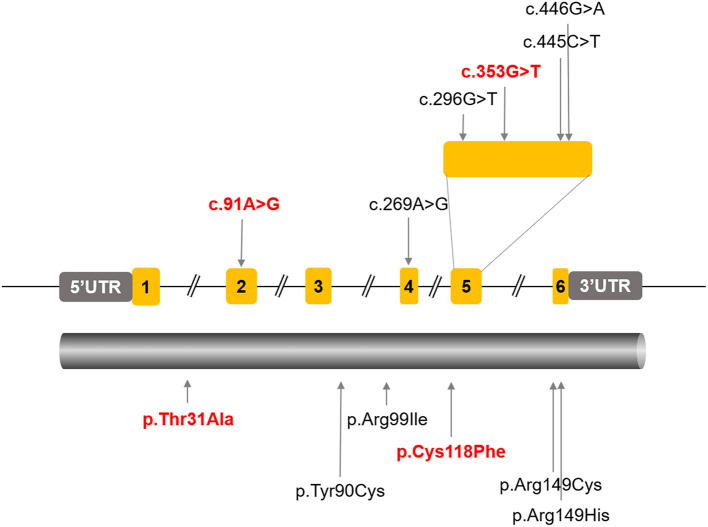
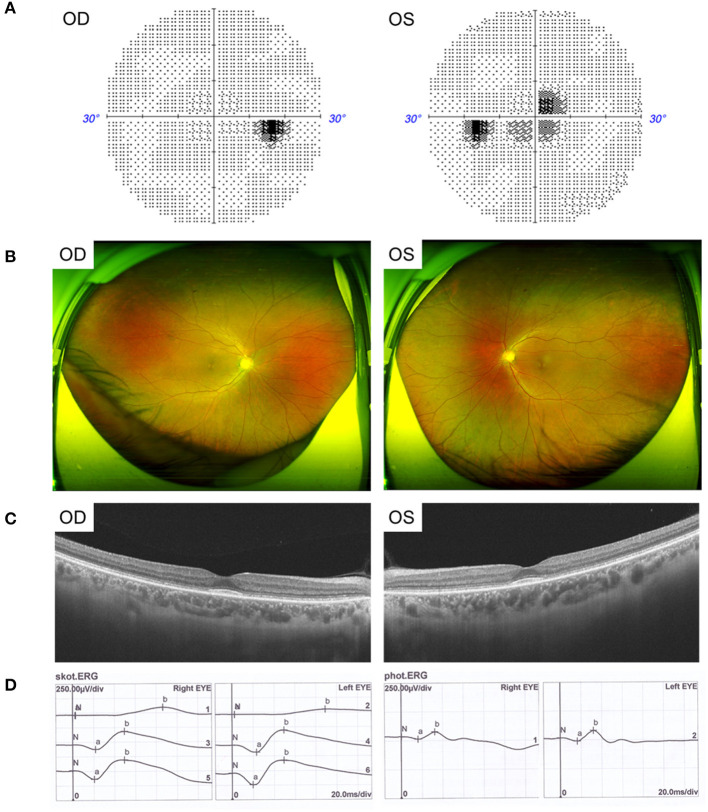
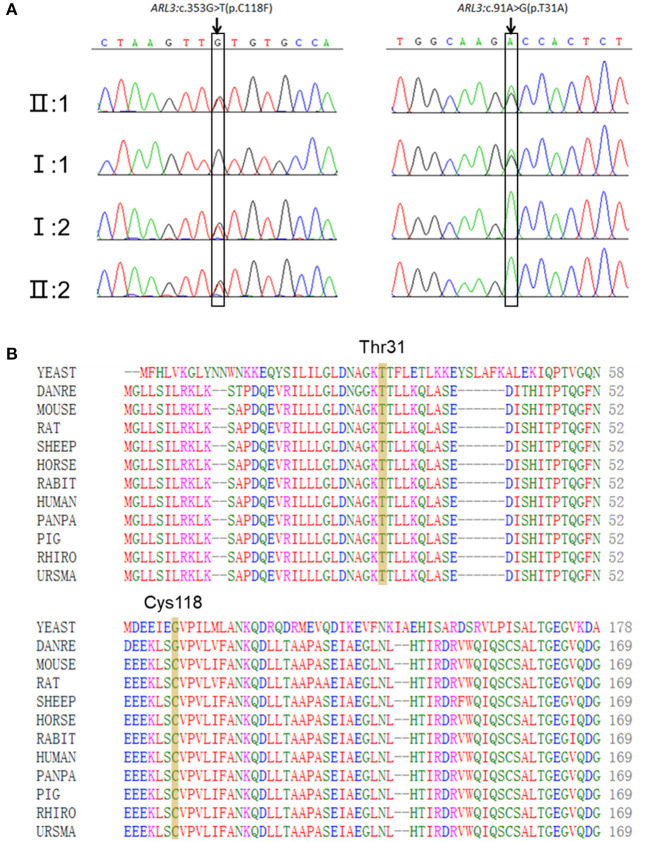
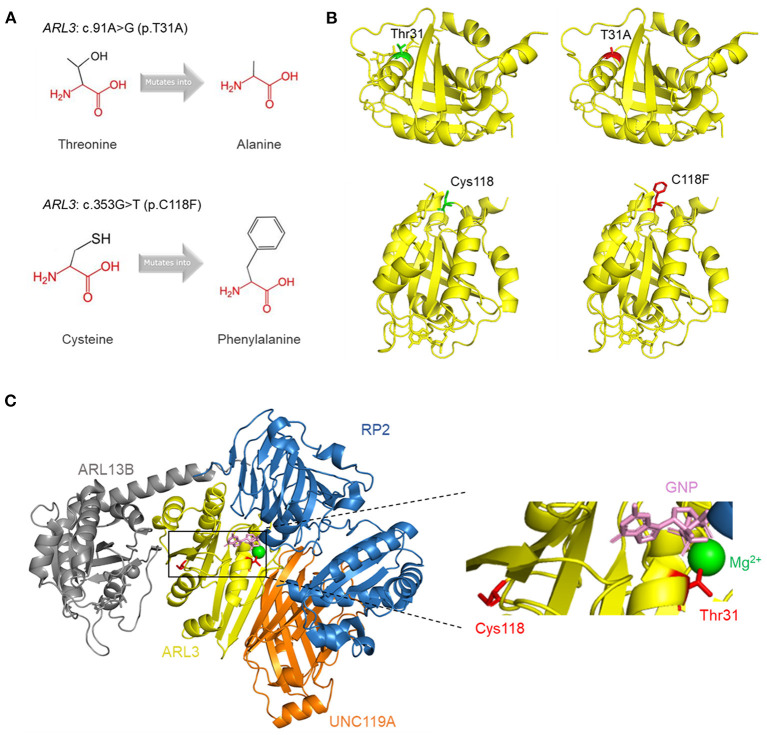
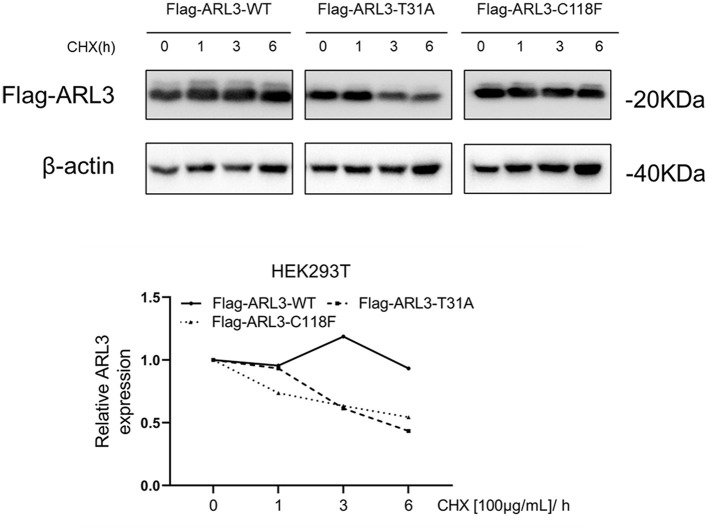
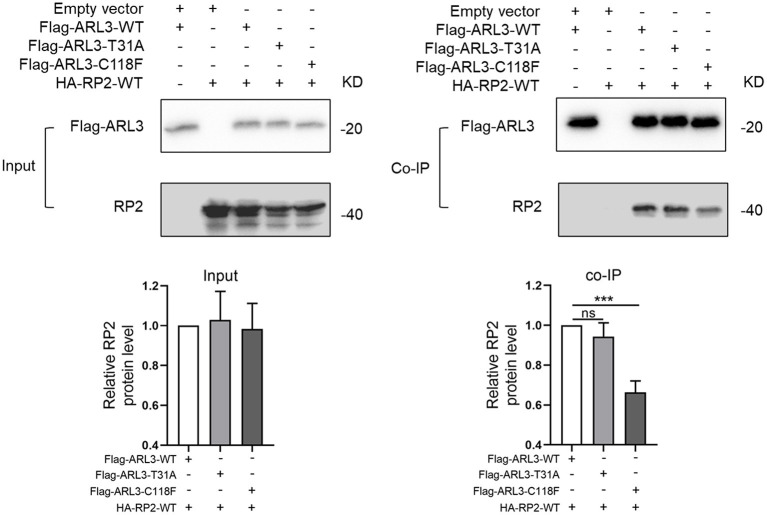
(ADP-ribosylation factor-like 3) variants cause autosomal dominant retinitis pigmentosa (RP) or autosomal recessive Joubert syndrome. We found a family with rod-cone dystrophy (RCD) and verified it was associated with compound heterozygous variants in gene. Ophthalmic examinations including optical coherence tomography and electroretinogram (ERG) were performed. Targeted next generation sequencing (NGS) was performed for the proband using a custom designed panel. Sanger sequencing and co-segregation were conducted in the family members. Changes of protein structure mediated by the variants were studied . ARL3 protein stability and its interaction with RP2 protein were assessed by cycloheximide chase assay and co-immunoprecipitation (Co-IP) assay. Visual acuity of the 18-year-old male proband was 0.25 in the right and 0.20 in the left eye, while his non-consanguineous parents and sister was normal. The proband showed signs of RCD, including nyctalopia, peripheral field loss, bone-spicule deposits in the retina, and reduced ERG responses. The father, aged 50 years old, showed visual acuity of 1.0 in both eyes. Unlike the proband, he presented late onset and mild cone-rod dystrophy (CRD), including macular atrophy, central scotomata, moderate reduction in photopic ERG responses. None of all the family members had hearing abnormality, mental dysplasia or gait instability. We identified two novel compound heterozygous variants (c.91A>G, p.T31A; c.353G>T, p.C118F) in in the proband, while his father only had variant c.91A>G. Bioinformatics analysis indicated amino acid positions of the two variants are highly conserved among species. The tools predicted the variants to be harmful. Protein structure analysis showed the two variants had potential to alter the protein structure. Based on the ACMG guidelines, the two variants were likely pathogenic. In addition, the mutations destabilized ARL3 protein, and the mutation c.353G>T disrupted the interaction between ARL3 and RP2 in HEK293T cells. We showed novel compound heterozygous variants in were associated with early onset of autosomal recessive RCD, while c.91A>G along may be associated with a late onset of dominant CRD. The two variants in could be causative by destabilizing ARL3 protein and impairing its interaction with RP2 protein.
(ADP-核糖基化因子样3)变体可导致常染色体显性遗传性视网膜色素变性(RP)或常染色体隐性遗传性儒贝尔综合征。我们发现了一个患有视锥视杆营养不良(RCD)的家族,并证实其与该基因中的复合杂合变体有关。进行了包括光学相干断层扫描和视网膜电图(ERG)在内的眼科检查。使用定制设计的面板对先证者进行了靶向新一代测序(NGS)。对家族成员进行了桑格测序和共分离分析。研究了由这些变体介导的蛋白质结构变化。通过环己酰亚胺追踪试验和免疫共沉淀(Co-IP)试验评估了ARL3蛋白的稳定性及其与RP2蛋白的相互作用。这位18岁男性先证者的右眼视力为0.25,左眼视力为0.20,而他非近亲结婚的父母和妹妹视力正常。先证者表现出RCD的症状,包括夜盲、周边视野缺损、视网膜骨针样沉积以及ERG反应降低。父亲50岁,双眼视力为1.0。与先证者不同,他表现为迟发性和轻度的视锥视杆营养不良(CRD),包括黄斑萎缩、中心暗点、明视觉ERG反应中度降低。所有家族成员均无听力异常、智力发育不全或步态不稳。我们在先证者中鉴定出两个新的复合杂合变体(c.91A>G,p.T31A;c.353G>T,p.C118F),而他的父亲仅具有变体c.91A>G。生物信息学分析表明这两个变体的氨基酸位置在物种间高度保守。这些工具预测这些变体是有害的。蛋白质结构分析表明这两个变体有可能改变蛋白质结构。根据美国医学遗传学与基因组学学会(ACMG)的指南,这两个变体可能具有致病性。此外,这些突变使ARL3蛋白不稳定,并且c.353G>T突变破坏了HEK293T细胞中ARL3与RP2之间的相互作用。我们发现该基因中的新复合杂合变体与常染色体隐性RCD的早发有关,而单独的c.91A>G可能与显性CRD的迟发有关。该基因中的这两个变体可能通过使ARL3蛋白不稳定并损害其与RP2蛋白的相互作用而致病。