Huang Xiao-Xiao, Wu Jia-Yi, Bai Yan-Nan, Wu Jun-Yi, Lv Jia-Hui, Chen Wei-Zhao, Huang Li-Ming, Huang Rong-Fa, Yan Mao-Lin
Department of Hepatobiliary and Pancreatic Surgery, Shengli Clinical Medical College of Fujian Medical University, Fujian Provincial Hospital, Fuzhou 350001, Fujian Province, China.
World J Clin Cases. 2021 Mar 16;9(8):1803-1813. doi: 10.12998/wjcc.v9.i8.1803.
Laparoscopic cholecystectomy (LC) combined with laparoscopic common bile duct (CBD) exploration (LCBDE) is one of the main treatments for choledocholithiasis with CBD diameter of larger than 10 mm. However, for patients with small CBD (CBD diameter ≤ 8 mm), endoscopic sphincterotomy remains the preferred treatment at present, but it also has some drawbacks associated with a series of complications, such as pancreatitis, hemorrhage, cholangitis, and duodenal perforation. To date, few studies have been reported that support the feasibility and safety of LCBDE for choledocholithiasis with small CBD.
To investigate the feasibility and safety of LCBDE for choledocholithiasis with small CBD.
A total of 257 patients without acute cholangitis who underwent LC + LCBDE for cholecystolithiasis from January 2013 to December 2018 in one institution were reviewed. The clinical data were retrospectively collected and analyzed. According to whether the diameter of CBD was larger than 8 mm, 257 patients were divided into large CBD group ( = 146) and small CBD group ( = 111). Propensity score matching (1:1) was performed to adjust for clinical differences. The demographics, intraoperative data, short-term outcomes, and long-term follow-up outcomes for the patients were recorded and compared.
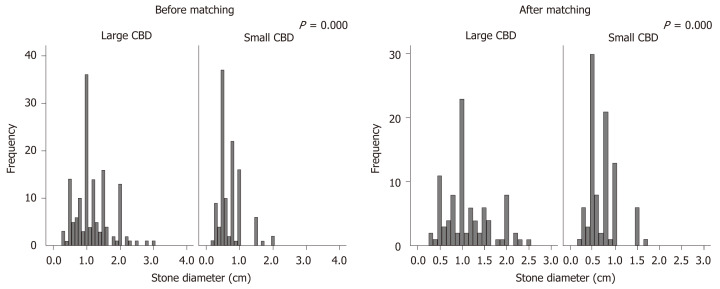
In total, 257 patients who underwent successful LC + LCBDE were enrolled in the study, 146 had large CBD and 111 had small CBD. The median follow-up period was 39 (14-86) mo. For small CBD patients, the median CBD diameter was 0.6 cm (0.2-2.0 cm), the mean operating time was 107.2 ± 28.3 min, and the postoperative bile leak rate, rate of residual CBD stones (CBDS), CBDS recurrence rate, and CBD stenosis rate were 5.41% (6/111), 3.60% (4/111), 1.80% (2/111), and 0% (0/111), respectively; the mean postoperative hospital stay was 7.4 ± 3.6 d. For large CBD patients, the median common bile duct diameter was 1.0 cm (0.3-3.0 cm), the mean operating time was 115.7 ± 32.0 min, and the postoperative bile leak rate, rate of residual CBDS, CBDS recurrence rate, and CBD stenosis rate were 5.41% (9/146), 1.37% (2/146), 6.85% (10/146), and 0% (0/146), respectively; the mean postoperative hospital stay was 7.7 ± 2.7 d. After propensity score matching, 184 patients remained, and all preoperative covariates except diameter of CBD stones were balanced. Postoperative bile leak occurred in 11 patients overall (5.98%), and no difference was found between the small CBD group (4.35%, 4/92) and the large CBD group (7.61%, 7/92). The incidence of CBDS recurrence did not differ significantly between the small CBD group (2.17%, 2/92) and the large CBD group (6.52%, 6/92).
LC + LCBDE is safe and feasible for choledocholithiasis patients with small CBD and did not increase the postoperative bile leak rate compared with chole-docholithiasis patients with large CBD.
腹腔镜胆囊切除术(LC)联合腹腔镜胆总管(CBD)探查术(LCBDE)是治疗胆总管直径大于10mm的胆总管结石的主要方法之一。然而,对于胆总管直径较小(胆总管直径≤8mm)的患者,目前内镜括约肌切开术仍是首选治疗方法,但它也存在一些与一系列并发症相关的缺点,如胰腺炎、出血、胆管炎和十二指肠穿孔。迄今为止,很少有研究报道支持LCBDE治疗小胆总管结石的可行性和安全性。
探讨LCBDE治疗小胆总管结石的可行性和安全性。
回顾性分析2013年1月至2018年12月在一家机构接受LC+LCBDE治疗胆囊结石且无急性胆管炎的257例患者。回顾性收集并分析临床资料。根据胆总管直径是否大于8mm,将257例患者分为胆总管直径大组(n=146)和胆总管直径小组(n=111)。采用倾向评分匹配(1:1)来调整临床差异。记录并比较患者的人口统计学资料、术中数据、短期结局和长期随访结局。
共有257例行成功LC+LCBDE的患者纳入本研究,其中146例胆总管直径大,111例胆总管直径小。中位随访期为39(14-86)个月。对于胆总管直径小的患者,胆总管中位直径为0.6cm(0.2-2.0cm),平均手术时间为107.2±28.3分钟,术后胆漏率、胆总管残留结石率、胆总管结石复发率和胆总管狭窄率分别为5.41%(6/111)、3.60%(4/111)、1.80%(2/111)和0%(0/111);术后平均住院时间为7.4±3.6天。对于胆总管直径大的患者,胆总管中位直径为1.0cm(0.3-3.0cm),平均手术时间为115.7±32.0分钟,术后胆漏率、胆总管残留结石率、胆总管结石复发率和胆总管狭窄率分别为5.41%(9/146)、1.37%(2/146)、6.85%(10/146)和0%(0/146);术后平均住院时间为7.7±2.7天。倾向评分匹配后,剩余184例患者,除胆总管结石直径外,所有术前协变量均达到平衡。总体上11例患者发生术后胆漏(5.98%),胆总管直径小组(4.35%,4/92)与胆总管直径大组(7.61%,7/92)之间无差异。胆总管结石复发率在胆总管直径小组(2.17%,2/92)与胆总管直径大组(6.52%,6/92)之间无显著差异。
对于小胆总管结石患者,LC+LCBDE是安全可行的,与胆总管直径大的胆总管结石患者相比,并未增加术后胆漏率。