• 文献检索
  • 文档翻译
  • 深度研究
  • 学术资讯
  • Suppr Zotero 插件Zotero 插件
  • 邀请有礼
  • 套餐&价格
  • 历史记录
应用&插件
Suppr Zotero 插件Zotero 插件浏览器插件Mac 客户端Windows 客户端微信小程序
定价
高级版会员购买积分包购买API积分包
服务
文献检索文档翻译深度研究API 文档MCP 服务
关于我们
关于 Suppr公司介绍联系我们用户协议隐私条款
关注我们

Suppr 超能文献

核心技术专利:CN118964589B侵权必究
粤ICP备2023148730 号-1Suppr @ 2026

文献检索

告别复杂PubMed语法,用中文像聊天一样搜索,搜遍4000万医学文献。AI智能推荐,让科研检索更轻松。

立即免费搜索

文件翻译

保留排版,准确专业,支持PDF/Word/PPT等文件格式,支持 12+语言互译。

免费翻译文档

深度研究

AI帮你快速写综述,25分钟生成高质量综述,智能提取关键信息,辅助科研写作。

立即免费体验

青少年多向性肩关节不稳关节镜下缝线锚钉修复术后的临床结果、生存率及恢复运动情况:6年随访结果

Clinical Outcomes, Survivorship, and Return to Sport After Arthroscopic Capsular Repair With Suture Anchors for Adolescent Multidirectional Shoulder Instability: Results at 6-Year Follow-up.

作者信息

Mitchell Brendon C, Siow Matthew Y, Carroll Alyssa N, Pennock Andrew T, Edmonds Eric W

机构信息

Department of Orthopaedic Surgery, University of California, San Diego, San Diego, California, USA.

Division of Orthopaedic Surgery, Rady Children's Hospital, San Diego, California, USA.

出版信息

Orthop J Sports Med. 2021 Feb 22;9(2):2325967121993879. doi: 10.1177/2325967121993879. eCollection 2021 Feb.

DOI:10.1177/2325967121993879
PMID:33748302
原文链接:https://pmc.ncbi.nlm.nih.gov/articles/PMC7903833/
Abstract

BACKGROUND

Multidirectional shoulder instability (MDI) refractory to rehabilitation can be treated with arthroscopic capsulolabral reconstruction with suture anchors. To the best of our knowledge, no studies have reported on outcomes or examined the risk factors that contribute to poor outcomes in adolescent athletes.

PURPOSE

To identify risk factors for surgical failure by comparing anatomic, clinical, and demographic variables in adolescents who underwent intervention for MDI.

STUDY DESIGN

Case series; Level of evidence, 4.

METHODS

All patients 20 years or younger who underwent arthroscopic shoulder surgery at a single institution between January 2009 and April 2017 were evaluated. MDI was defined by positive drive-through sign on arthroscopy plus positive sulcus sign and/or multidirectional laxity on anterior and posterior drawer tests while under anesthesia. A 2-year minimum follow-up was required, but those whose treatment failed earlier were also included. Demographic characteristics and intraoperative findings were recorded, as were scores on the Single Assessment Numeric Evaluation (SANE), Pediatric and Adolescent Shoulder Survey (PASS), and short version of the Disabilities of the Arm, Shoulder and Hand (QuickDASH).

RESULTS

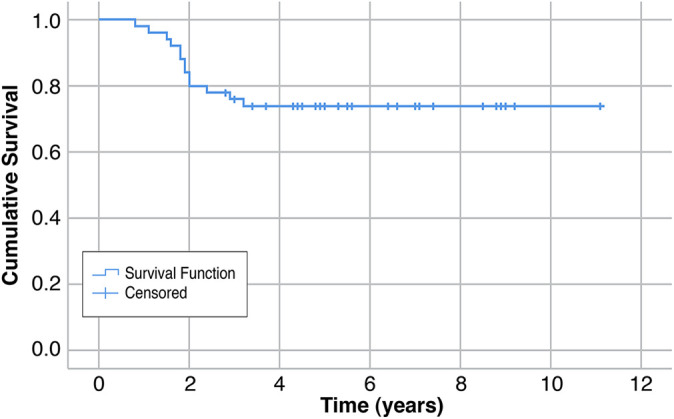
Overall, 42 adolescents (50 shoulders; 31 female, 19 male) were identified as having undergone surgical treatment for MDI with minimum 2-year follow-up or failure. The mean follow-up period was 6.3 years (range, 2.8-10.2 years). Surgical failure, defined as recurrence of subluxation and instability, was noted in 13 (26.0%) shoulders; all underwent reoperation at a mean of 1.9 years (range, 0.8-3.2 years). None of the anatomic, clinical, or demographic variables tested, or the presence of generalized ligamentous laxity, was associated with subjective outcomes or reoperation. Number of anchors used was not different between shoulders that failed and those that did not fail. Patients reported a mean SANE score of 83.3, PASS score of 85.0, and QuickDASH score of 6.8. Return to prior level of sport occurred in 56% of patients.

CONCLUSION

Adolescent MDI refractory to nonsurgical management appeared to have long-term outcomes after surgical intervention that were comparable with outcomes of adolescent patients with unidirectional instability. In patients who experienced failure of capsulorrhaphy, results showed that failure most likely occurred within 3 years of the index surgical treatment.

摘要

背景

康复治疗无效的多向性肩关节不稳(MDI)可通过使用缝合锚钉进行关节镜下关节囊盂唇重建来治疗。据我们所知,尚无研究报道青少年运动员的手术疗效或探讨导致疗效不佳的风险因素。

目的

通过比较接受MDI干预的青少年的解剖学、临床和人口统计学变量,确定手术失败的风险因素。

研究设计

病例系列;证据等级,4级。

方法

对2009年1月至2017年4月在单一机构接受关节镜下肩部手术的所有20岁及以下患者进行评估。MDI的定义为关节镜下阳性通过征,加上麻醉下前抽屉试验和后抽屉试验阳性沟征和/或多向性松弛。需要至少2年的随访,但那些治疗较早失败的患者也包括在内。记录人口统计学特征和术中发现,以及单项评估数字评分(SANE)、儿童和青少年肩部调查(PASS)以及手臂、肩部和手部功能障碍简表(QuickDASH)的评分。

结果

总体而言,42名青少年(50个肩部;31名女性,19名男性)被确定接受了MDI手术治疗,随访至少2年或出现失败情况。平均随访期为6.3年(范围2.8 - 10.2年)。13个(26.0%)肩部出现手术失败,定义为半脱位和不稳复发;所有患者均在平均1.9年(范围0.8 - 3.2年)时接受了再次手术。所测试的解剖学、临床或人口统计学变量,或全身性韧带松弛的存在,均与主观疗效或再次手术无关。失败肩部和未失败肩部使用的锚钉数量没有差异。患者报告的SANE平均评分为83.3,PASS评分为85.0,QuickDASH评分为6.8。56%的患者恢复到了之前的运动水平。

结论

非手术治疗无效的青少年MDI在手术干预后的长期疗效似乎与单向性不稳的青少年患者的疗效相当。在关节囊缝合失败的患者中,结果显示失败最可能发生在初次手术治疗后的3年内。
https://cdn.ncbi.nlm.nih.gov/pmc/blobs/5706/7903833/8fa2decfc1ea/10.1177_2325967121993879-fig5.jpg
https://cdn.ncbi.nlm.nih.gov/pmc/blobs/5706/7903833/16cc3b451bc4/10.1177_2325967121993879-fig1.jpg
https://cdn.ncbi.nlm.nih.gov/pmc/blobs/5706/7903833/cfe3548077ff/10.1177_2325967121993879-fig2.jpg
https://cdn.ncbi.nlm.nih.gov/pmc/blobs/5706/7903833/89c17dad9288/10.1177_2325967121993879-fig3.jpg
https://cdn.ncbi.nlm.nih.gov/pmc/blobs/5706/7903833/7119f330a39e/10.1177_2325967121993879-fig4.jpg
https://cdn.ncbi.nlm.nih.gov/pmc/blobs/5706/7903833/8fa2decfc1ea/10.1177_2325967121993879-fig5.jpg
https://cdn.ncbi.nlm.nih.gov/pmc/blobs/5706/7903833/16cc3b451bc4/10.1177_2325967121993879-fig1.jpg
https://cdn.ncbi.nlm.nih.gov/pmc/blobs/5706/7903833/cfe3548077ff/10.1177_2325967121993879-fig2.jpg
https://cdn.ncbi.nlm.nih.gov/pmc/blobs/5706/7903833/89c17dad9288/10.1177_2325967121993879-fig3.jpg
https://cdn.ncbi.nlm.nih.gov/pmc/blobs/5706/7903833/7119f330a39e/10.1177_2325967121993879-fig4.jpg
https://cdn.ncbi.nlm.nih.gov/pmc/blobs/5706/7903833/8fa2decfc1ea/10.1177_2325967121993879-fig5.jpg

相似文献

1
Clinical Outcomes, Survivorship, and Return to Sport After Arthroscopic Capsular Repair With Suture Anchors for Adolescent Multidirectional Shoulder Instability: Results at 6-Year Follow-up.青少年多向性肩关节不稳关节镜下缝线锚钉修复术后的临床结果、生存率及恢复运动情况:6年随访结果
Orthop J Sports Med. 2021 Feb 22;9(2):2325967121993879. doi: 10.1177/2325967121993879. eCollection 2021 Feb.
2
Outcomes After Arthroscopic Pancapsular Capsulorrhaphy With Suture Anchors for the Treatment of Multidirectional Glenohumeral Instability in Athletes.使用缝合锚钉进行关节镜下全关节囊缝合修复治疗运动员多向性肩关节不稳的疗效
Am J Sports Med. 2016 Dec;44(12):3188-3197. doi: 10.1177/0363546516659644. Epub 2016 Aug 19.
3
Posterior Shoulder Instability: Surgical Outcomes and Risk of Failure in Adolescence.青少年的肩关节后向不稳定:手术效果和失败风险。
Am J Sports Med. 2020 Apr;48(5):1200-1206. doi: 10.1177/0363546520907156. Epub 2020 Mar 3.
4
Comparable clinical outcomes using knotless and knot-tying anchors for arthroscopic capsulolabral repair in recurrent anterior glenohumeral instability at mean 5-year follow-up.平均 5 年随访时,采用无结和打结锚钉行关节镜下肩袖盂唇复合体修复术治疗复发性肩关节前向不稳定的临床结果相当。
Knee Surg Sports Traumatol Arthrosc. 2021 Jul;29(7):2077-2084. doi: 10.1007/s00167-020-06057-7. Epub 2020 May 18.
5
Risk Factors and Outcomes of Revision Arthroscopic Posterior Shoulder Capsulolabral Repair.关节镜下修复肩关节后方肩袖和盂唇复合体翻修的风险因素和结果。
Am J Sports Med. 2018 Aug;46(10):2457-2465. doi: 10.1177/0363546518785893. Epub 2018 Jul 17.
6
Association of Traumatic and Atraumatic Posterior Shoulder Instability With Glenoid Retroversion and Outcomes After Arthroscopic Capsulolabral Repair.创伤性和非创伤性后肩关节不稳与肩胛盂后倾的相关性及关节镜下关节囊盂唇修复后的疗效
Arthroscopy. 2017 Feb;33(2):284-290. doi: 10.1016/j.arthro.2016.07.020. Epub 2016 Oct 4.
7
Clinical Outcomes After Arthroscopic Pancapsular Shift for the Treatment of Multidirectional Glenohumeral Instability at a Mean Follow-up of 9 Years.关节镜下全关节囊移位治疗多向性肩关节不稳平均随访9年的临床结果
Am J Sports Med. 2022 Dec;50(14):3897-3906. doi: 10.1177/03635465221127293. Epub 2022 Nov 2.
8
Return to sports after arthroscopic capsulolabral repair using knotless suture anchors for anterior shoulder instability in soccer players: minimum 5-year follow-up study.使用无结缝合锚钉修复关节镜下盂唇关节囊治疗足球运动员前肩不稳后重返运动:至少5年的随访研究
Knee Surg Sports Traumatol Arthrosc. 2016 Feb;24(2):440-6. doi: 10.1007/s00167-015-3895-y. Epub 2015 Dec 19.
9
Arthroscopic capsulolabral reconstruction for posterior instability of the shoulder: a prospective study of 200 shoulders.关节镜下囊-盂唇重建术治疗肩关节后方不稳定:200 例前瞻性研究。
Am J Sports Med. 2013 Sep;41(9):2005-14. doi: 10.1177/0363546513493599. Epub 2013 Jun 26.
10
Minimum 10-Year Clinical Outcomes After Arthroscopic 270° Labral Repair in Traumatic Shoulder Instability Involving Anterior, Inferior, and Posterior Labral Injury.关节镜下 270° 盂唇修补术治疗累及前、下和后盂唇损伤的创伤性肩关节不稳定的 10 年以上临床结果。
Am J Sports Med. 2021 Dec;49(14):3937-3944. doi: 10.1177/03635465211053632. Epub 2021 Nov 1.

引用本文的文献

1
Anterior Capsulolabral Allograft Reconstruction for Revision Multidirectional Instability Surgery.前侧关节囊盂唇同种异体移植重建用于翻修性多向不稳定手术。
Arthrosc Tech. 2025 Mar 1;14(6):103500. doi: 10.1016/j.eats.2025.103500. eCollection 2025 Jun.
2
Multidirectional instability of the shoulder: a systematic review with a novel classification.肩关节多向不稳定:一项采用新分类法的系统评价
EFORT Open Rev. 2024 Apr 4;9(4):285-296. doi: 10.1530/EOR-23-0029.
3
Current Evidence Regarding Shoulder Instability in the Paediatric and Adolescent Population.

本文引用的文献

1
Posterior Shoulder Instability: Surgical Outcomes and Risk of Failure in Adolescence.青少年的肩关节后向不稳定:手术效果和失败风险。
Am J Sports Med. 2020 Apr;48(5):1200-1206. doi: 10.1177/0363546520907156. Epub 2020 Mar 3.
2
Surgical stabilization of pediatric anterior shoulder instability yields high recurrence rates: a systematic review.手术治疗儿童前肩不稳定的复发率较高:系统评价。
Knee Surg Sports Traumatol Arthrosc. 2021 Jan;29(1):192-201. doi: 10.1007/s00167-020-05913-w. Epub 2020 Feb 28.
3
Multidirectional Instability of the Shoulder: Treatment Options and Considerations.
关于儿童和青少年人群肩部不稳定的当前证据
J Clin Med. 2024 Jan 26;13(3):724. doi: 10.3390/jcm13030724.
4
Arthroscopic Labral Repair and Pancapsular Shift With Knotless All-Suture Anchors in the Setting of Multidirectional Instability of the Shoulder.在肩关节多向不稳定情况下使用无结全缝线锚钉进行关节镜下盂唇修复和关节囊全层移位术
Arthrosc Tech. 2023 Jul 3;12(8):e1289-e1295. doi: 10.1016/j.eats.2023.03.020. eCollection 2023 Aug.
5
Pediatric and Adolescent Shoulder Instability.小儿及青少年肩部不稳
Curr Rev Musculoskelet Med. 2023 Jul;16(7):263-273. doi: 10.1007/s12178-023-09837-z. Epub 2023 Apr 17.
6
Management of Shoulder Instability in Patients with Underlying Hyperlaxity.潜在关节过度松弛患者肩部不稳定的管理
Curr Rev Musculoskelet Med. 2023 Apr;16(4):123-144. doi: 10.1007/s12178-023-09822-6. Epub 2023 Feb 23.
7
Rehabilitation and Return to Play of the Athlete after an Upper Extremity Injury.上肢损伤后运动员的康复与重返赛场
Arthrosc Sports Med Rehabil. 2022 Jan 28;4(1):e163-e173. doi: 10.1016/j.asmr.2021.09.033. eCollection 2022 Jan.
肩部多向不稳定:治疗选择与注意事项
Sports Med Arthrosc Rev. 2018 Sep;26(3):113-119. doi: 10.1097/JSA.0000000000000199.
4
Outcomes After Arthroscopic Pancapsular Capsulorrhaphy With Suture Anchors for the Treatment of Multidirectional Glenohumeral Instability in Athletes.使用缝合锚钉进行关节镜下全关节囊缝合修复治疗运动员多向性肩关节不稳的疗效
Am J Sports Med. 2016 Dec;44(12):3188-3197. doi: 10.1177/0363546516659644. Epub 2016 Aug 19.
5
Multidirectional Instability of the Shoulder: A Systematic Review.肩关节多向不稳定:一项系统评价
Arthroscopy. 2015 Dec;31(12):2431-43. doi: 10.1016/j.arthro.2015.06.006. Epub 2015 Jul 21.
6
Traumatic anterior instability of the pediatric shoulder: a comparison of arthroscopic and open bankart repairs.小儿肩关节创伤性前不稳定:关节镜下与开放性Bankart修复术的比较
J Pediatr Orthop. 2015 Jan;35(1):1-6. doi: 10.1097/BPO.0000000000000215.
7
Risk factors for recurrence after Bankart repair a systematic review.Bankart 修复术后复发的危险因素:系统评价。
Knee Surg Sports Traumatol Arthrosc. 2012 Nov;20(11):2129-38. doi: 10.1007/s00167-012-2140-1. Epub 2012 Jul 27.
8
Management of multidirectional instability of the shoulder.肩关节多向不稳定的治疗。
J Am Acad Orthop Surg. 2011 Dec;19(12):758-67. doi: 10.5435/00124635-201112000-00006.
9
Arthroscopic capsulolabral revision repair for recurrent anterior shoulder instability.关节镜下囊-盂唇复合体修复术治疗复发性肩关节前向不稳定。
Am J Sports Med. 2011 Mar;39(3):511-8. doi: 10.1177/0363546510388909. Epub 2011 Jan 6.
10
Psychology and socioculture affect injury risk, response, and recovery in high-intensity athletes: a consensus statement.心理学和社会文化因素影响高强度运动员的损伤风险、反应和恢复:共识声明。
Scand J Med Sci Sports. 2010 Oct;20 Suppl 2:103-11. doi: 10.1111/j.1600-0838.2010.01195.x.