Alkethiri Khaled, Almtroudi Tariq, Jurays Abdullah Bin, Abanumay Faisal, Aldammas Mohammed, AlKhodheer Meshaal, Iqbal Muhammad, Habib Syed Shahid, Bashir Shahid
College of Medicine, King Saud University, Riyadh, Saudi Arabia.
Department of Physiology, College of Medicine, King Saud University, Riyadh, Saudi Arabia.
Heliyon. 2021 Mar 8;7(3):e06358. doi: 10.1016/j.heliyon.2021.e06358. eCollection 2021 Mar.
Type 2 diabetes mellitus (T2DM) has been associated with impairment of cognitive functions. Since the majority of patients with diabetes in the Saudi population are between the ages of 40 and 69 years, it is crucial to ascertain whether the control of blood glucose level negatively correlates with the level of cognitive function scores similar to the way it correlates in those who are not controlling their blood glucose level with medications.
To assess cognitive functions in patients with T2DM and examine the effect of glycemic control on cognitive functions impairment in Saudi adults with T2DM.
Seventy-nine patients with T2DM underwent cognitive assessment testing using the Cambridge neuropsychological test automated battery (CANTAB), Mini-Mental State Examination (MMSE), and Fatigue severity scale. Their cognitive function scores were then correlated with their blood glucose levels, duration of diabetes, and levels of education. Poor glycemic control was defined as glycated hemoglobin levels more than 7.5. We excluded patients with depression or neurocognitive disorders as well as those over 75 years of age.
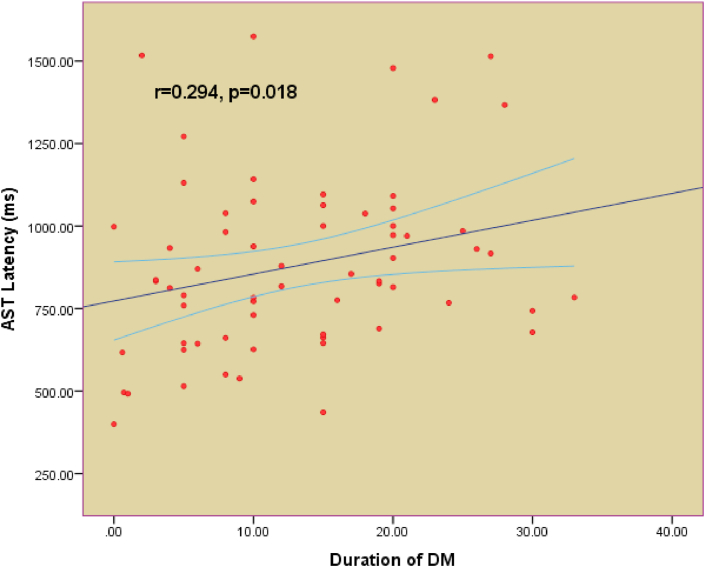
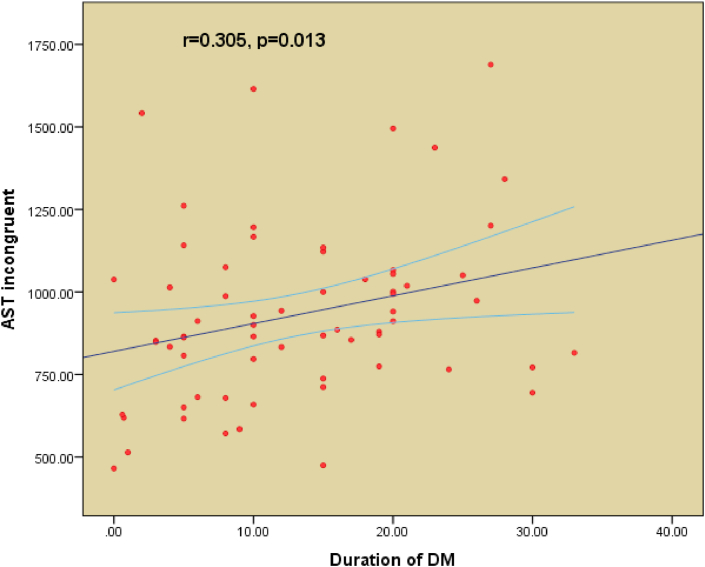
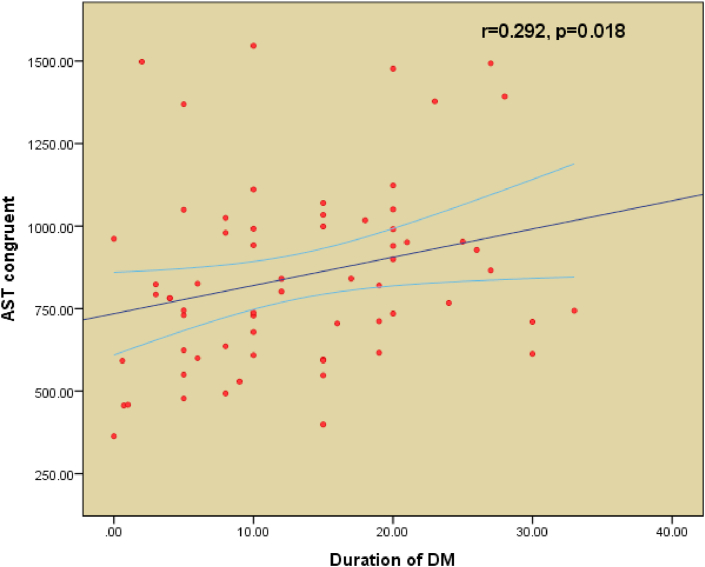
Attention switching task (AST) total latency (P = 0.003), AST congruent score (P = 0.002), AST incongruent score (P = 0.003), AST block 3 (p = 0.004), and AST Block 7 (p = 0.006) were significantly higher in poorly-controlled DM. The intra-extra dimensional set shift (IED) total errors were significantly higher in poorly-controlled patients (p = 0.023). The difference in IED stages completed (p = 0.716) and spatial span (SSP) (p = 0.782) were not significant between the two groups. The mini-mental state exam (p = 0.336) and the fatigue severity scale (P = 0.167) did not show any statistical significance between good and poor control of T2DM. There was a significant positive correlation between the duration of T2DM and AST latencies for AST total latency, AST congruent score, and AST incongruent score.
Patients with T2DM have a statistically significant association between their cognitive functions and their glycemic control. Patients with uncontrolled T2DM showed decreased cognitive scores. Moreover, worsened cognitive scores were associated with longer disease duration.
2型糖尿病(T2DM)与认知功能损害有关。由于沙特人群中大多数糖尿病患者年龄在40至69岁之间,确定血糖水平的控制是否与认知功能评分水平呈负相关,类似于未通过药物控制血糖水平的人群中的关联方式,这一点至关重要。
评估T2DM患者的认知功能,并研究血糖控制对沙特成年T2DM患者认知功能损害的影响。
79例T2DM患者使用剑桥神经心理测试自动成套系统(CANTAB)、简易精神状态检查表(MMSE)和疲劳严重程度量表进行认知评估测试。然后将他们的认知功能评分与血糖水平、糖尿病病程和教育程度进行关联。血糖控制不佳定义为糖化血红蛋白水平超过7.5。我们排除了患有抑郁症或神经认知障碍的患者以及75岁以上的患者。
在血糖控制不佳的糖尿病患者中,注意力转换任务(AST)总潜伏期(P = 0.003)、AST一致得分(P = 0.002)、AST不一致得分(P = 0.003)、AST第3组(p = 0.004)和AST第7组(p = 0.006)显著更高。在血糖控制不佳的患者中,维度内-维度间转换(IED)总错误显著更高(p = 0.023)。两组之间在完成的IED阶段(p = 0.716)和空间广度(SSP)(p = 0.782)上的差异不显著。简易精神状态检查表(p = 0.336)和疲劳严重程度量表(P = 0.167)在T2DM的良好和不佳控制之间未显示任何统计学意义。T2DM病程与AST总潜伏期、AST一致得分和AST不一致得分的AST潜伏期之间存在显著正相关。
T2DM患者的认知功能与其血糖控制之间存在统计学上的显著关联。血糖控制不佳的T2DM患者认知评分降低。此外,认知评分恶化与疾病持续时间延长有关。