Triolo Taylor M, Pyle Laura, Seligova Sona, Yu Liping, Simmons Kimber, Gottlieb Peter, Evans-Molina Carmella, Steck Andrea K
University of Colorado Denver School of Medicine - the Barbara Davis Center for Diabetes, Aurora, CO, USA.
University of Colorado Anschutz Medical Campus, Pediatrics, Aurora, CO, USA.
J Transl Autoimmun. 2021 Feb 19;4:100089. doi: 10.1016/j.jtauto.2021.100089. eCollection 2021.
Biomarkers are needed to characterize heterogeneity within populations at risk for type 1 diabetes. The ratio of proinsulin to C-peptide (PI:C ratio), has been proposed as a biomarker of beta cell dysfunction and is associated with progression to type 1 diabetes. However, relationships between PI:C ratios and autoantibody type and number have not been examined. We sought to characterize PI:C ratios in multiple islet autoantibody positive, single autoantibody positive and autoantibody negative relatives of individuals with type 1 diabetes.
We measured PI:C ratios and autoantibodies with both electrochemiluminescence (ECL) assays (ECL-IAA, ECL-GADA and ECL-IA2A) and radiobinding (RBA) assays (mIAA, GADA, IA2A and ZnT8A) in 98 relatives of individuals with type 1 diabetes followed in the TrialNet Pathway to Prevention Study at the Barbara Davis Center for a mean of 7.4 ± 4.1 years. Of these subjects, eight progressed to T1D, 31 were multiple autoantibody (Ab) positive, 37 were single Ab positive and 22 were Ab negative (by RBA).
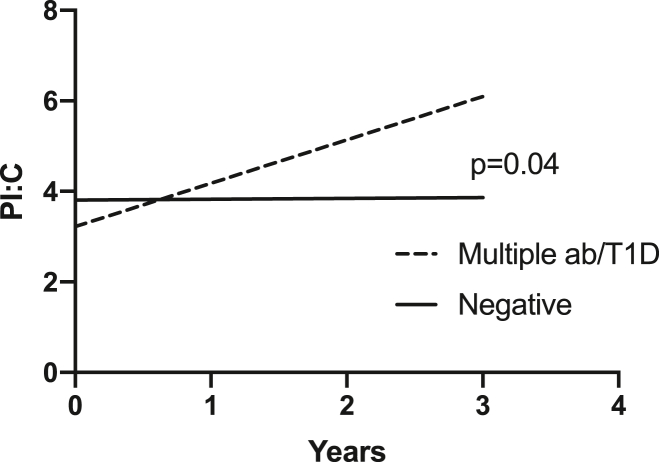
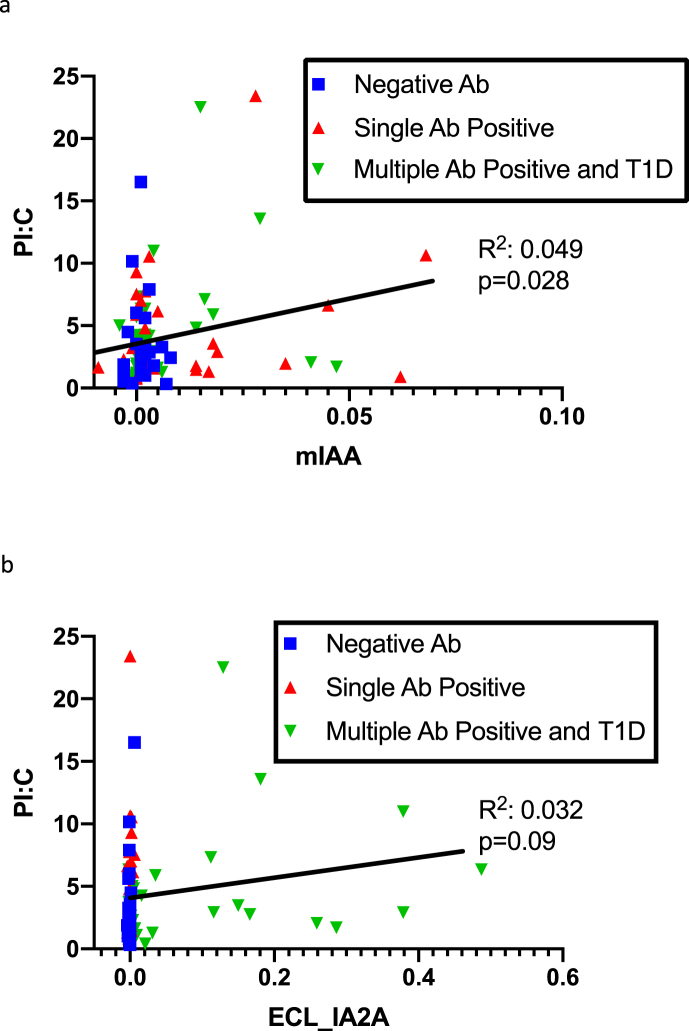
In cross-sectional analyses, there were no significant differences in PI:C ratios between type 1 diabetes and/or multiple Ab positive subjects (4.16 ± 4.06) compared to single Ab positive subjects (4.08 ± 4.34) and negative Ab subjects (3.72 ± 3.78) (p = 0.92) overall or after adjusting for age, sex and BMI. Higher PI:C ratios were associated with mIAA titers (p = 0.03) and showed an association with ECL-IA2A titers (p = 0.09), but not with ECL-IAA, GADA, ECL-GADA, IA2A nor ZnT8A titers. In mixed-effects longitudinal models, the trajectories of PI:C ratio over time were significantly different between the Ab negative and multiple Ab positive/type 1 diabetes groups, after adjusting for sex, age, and BMI (p = 0.04).
PI:C ratio trajectories increase over time in subjects who have multiple Ab or develop type 1 diabetes and may be a helpful biomarker to further characterize and stratify risk of progression to type 1 diabetes over time.
需要生物标志物来表征1型糖尿病风险人群中的异质性。胰岛素原与C肽的比值(PI:C比值)已被提议作为β细胞功能障碍的生物标志物,并且与进展为1型糖尿病相关。然而,PI:C比值与自身抗体类型和数量之间的关系尚未得到研究。我们试图对1型糖尿病患者的多种胰岛自身抗体阳性、单一自身抗体阳性和自身抗体阴性的亲属的PI:C比值进行特征描述。
我们在Barbara Davis中心的TrialNet预防研究路径中,对98名1型糖尿病患者的亲属进行了电化学发光(ECL)检测(ECL-IAA、ECL-GADA和ECL-IA2A)和放射结合(RBA)检测(mIAA、GADA、IA2A和ZnT8A),以测量PI:C比值和自身抗体,随访时间平均为7.4 ± 4.1年。在这些受试者中,8人进展为1型糖尿病,31人多种自身抗体(Ab)阳性,37人单一Ab阳性,22人Ab阴性(通过RBA检测)。
在横断面分析中,与单一Ab阳性受试者(4.08 ± 4.34)和Ab阴性受试者(3.72 ± 3.78)相比,1型糖尿病和/或多种Ab阳性受试者(4.16 ± 4.06)的PI:C比值总体上或在调整年龄、性别和BMI后无显著差异(p = 0.92)。较高的PI:C比值与mIAA滴度相关(p = 0.03),并与ECL-IA2A滴度有相关性(p = 0.09),但与ECL-IAA、GADA、ECL-GADA、IA2A和ZnT8A滴度无关。在混合效应纵向模型中,在调整性别、年龄和BMI后,Ab阴性组与多种Ab阳性/1型糖尿病组之间PI:C比值随时间的轨迹有显著差异(p = 0.04)。
在有多种Ab或发展为1型糖尿病的受试者中,PI:C比值轨迹随时间增加,可能是一种有助于进一步表征和分层随时间进展为1型糖尿病风险的有用生物标志物。