Goel Nikky, Ahmad Razi, Fatima Huma, Khare Sunil Kumar
Enzyme and Microbial Biochemistry Laboratory, Department of Chemistry Indian Institute of Technology Delhi, Hauz Khas, New Delhi 110016, India.
Med Drug Discov. 2021 Jun;10:100089. doi: 10.1016/j.medidd.2021.100089. Epub 2021 Mar 17.
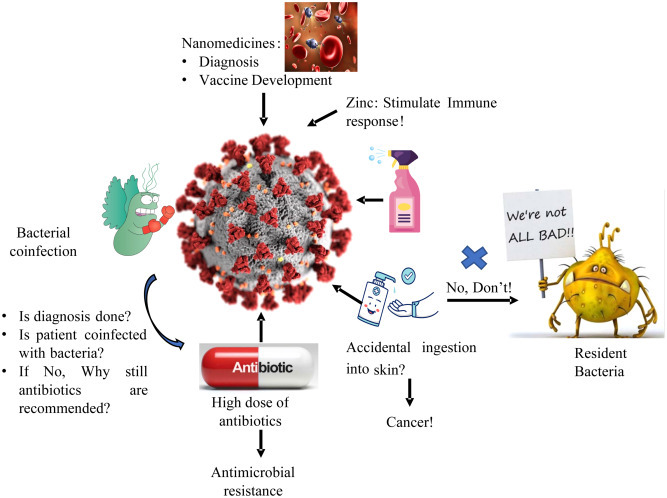
Coronavirus disease (COVID-19) is a global pandemic. The COVID-19 outbreak caused by severe acute respiratory syndrome coronavirus 2 (SARS-CoV-2) has overloaded healthcare systems that need medication to be rapidly established, at least to minimize the incidence of COVID-19. The coinfection with other microorganisms has drastically affected human health. Due to the utmost necessity to treat the patient infected with COVID-19 earliest, poor diagnosis and misuse of antibiotics may lead the world where no more drugs are available even to treat mild infections. Besides, sanitizers and disinfectants used to help minimize widespread coronavirus infection risk also contribute to an increased risk of antimicrobial resistance. To ease the situation, zinc supplements' potentiality has been explored and found to be an effective element to boost the immune system. Zinc also prevents the entry of the virus by increasing the ciliary beat frequency. Furthermore, the limitations of current antiviral agents such as a narrow range and low bioavailability can be resolved using nanomaterials, which are considered an important therapeutic alternative for the next generation. Thus, the development of new antiviral nanoagents will significantly help tackle many potential challenges and knowledge gaps. This review paper provides profound insight into how COVID-19 and antimicrobial resistance (AMR) are interrelated and the possible implications and current strategies to fight the ongoing pandemic.
冠状病毒病(COVID-19)是一场全球大流行疾病。由严重急性呼吸综合征冠状病毒2(SARS-CoV-2)引发的COVID-19疫情使医疗系统不堪重负,这些系统需要迅速确定治疗药物,至少要尽量降低COVID-19的发病率。与其他微生物的合并感染已严重影响人类健康。由于迫切需要尽早治疗感染COVID-19的患者,诊断不当和抗生素的滥用可能会导致世界面临无药可用的局面,甚至无法治疗轻度感染。此外,用于帮助降低冠状病毒广泛传播风险的消毒剂也会增加抗菌药物耐药性的风险。为缓解这种情况,人们对锌补充剂的潜力进行了探索,发现它是增强免疫系统的有效元素。锌还可通过增加纤毛摆动频率来阻止病毒进入。此外,利用纳米材料可以解决当前抗病毒药物存在的诸如作用范围窄和生物利用度低等局限性,纳米材料被认为是下一代重要的治疗选择。因此,新型抗病毒纳米制剂的开发将极大地有助于应对许多潜在挑战和知识空白。这篇综述文章深入探讨了COVID-19与抗菌药物耐药性(AMR)之间的相互关系以及抗击当前疫情的可能影响和现行策略。