School of Medical Sciences, Faculty of Medicine, UNSW Australia, Sydney, NSW, Australia.
The Kirby Institute, UNSW Australia, Sydney, NSW, Australia.
Cell Rep Med. 2021 Apr 20;2(4):100228. doi: 10.1016/j.xcrm.2021.100228. Epub 2021 Mar 14.
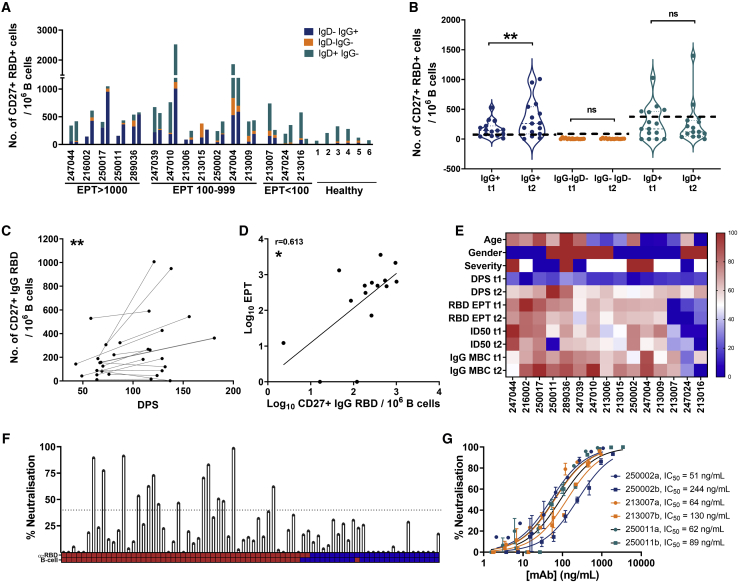
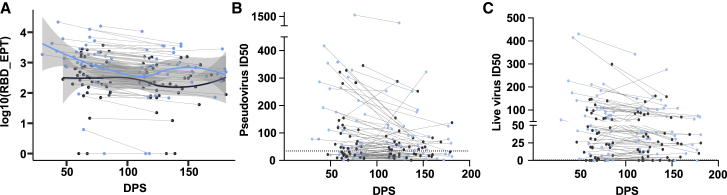
Considerable concerns relating to the duration of protective immunity against severe acute respiratory syndrome-coronavirus-2 (SARS-CoV-2) exist, with evidence of antibody titers declining rapidly after infection and reports of reinfection. Here, we monitor the antibody responses against SARS-CoV-2 receptor-binding domain (RBD) for up to 6 months after infection. While antibody titers are maintained, ∼13% of the cohort's neutralizing responses return to background. However, encouragingly, in a selected subset of 13 participants, 12 have detectable RBD-specific memory B cells and these generally are increasing out to 6 months. Furthermore, we are able to generate monoclonal antibodies with SARS-CoV-2 neutralizing capacity from these memory B cells. Overall, our study suggests that the loss of neutralizing antibodies in plasma may be countered by the maintenance of neutralizing capacity in the memory B cell repertoire.
人们对严重急性呼吸综合征冠状病毒 2(SARS-CoV-2)的保护性免疫持续时间存在相当大的担忧,有证据表明感染后抗体滴度迅速下降,并有再次感染的报告。在这里,我们监测了感染后长达 6 个月的 SARS-CoV-2 受体结合域(RBD)的抗体反应。虽然抗体滴度保持不变,但约 13%的队列的中和反应恢复到背景水平。然而,令人鼓舞的是,在 13 名选定参与者的亚组中,有 12 名可检测到 RBD 特异性记忆 B 细胞,这些细胞通常在 6 个月时增加。此外,我们能够从这些记忆 B 细胞中产生具有 SARS-CoV-2 中和能力的单克隆抗体。总体而言,我们的研究表明,血浆中中和抗体的丧失可能被记忆 B 细胞库中中和能力的维持所抵消。