Kanduc Darja
Department of Biosciences, Biotechnologies, and Biopharmaceutics, University of Bari, Bari, Italy.
Glob Med Genet. 2021 Mar;8(1):32-37. doi: 10.1055/s-0041-1724106. Epub 2021 Feb 19.
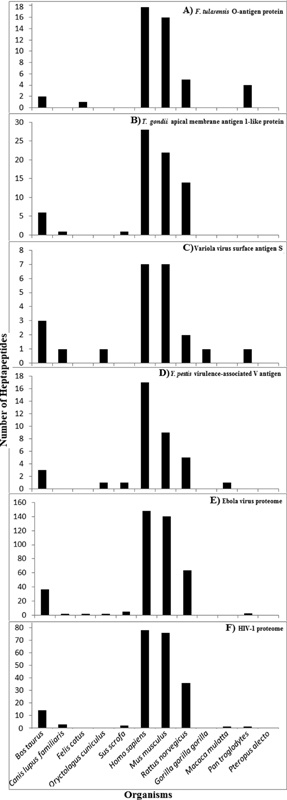
Recently, it was found that proteomes from poliovirus, measles virus, dengue virus, and severe acute respiratory syndrome-related Coronavirus 2 (SARS-CoV-2) have high molecular mimicry at the heptapeptide level with the human proteome, while heptapeptide commonality is minimal or absent with proteomes from nonhuman primates, that is, gorilla, chimpanzee, and rhesus macaque. To acquire more data on the issue, analyses here have been expanded to Ebola virus, , human immunodeficiency virus-1 (HIV-1), , Variola virus, and . Results confirm that heptapeptide overlap is high between pathogens and , but not between pathogens and primates. Data are discussed in light of the possible genetic bases that differently model primate phenomes, thus possibly underlying the zero/low level of molecular mimicry between infectious agents and primates. Notably, this study might help address preclinical vaccine tests that currently utilize primates as animal models, since autoimmune cross-reactions and the consequent adverse events cannot occur of shared sequences.
最近发现,脊髓灰质炎病毒、麻疹病毒、登革热病毒和严重急性呼吸综合征冠状病毒2(SARS-CoV-2)的蛋白质组在七肽水平上与人类蛋白质组具有高度的分子模拟,而与非人灵长类动物(即大猩猩、黑猩猩和恒河猴)的蛋白质组相比,七肽的共性极小或不存在。为了获取更多关于该问题的数据,此处的分析已扩展到埃博拉病毒、人类免疫缺陷病毒1型(HIV-1)、天花病毒等。结果证实,病原体与人类之间七肽重叠度高,但病原体与灵长类动物之间七肽重叠度不高。根据可能不同地塑造灵长类动物表型的遗传基础对数据进行了讨论,这可能是感染因子与灵长类动物之间分子模拟为零/低水平的潜在原因。值得注意的是,这项研究可能有助于解决目前将灵长类动物用作动物模型的临床前疫苗试验问题,因为共享序列不会引发自身免疫交叉反应及随之而来的不良事件。