Columbia University Vagelos College of Physicians and Surgeons, New York, NY, USA.
Department of Biomedical Informatics, Columbia University, New York, NY, USA.
J Alzheimers Dis. 2021;81(2):679-690. doi: 10.3233/JAD-210050.
Patients with dementia are vulnerable during the coronavirus disease 2019 (COVID-19) pandemic, yet few studies describe their hospital course and outcomes.
To describe and compare the hospital course for COVID-19 patients with dementia to an aging cohort without dementia in a large New York City academic medical center.
This was a single-center retrospective cohort study describing all consecutive patients age 65 or older with confirmed COVID-19 who presented to the emergency department or were hospitalized at New York-Presbyterian/Columbia University Irving Medical Center between March 6 and April 7, 2020.
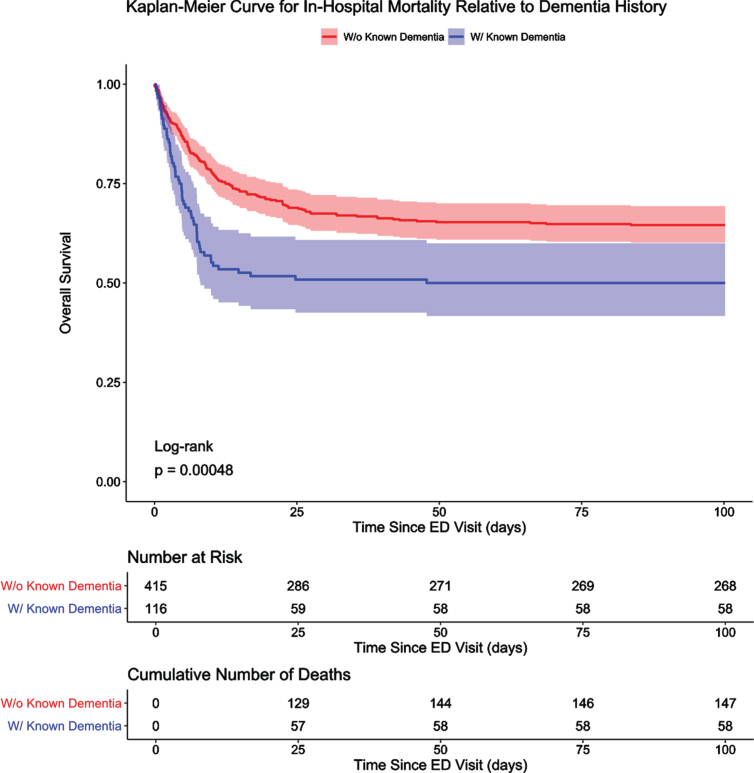
A total of 531 patients were evaluated, including 116 (21.8%) with previously diagnosed dementia, and 415 without dementia. Patients with dementia had higher mortality (50.0%versus 35.4%, p = 0.006); despite similar comorbidities and complications, multivariate analysis indicated the association was dependent on age, sex, comorbidities, and code status. Patients with dementia more often presented with delirium (36.2%versus 11.6%, p < 0.001) but less often presented with multiple other COVID-19 symptoms, and these findings remained after adjusting for age and sex.
Hospitalized COVID-19 patients with dementia had higher mortality, but dementia was not an independent risk factor for death. These patients were approximately 3 times more likely to present with delirium but less often manifested or communicated other common COVID-19 symptoms. For this high-risk population in a worsening pandemic, understanding the unique manifestations and course in dementia and aging populations may help guide earlier diagnosis and optimize medical management.
在 2019 冠状病毒病(COVID-19)大流行期间,痴呆患者较为脆弱,但很少有研究描述他们的住院过程和结局。
描述和比较在纽约市一家大型学术医疗中心,COVID-19 痴呆患者与无痴呆老年患者的住院过程。
这是一项单中心回顾性队列研究,描述了 2020 年 3 月 6 日至 4 月 7 日期间,在纽约长老会/哥伦比亚大学欧文医学中心急诊科就诊或住院的所有年龄在 65 岁或以上、确诊 COVID-19 的连续患者。
共评估了 531 名患者,其中 116 名(21.8%)患有先前诊断的痴呆症,415 名无痴呆症。痴呆症患者死亡率更高(50.0%比 35.4%,p=0.006);尽管存在相似的合并症和并发症,但多变量分析表明,这种关联取决于年龄、性别、合并症和临终状态。痴呆症患者更常出现谵妄(36.2%比 11.6%,p<0.001),但较少出现其他 COVID-19 症状,且这些发现在调整年龄和性别后仍然存在。
住院 COVID-19 痴呆患者死亡率较高,但痴呆症不是死亡的独立危险因素。这些患者出现谵妄的可能性大约高出 3 倍,但表现出或传达其他常见 COVID-19 症状的可能性较小。对于这种在不断恶化的大流行中处于高风险的人群,了解痴呆症和老年人群中的独特表现和病程可能有助于指导早期诊断和优化医疗管理。