
成纤维细胞生长因子 19 通过 AMPK/SIRT-1/PGC-α 通路保护骨骼肌免受肥胖引起的肌肉萎缩、代谢紊乱和异常鸢尾素水平的影响。
FGF19 protects skeletal muscle against obesity-induced muscle atrophy, metabolic derangement and abnormal irisin levels via the AMPK/SIRT-1/PGC-α pathway.
机构信息
Department of Geriatrics, The First Affiliated Hospital of Chongqing Medical University, Chongqing, China.
Department of Orthopedics, The First Affiliated Hospital of Chongqing Medical University, Chongqing, China.
出版信息
J Cell Mol Med. 2021 Apr;25(7):3585-3600. doi: 10.1111/jcmm.16448. Epub 2021 Mar 10.
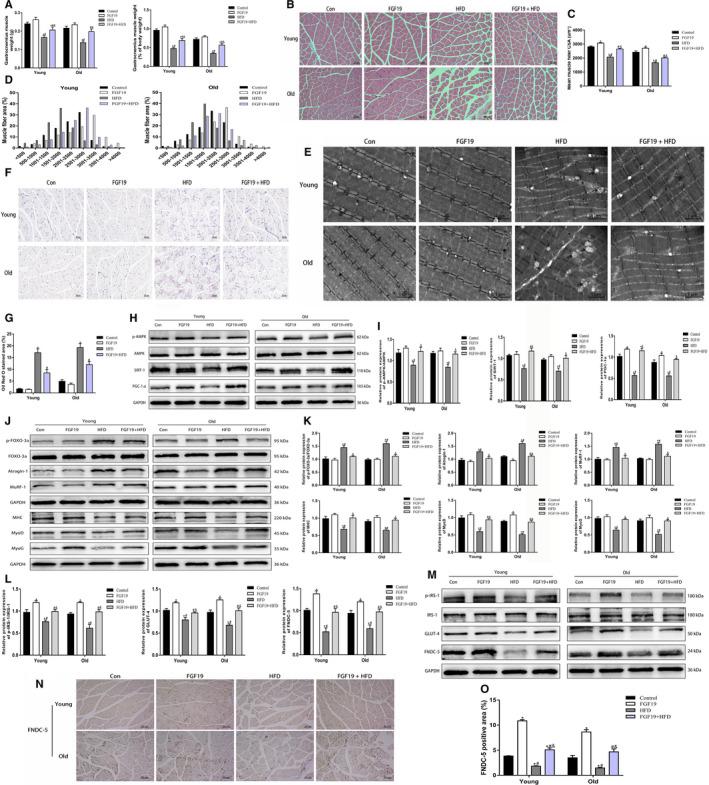
Obesity is associated with biological dysfunction in skeletal muscle. As a condition of obesity accompanied by muscle mass loss and physical dysfunction, sarcopenic obesity (SO) has become a novel public health problem. Human fibroblast growth factor 19 (FGF19) plays a therapeutic role in metabolic diseases. However, the protective effects of FGF19 on skeletal muscle in obesity and SO are still not completely understood. Our results showed that FGF19 administration improved muscle loss and grip strength in young and aged mice fed a high-fat diet (HFD). Increases in muscle atrophy markers (FOXO-3, Atrogin-1, MuRF-1) were abrogated by FGF19 in palmitic acid (PA)-treated C2C12 myotubes and in the skeletal muscle of HFD-fed mice. FGF19 not only reduced HFD-induced body weight gain, excessive lipid accumulation and hyperlipidaemia but also promoted energy expenditure (PGC-1α, UCP-1, PPAR-γ) in brown adipose tissue (BAT). FGF19 treatment restored PA- and HFD-induced hyperglycaemia, impaired glucose tolerance and insulin resistance (IRS-1, GLUT-4) and mitigated the PA- and HFD-induced decrease in FNDC-5/irisin expression. However, these beneficial effects of FGF19 on skeletal muscle were abolished by inhibiting AMPK, SIRT-1 and PGC-1α expression. Taken together, this study suggests that FGF19 protects skeletal muscle against obesity-induced muscle atrophy, metabolic derangement and abnormal irisin secretion partially through the AMPK/SIRT-1/PGC-α signalling pathway, which might be a potential therapeutic target for obesity and SO.
肥胖与骨骼肌的生物功能障碍有关。作为一种伴随着肌肉质量损失和身体功能障碍的肥胖状态,肌少型肥胖(SO)已成为一个新的公共健康问题。人类成纤维细胞生长因子 19(FGF19)在代谢性疾病中具有治疗作用。然而,FGF19 对肥胖和 SO 中骨骼肌的保护作用仍不完全清楚。我们的结果表明,FGF19 给药可改善高脂肪饮食(HFD)喂养的年轻和老年小鼠的肌肉损失和握力。FGF19 可消除棕榈酸(PA)处理的 C2C12 肌管和 HFD 喂养小鼠骨骼肌中肌肉萎缩标志物(FOXO-3、Atrogin-1、MuRF-1)的增加。FGF19 不仅减少了 HFD 诱导的体重增加、过量脂质积累和高脂血症,还促进了棕色脂肪组织(BAT)中的能量消耗(PGC-1α、UCP-1、PPAR-γ)。FGF19 治疗可恢复 PA 和 HFD 诱导的高血糖、葡萄糖耐量受损和胰岛素抵抗(IRS-1、GLUT-4),并减轻 PA 和 HFD 诱导的 FNDC-5/鸢尾素表达降低。然而,通过抑制 AMPK、SIRT-1 和 PGC-1α 的表达,FGF19 对骨骼肌的这些有益作用被消除。综上所述,本研究表明,FGF19 通过 AMPK/SIRT-1/PGC-α 信号通路部分保护骨骼肌免受肥胖引起的肌肉萎缩、代谢紊乱和异常鸢尾素分泌,这可能是肥胖和 SO 的潜在治疗靶点。



 Zotero 插件