Laboratory of Exercise Biochemistry, Department of Physical Education, College of Arts and Physical Education, Dong-A University, 37 Nakdong-daero 550 beon-gil, Hadan-dong, Saha-gu, Busan, 604-714, Republic of Korea.
Laboratory of Exercise Physiology, Division of Sport Science, Kangwon National University, 1 Kangwondaehak-gil, Chuncheon-si, Gangwon-do, 24341, Republic of Korea.
Lipids Health Dis. 2018 Apr 27;17(1):97. doi: 10.1186/s12944-018-0751-3.
Increased intramuscular peroxisome proliferator-activated receptor gamma coactivator-1α (PGC-1α) with exercise directly or indirectly affects other tissues, but the effector pathway of PGC-1α has not been clearly elucidated. The purpose of this study was to investigate the effect of exercise and/or dietary change on the protein levels of the soleus muscle energy-sensing network and meteorin-like (Metrnl), and additionally to analyze the detraining and retraining effects in high-fat diet (HFD)-induced obese mice.
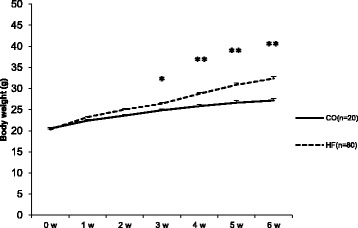
One hundred male C57BL/6 mice were divided into normal-diet + sedentary (CO, n = 20) and HFD + sedentary (HF, n = 80) groups, and obesity was induced in the HF group through consumption of a 45% HFD for 6 weeks. The HF group was subdivided into HF only (n = 20), HF + training (HFT, n = 20), dietary change + sedentary (HFND, n = 20), and HFND + training (HFNDT, n = 20) groups, and the mice in the training groups underwent a treadmill training for 8 weeks, 5 times per week, 40 min per day. The HFT and HFNDT groups underwent 8-week training, 8-week detraining, and 4-week retraining.
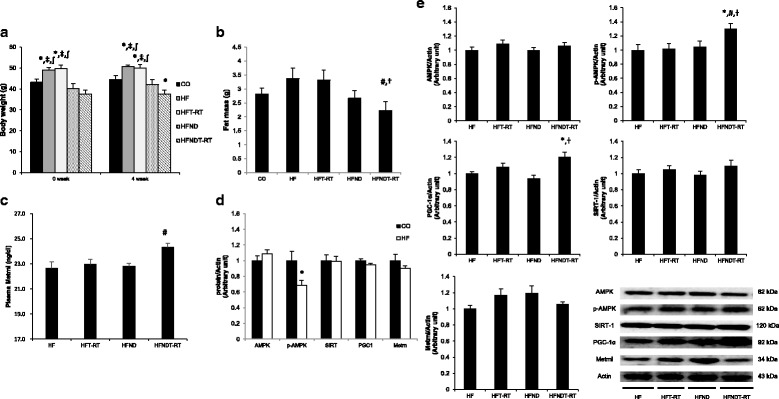
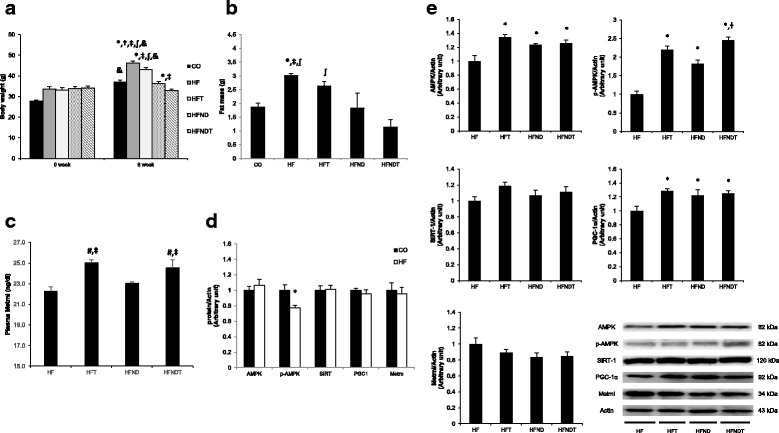
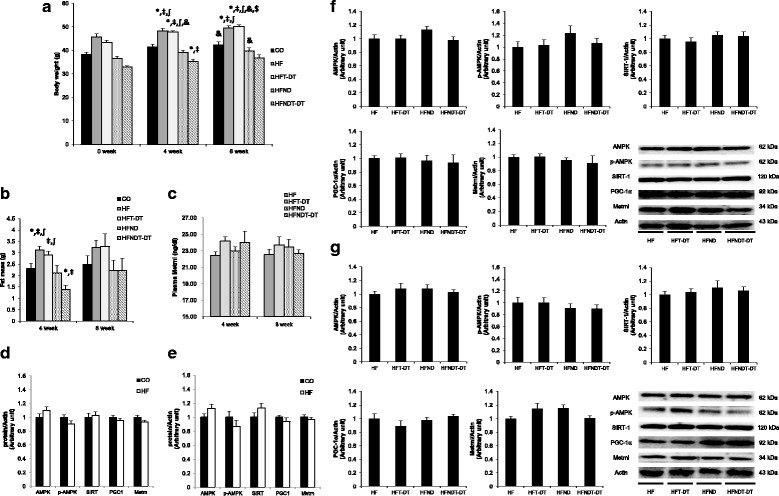
An 8-week training was effective in increasing the protein levels of soleus muscle AMP-activated protein kinase (AMPK), PGC-1α, and plasma Metrnl in the obese mice (P < 0.05). Moreover, exercise in obesity reduced body weight (P < 0.05), and exercise with dietary conversion was effective in reducing body weight (P < 0.05) and fat mass (P < 0.05) after 8-week training. 8-week detraining restored the increased protein level to the pre-exercise state, but, the previous exercise effect in body weight and fat mass (P < 0.05) of the HFNDT group remained until the end of 4-week detraining. 4-week retraining was effective in increasing the protein levels of soleus muscle AMPK, PGC-1α, blood Metrnl (P < 0.05), and reducing in body weight (P < 0.05) and fat mass (P < 0.05), when retraining with dietary change.
The results of this study suggest that regular exercise is indispensable to reduce body weight and fat mass through upregulation of the muscle energy-sensing network and Metrnl protein levels, and retraining with dietary change is necessary to obtain the retraining effects more quickly.
运动可直接或间接增加肌肉中的过氧化物酶体增殖物激活受体γ共激活因子 1α(PGC-1α),进而影响其他组织,但 PGC-1α 的效应途径尚未明确。本研究旨在探讨运动和/或饮食变化对比目鱼肌能量感应网络和 Meteorin 样蛋白(Metrnl)蛋白水平的影响,并分析高脂饮食(HFD)诱导肥胖小鼠的脱训和再训练效果。
100 只雄性 C57BL/6 小鼠分为正常饮食+安静(CO,n=20)和 HFD+安静(HF,n=80)组,HF 组通过摄入 45%HFD 诱导肥胖 6 周。HF 组进一步分为仅 HF(n=20)、HF+运动(HFT,n=20)、饮食改变+安静(HFND,n=20)和 HFND+运动(HFNDT,n=20)组,运动组进行 8 周、每周 5 次、每天 40min 的跑台运动。HFT 和 HFNDT 组进行 8 周训练、8 周脱训和 4 周再训练。
8 周运动可有效增加肥胖小鼠比目鱼肌 AMP 激活蛋白激酶(AMPK)、PGC-1α 和血浆 Metrnl 蛋白水平(P<0.05)。此外,运动可降低肥胖小鼠的体重(P<0.05),而运动结合饮食改变可有效降低体重(P<0.05)和脂肪量(P<0.05)。8 周脱训可使蛋白水平恢复到运动前状态,但 HFNDT 组的体重和脂肪量的先前运动效果(P<0.05)在 4 周脱训结束时仍持续存在。饮食改变联合 4 周再训练可有效增加比目鱼肌 AMPK、PGC-1α、血液 Metrnl 蛋白水平(P<0.05),降低体重(P<0.05)和脂肪量(P<0.05)。
本研究结果表明,定期运动对于通过上调肌肉能量感应网络和 Metrnl 蛋白水平来降低体重和脂肪量是必不可少的,并且再训练结合饮食改变对于更快获得再训练效果是必要的。