Rosa Susana, Martins Diogo, Martins Mariana, Guimarães Bruno, Cabral Leonor, Horta Luís
Physical Medicine and Rehabilitation, Centro Hospitalar Universitário de Lisboa Central, Lisbon, PRT.
Physical Medicine and Rehabilitation, Central Entre o Douro e Vouga Hospital, Santa Maria da Feira, PRT.
Cureus. 2021 Feb 17;13(2):e13400. doi: 10.7759/cureus.13400.
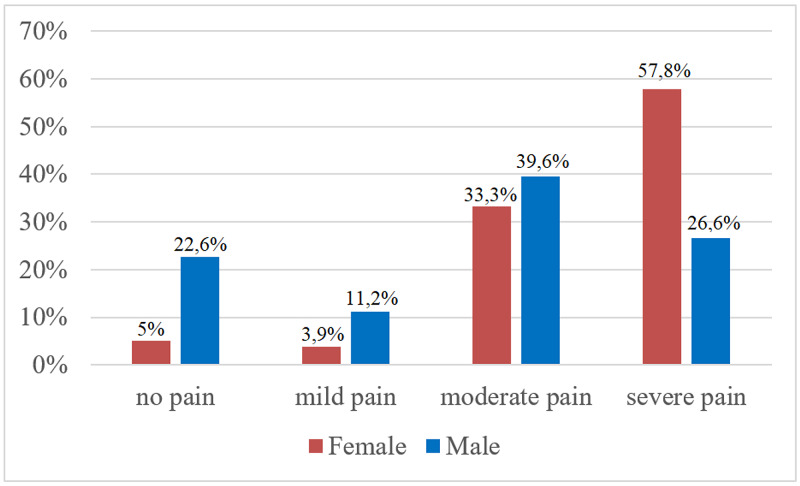
Introduction With obesity reaching pandemic proportions, its detrimental influence on many health-related conditions has recently become a focus of research. Musculoskeletal (MSK) pain is one of several disorders associated with obesity. Materials and methods This study was designed to identify MSK pain in individuals with severe obesity, recruited from a specialized obesity clinic, and to evaluate the correlation between the MSK symptoms and some individual criteria. Results In 466 patients (342 females and 124 males), with a mean BMI of 42,77 ± 5.64 kg/m², 90,3% reported MSK pain. Severe pain was reported by 57,8% of female 26,6% of male patients. Female patients showed higher mean pain level when compared with males. Body sites with a higher prevalence of pain were: knee (63.5%), lumbar region (46.8%), hip (29%) and ankle (23%), with a predominance of severe pain. BMI have shown a positive correlation to numeric rating scale score in female participants in three body regions: shoulder (P = 0.010), knee (P = 0.042) and ankle (P = 0.024). Body sites with higher pain prevalence were especially in areas of increased mechanical load. Conclusions Understanding the relationship between obesity and pain may provide insights into preventive measures and therapeutic strategies for MSK pain. Persistent MSK pain is a significant problem in obese patients that can have a negative relationship with quality of life and function. This fact highlights the importance that patients with obesity may have access to interdisciplinary care, for the prevention and rehabilitation of MSK disorders. To further understand this association, more robust studies are needed.
引言 随着肥胖症达到流行程度,其对许多与健康相关状况的有害影响最近已成为研究焦点。肌肉骨骼(MSK)疼痛是与肥胖症相关的几种疾病之一。
材料与方法 本研究旨在识别从一家专门的肥胖症诊所招募的重度肥胖个体中的MSK疼痛,并评估MSK症状与一些个体标准之间的相关性。
结果 在466名患者(342名女性和124名男性)中,平均BMI为42.77±5.64kg/m²,90.3%的患者报告有MSK疼痛。57.8%的女性和26.6%的男性患者报告有重度疼痛。与男性相比,女性患者的平均疼痛水平更高。疼痛发生率较高的身体部位为:膝盖(63.5%)、腰部(46.8%)、臀部(29%)和脚踝(23%),且以重度疼痛为主。在三个身体部位,BMI与女性参与者的数字评分量表得分呈正相关:肩部(P=0.010)、膝盖(P=0.042)和脚踝(P=0.024)。疼痛发生率较高的身体部位尤其在机械负荷增加的区域。
结论 了解肥胖与疼痛之间的关系可能为MSK疼痛的预防措施和治疗策略提供见解。持续性MSK疼痛是肥胖患者中的一个重要问题,可能与生活质量和功能呈负相关。这一事实凸显了肥胖患者获得跨学科护理以预防和康复MSK疾病的重要性。为了进一步了解这种关联,需要更有力的研究。