Stubbs Thomas L, Pierce Stephanie E, Elsler Armin, Anderson Philip S L, Rayfield Emily J, Benton Michael J
School of Earth Sciences, University of Bristol, UK.
Museum of Comparative Zoology, Harvard University, Cambridge, MA, USA.
Proc Biol Sci. 2021 Mar 31;288(1947):20210069. doi: 10.1098/rspb.2021.0069. Epub 2021 Mar 24.
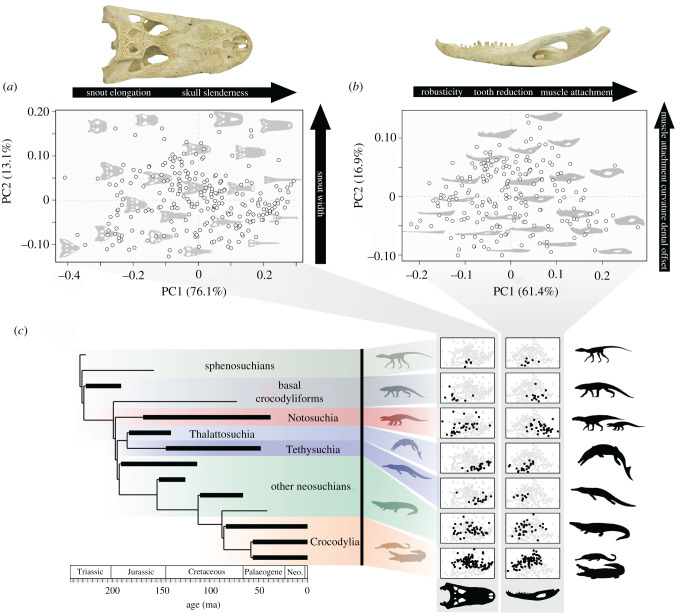
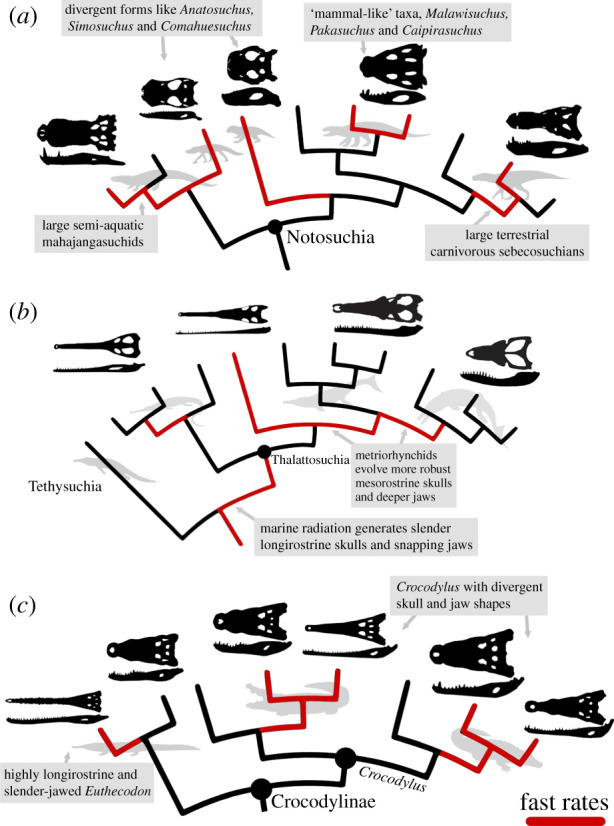
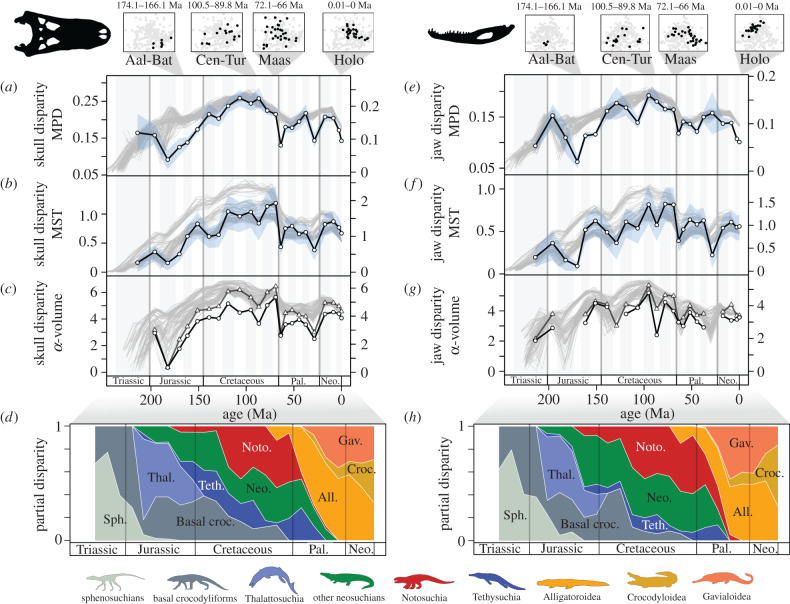
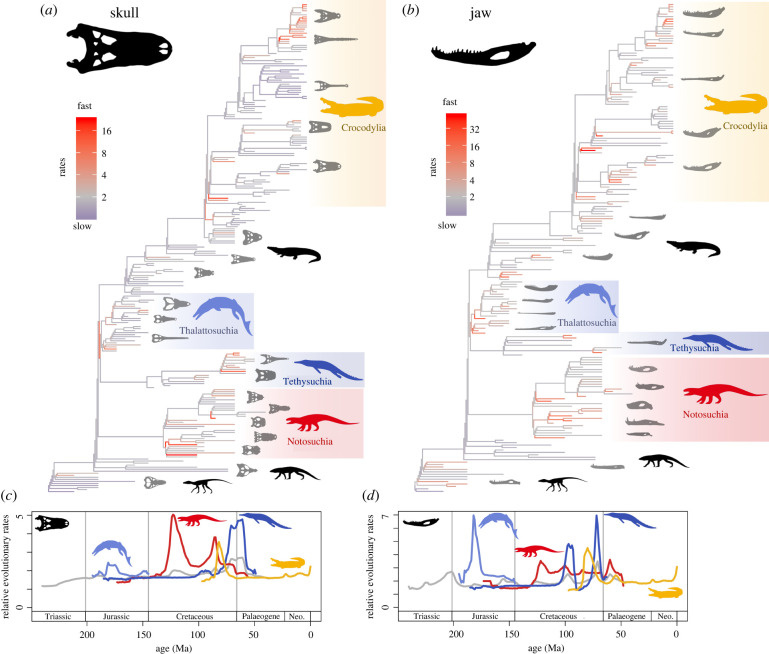
Understanding the origin, expansion and loss of biodiversity is fundamental to evolutionary biology. The approximately 26 living species of crocodylomorphs (crocodiles, caimans, alligators and gharials) represent just a snapshot of the group's rich 230-million-year history, whereas the fossil record reveals a hidden past of great diversity and innovation, including ocean and land-dwelling forms, herbivores, omnivores and apex predators. In this macroevolutionary study of skull and jaw shape disparity, we show that crocodylomorph ecomorphological variation peaked in the Cretaceous, before declining in the Cenozoic, and the rise and fall of disparity was associated with great heterogeneity in evolutionary rates. Taxonomically diverse and ecologically divergent Mesozoic crocodylomorphs, like marine thalattosuchians and terrestrial notosuchians, rapidly evolved novel skull and jaw morphologies to fill specialized adaptive zones. Disparity in semi-aquatic predatory crocodylians, the only living crocodylomorph representatives, accumulated steadily, and they evolved more slowly for most of the last 80 million years, but despite their conservatism there is no evidence for long-term evolutionary stagnation. These complex evolutionary dynamics reflect ecological opportunities, that were readily exploited by some Mesozoic crocodylomorphs but more limited in Cenozoic crocodylians.
了解生物多样性的起源、扩张和丧失是进化生物学的基础。现存的约26种鳄形超目动物(鳄鱼、凯门鳄、短吻鳄和印度食鱼鳄)只是该类群有着2.3亿年丰富历史的一个缩影,而化石记录揭示了一个隐藏着的过去,其中有着丰富的多样性和创新性,包括海洋和陆地栖息形式、食草动物、杂食动物和顶级食肉动物。在这项关于头骨和颌骨形状差异的宏观进化研究中,我们表明鳄形超目动物的生态形态学变异在白垩纪达到峰值,随后在新生代下降,并且差异的兴衰与进化速率的巨大异质性相关。分类学上多样且生态上不同的中生代鳄形超目动物,如海洋的海鳄亚目和陆地的诺托鳄类,迅速进化出新颖的头骨和颌骨形态以占据特殊的适应区。半水生食肉鳄类作为仅存的鳄形超目动物代表,其差异稳步积累,在过去8000万年的大部分时间里进化较为缓慢,但尽管它们较为保守,却没有长期进化停滞的证据。这些复杂的进化动态反映了生态机遇,中生代的一些鳄形超目动物能够轻易利用这些机遇,而新生代鳄类所面临的机遇则较为有限。