Shen Jian, Zhang Jun, He Qiang, Pan Haihui, Wu Zhiqiang, Nie Liangming, Zhang Hongfang, Liu Shuning, Sun Yan, Du Yaoqiang, Huang Dongsheng
Department of Medical Administration, Zhejiang Provincial People's Hospital, People's Hospital of Hangzhou Medical College, No.158 Shangtang Road, Zhejiang, Hangzhou, China.
Department of Blood Transfusion, Zhejiang Provincial People's Hospital, People's Hospital of Hangzhou Medical College, No.158 Shangtang Road, Zhejiang, Hangzhou, China.
BMC Health Serv Res. 2021 Mar 23;21(1):267. doi: 10.1186/s12913-021-06260-3.
To implement the "without the need for a second visit" (WNASV) initiative in our hospital by optimizing the outpatient clinic services via an upgraded information system, in order to increase the quality of outpatient medical services and improve patients' satisfaction.
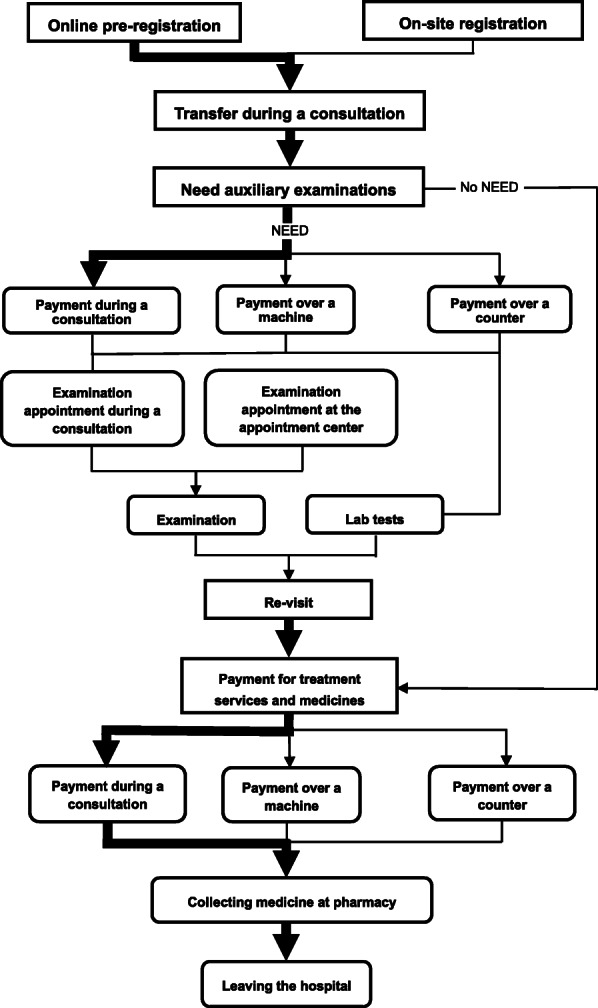
An Internet-based care delivery approach was developed and applied to improve the delivery of health care services, simplify the treatment process, and reduce patient waiting time. The patient waiting time and consultation time in the outpatient clinics of our hospital during the peak service intervals and the proportions of various payment methods for outpatient services during the period from May 2017 to September 2019 were retrospectively analyzed. Also, the patients' satisfaction with the outpatient process was surveyed.
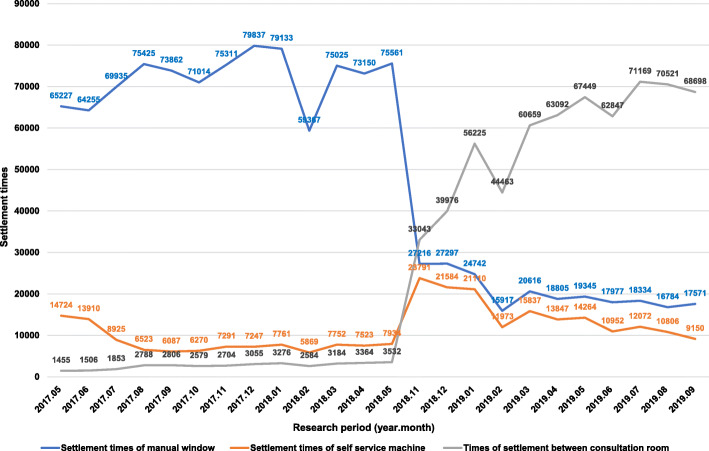
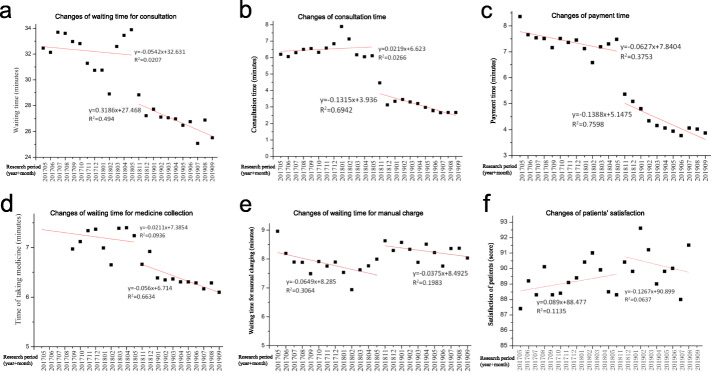
The waiting time for consultation was shortened from 32.25 min to 28.42 min; the consultation time was shortened from 6.52 min to 3.15 min; and the waiting time for payment decreased from 7.40 min to 4.31 min. The proportion of payment via a counter was reduced from 86.80 to 21.79%, the proportion of self-service payment increased from 9.99 to 16.05%, and the proportion of payment during a consultation increased from 3.21 to 61.91%. The scores of the patients' satisfaction with the outpatient services increased from an average of 89.10 points in 2017 to an average of 90.26 points in 2019.
The continuous improvement of the service process markedly increases the efficiency of the outpatient services, and effectively improves patient's satisfaction with the outpatient process, this initiative thus deserves further application.
通过升级信息系统优化门诊服务,在我院实施“无需二次就诊”(WNASV)计划,以提高门诊医疗服务质量并提升患者满意度。
开发并应用基于互联网的医疗服务提供方式,以改善医疗服务的提供,简化治疗流程并减少患者等待时间。回顾性分析了我院2017年5月至2019年9月高峰服务时段门诊患者的等待时间和就诊时间,以及门诊服务各种支付方式的比例。此外,还对患者对门诊流程的满意度进行了调查。
就诊等待时间从32.25分钟缩短至28.42分钟;就诊时间从6.52分钟缩短至3.15分钟;缴费等待时间从7.40分钟降至4.31分钟。柜台缴费比例从86.80%降至21.79%,自助缴费比例从9.99%增至16.05%,就诊时缴费比例从3.21%增至61.91%。患者对门诊服务的满意度评分从2017年的平均89.10分提高到2019年的平均90.26分。
服务流程的持续改进显著提高了门诊服务效率,并有效提升了患者对门诊流程的满意度,因此该计划值得进一步推广应用。