Centre for Evidence-Based Chinese Medicine, Beijing University of Chinese Medicine, 11 Bei San Huan Dong Lu, Chaoyang District, Beijing, 100029, China.
Institute for Complementary and Integrative Medicine, University Hospital Zurich and University of Zurich, Zurich, Switzerland.
BMC Complement Med Ther. 2021 Mar 23;21(1):101. doi: 10.1186/s12906-021-03272-8.
Chinese eye acupuncture, focuses on treating different diseases by applying needle stimulation around the orbit of the eye. Since 1970, it has been used in China for the management of pain-related disorders. This scoping review systematically collected clinical studies on the use of eye acupuncture to treat pain conditions and identify any adverse events.
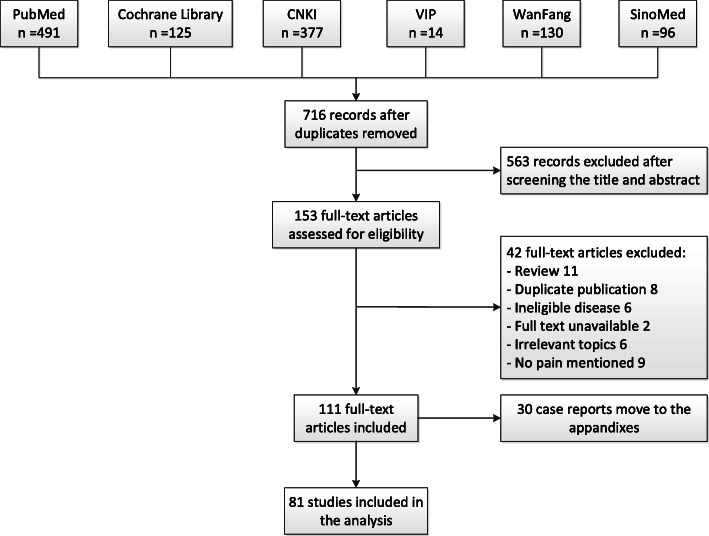
Six databases including PubMed, the Cochrane Library, CNKI, VIP, Wan Fang Data and SinoMed were searched from 1970 to March 2019. Randomized controlled trials (RCTs), clinical controlled trials (CCTs) and case series on eye-acupuncture for pain conditions meeting the inclusion criteria were identified. Data were extracted on patients, interventions, details of eye acupuncture, control treatments and outcomes.
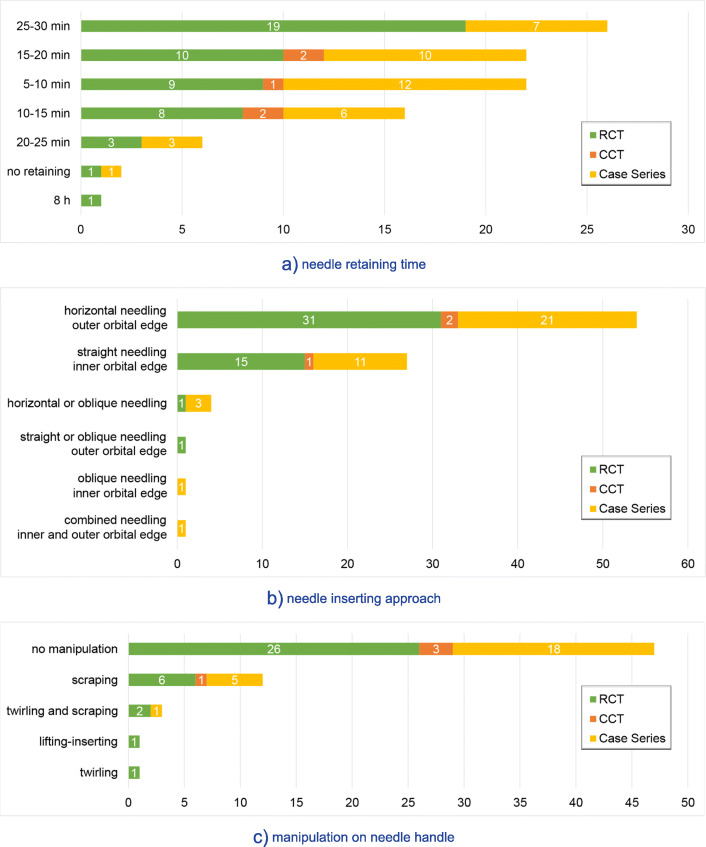
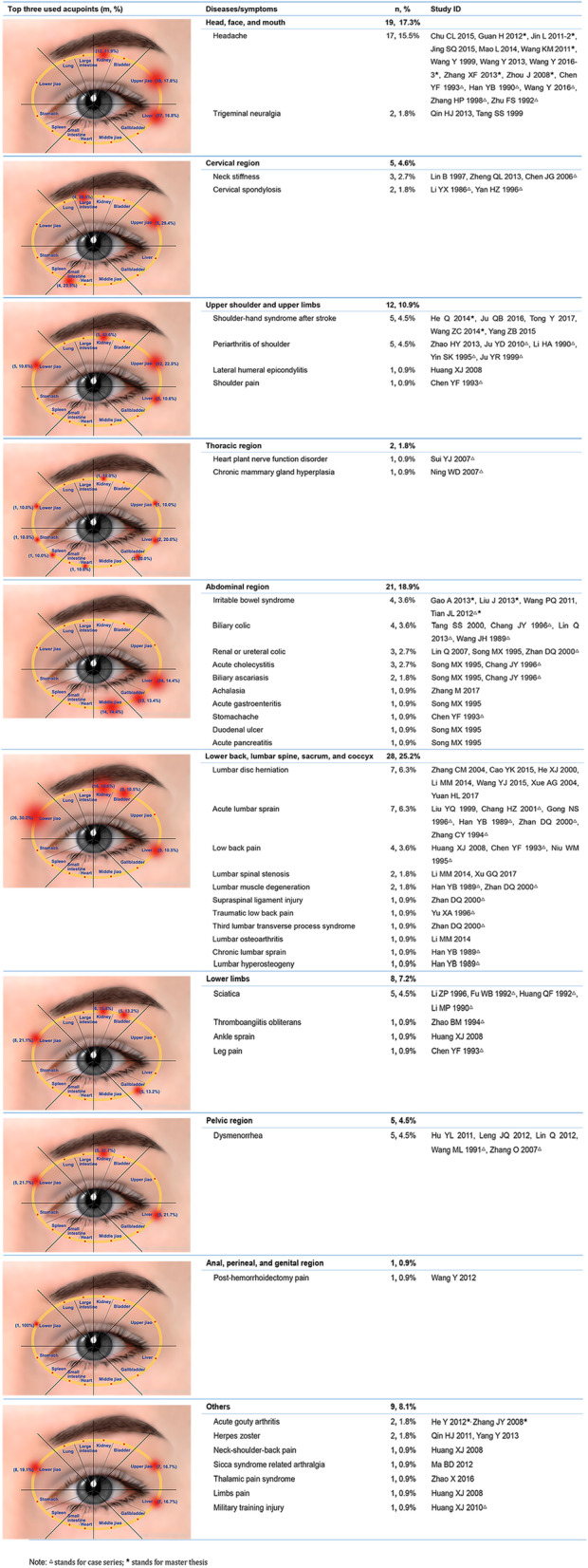
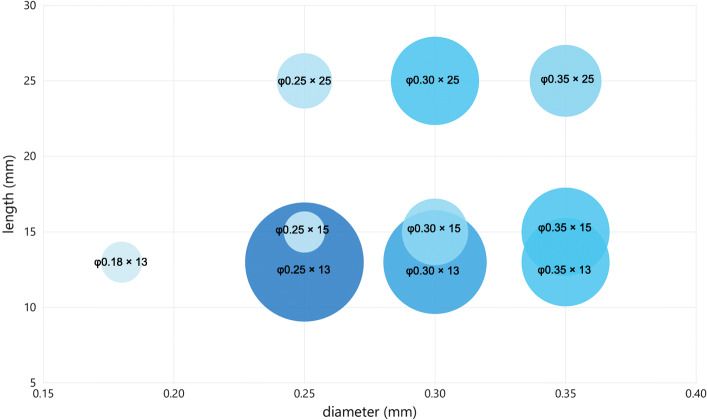
Searches identified 81 clinical studies and a trend demonstrating an increasing number of published studies. All studies were conducted in China and published in Chinese. These included, 45 (55.6%) RCTs, 5 (6.2%) CCTs, and 31 (38.3%) case series, treating 7113 patients with 44 different pain-related diseases or symptoms. The most frequently reported conditions were headache (18, 16.2%), acute lumbar pain (7, 6.3%) and lumbar disc herniation (7, 6.3%). Treatment using small needles (φ0.25 × 13 mm), retained ≤30 min, needling the horizontal outer orbital edge and the avoidance of manipulation during treatment were the most frequent descriptions of the interventions used. Eye acupuncture was used alone in about half of the studies and of the remaining studies it was combined with other treatment. All studies suggested some beneficial effects including: pain relief, improved quality of life and mental health, and 18 (22.2%) adverse events.
Eye acupuncture, predominantly studied in China, may be a promising intervention for managing diverse pain conditions. However, given the variety of study designs and reported treatment outcomes, conclusions about the evidence for eye acupuncture for specific conditions are not possible at this stage.
中国眼针疗法,通过在眼眶周围进行针刺刺激来治疗各种疾病。自 1970 年以来,它已在中国用于治疗与疼痛相关的疾病。本系统评价综述系统地收集了关于眼针治疗疼痛疾病的临床研究,并确定任何不良反应。
从 1970 年至 2019 年 3 月,检索了 PubMed、Cochrane 图书馆、中国知网、维普、万方数据和中国生物医学文献服务系统六个数据库。纳入符合纳入标准的眼针治疗疼痛疾病的随机对照试验(RCT)、临床对照试验(CCT)和病例系列研究。提取患者、干预措施、眼针细节、对照治疗和结局数据。
检索到 81 项临床研究,研究数量呈上升趋势。所有研究均在中国进行,发表于中文期刊。其中包括 45 项(55.6%)RCT、5 项(6.2%)CCT 和 31 项(38.3%)病例系列研究,共治疗了 7113 例 44 种不同的疼痛相关疾病或症状的患者。报告最多的疾病为头痛(18 项,16.2%)、急性腰痛(7 项,6.3%)和腰椎间盘突出症(7 项,6.3%)。最常报道的干预措施包括使用小针(φ0.25×13mm)、留针时间≤30min、针刺水平眶外缘和治疗期间避免运针。大约一半的研究单独使用眼针,其余研究则与其他治疗联合使用。所有研究均提示眼针具有一定的疗效,包括减轻疼痛、改善生活质量和心理健康,有 18 项(22.2%)不良事件。
眼针疗法主要在中国进行研究,可能是治疗各种疼痛疾病的一种有前途的干预措施。然而,鉴于研究设计和报告的治疗结局的多样性,现阶段还无法得出关于眼针对特定疾病的证据的结论。