Clinical Psychology Department, Ruppin Academic Center, Emek Hefer, Israel.
The Falk Institute for Mental Health Studies, Kfar Shaul Hospital, Jerusalem, Israel.
Isr J Health Policy Res. 2021 Mar 23;10(1):27. doi: 10.1186/s13584-021-00454-0.
Suicide rates among Ethiopian immigrants to Israel (EI) are relatively high. This study sought to identify suicide-risk factors in this population in order to suggest some potentially preventive measures to mental health policymakers who are struggling to prevent suicide among EI.
Nationwide age-adjusted suicide rates were calculated for EI, Former Soviet Union immigrants (FSUI) and Israeli-born (IB) Jews by age, gender, and year of death and, for EI, by marital status and immigration period in the years 1985-2017 (1990-2017 for FSUI).
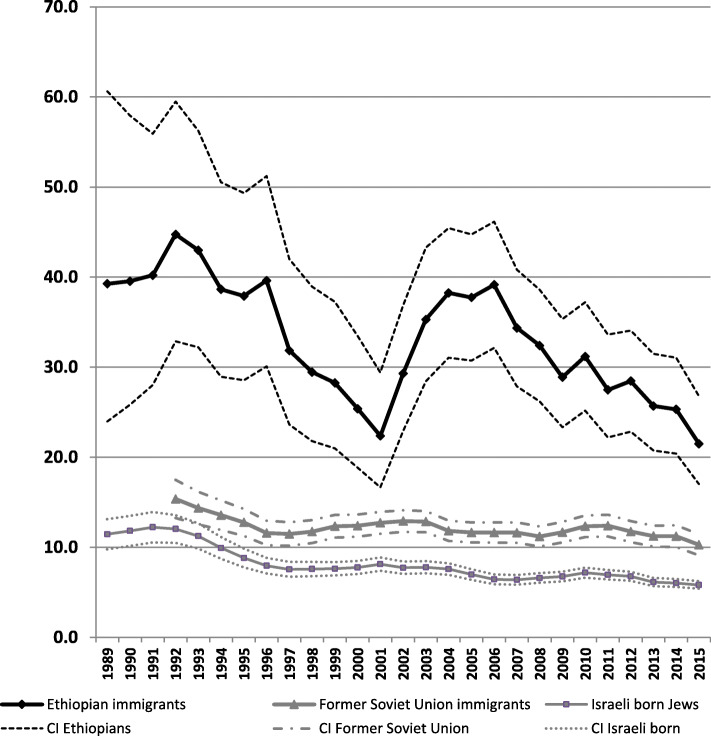
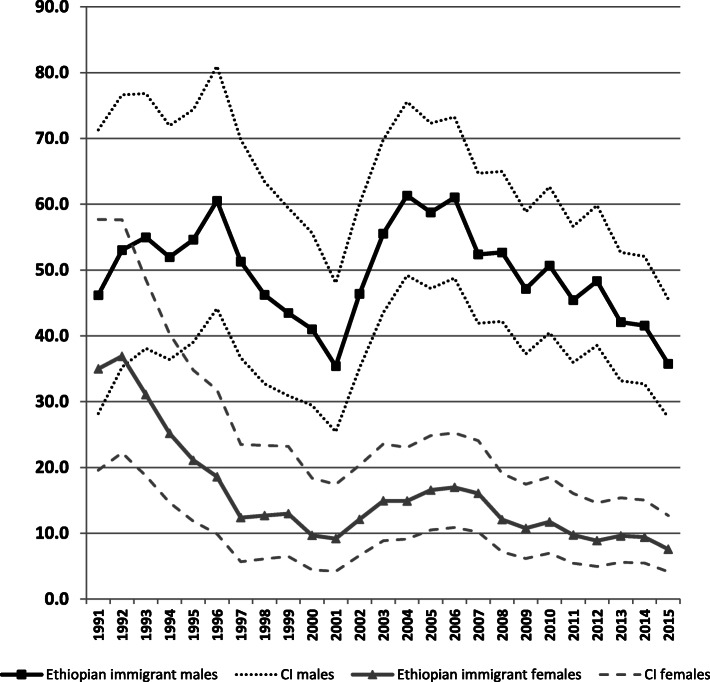
Age-adjusted suicide rates for the period 1990-2017 confirmed the significantly higher rate among EI--3.1 times higher than for FSUI and 4.1 times higher than for IB. Similar rates were obtained for both genders, within each age group, and in all study years. Comparable male/female rate ratios were found among EI and IB (3.3, 3.6, respectively). Over the years of the study, only among the Ethiopian immigrants were there large fluctuations in suicide rates: a decrease (1992-2001), followed by an increase (2001-2006), and then a progressive decrease (from 2006). The secular changes differed greatly according to age. Among females, these fluctuations were smaller, the decrease began earlier and was greater, and the subsequent increase was much smaller. Marriage was found to be less protective for Ethiopian immigrants than for the other surveyed populations.
The considerable gap between the EI's and FSUI's suicide rates highlights the critical role of immigrants' integration difficulties. These difficulties among EI lead to ongoing conflict within the family, which may explain why marriage is less protective for EI. Nevertheless, progressive integration is occurring as indicated by the decline in suicide rates since 2006. The fluctuations in EI suicide rates over time seem to be associated with modifications in social welfare allowances, which are crucial for EI of low socioeconomic status. Groups at risk, particularly EI men facing socioeconomic challenges and EI with considerable family conflict, typically identified by HMOs and welfare services, should be screened for suicide risk, and those identified as at risk referred to tailored workshops sensitive to Ethiopian culture.
在以色列的埃塞俄比亚移民(EI)中,自杀率相对较高。本研究旨在确定该人群中的自杀风险因素,以便向那些正在努力预防 EI 自杀的心理健康政策制定者提出一些潜在的预防措施。
按年龄、性别和死亡年份计算了 1985-2017 年(FSUI 为 1990-2017 年)期间 EI、前苏联移民(FSUI)和以色列出生(IB)犹太人的年龄调整后自杀率,并按婚姻状况和移民时期计算了 EI 的自杀率。
1990-2017 年期间的年龄调整后自杀率证实,EI 的自杀率明显较高,是 FSUI 的 3.1 倍,是 IB 的 4.1 倍。在每个年龄组和所有研究年份中,男女两性的自杀率都相似。在 EI 和 IB 中,男女两性的比率相似(分别为 3.3、3.6)。在研究期间,只有埃塞俄比亚移民的自杀率出现了大幅波动:从 1992-2001 年下降,然后从 2001-2006 年上升,随后从 2006 年开始逐渐下降。这种长期变化在不同年龄段有很大差异。在女性中,这些波动较小,下降开始较早且幅度较大,随后的上升幅度较小。婚姻对埃塞俄比亚移民的保护作用不如其他被调查人群。
EI 和 FSUI 之间相当大的自杀率差距突出了移民融入困难的关键作用。EI 移民的这些困难导致家庭内部持续存在冲突,这可能解释了为什么婚姻对 EI 的保护作用较小。然而,自 2006 年以来,自杀率的下降表明,渐进式的融入正在发生。EI 自杀率随时间的波动似乎与社会福利津贴的调整有关,这对社会经济地位较低的 EI 移民至关重要。高危人群,特别是面临社会经济挑战的 EI 男性和存在严重家庭冲突的 EI 移民,通常会被 HMO 和福利服务机构识别出来,需要对他们进行自杀风险筛查,并将那些被识别为高危的人转介到针对埃塞俄比亚文化的定制工作坊。