Bacigalupe Amaia, Cabezas-Rodríguez Andrea, Giné-March Anna, Jiménez Carrillo Marta
Departamento de Sociología y Trabajo Social, Universidad del País Vasco UPV/EHU, Leioa (Bizkaia), España; Grupo de Investigación en Determinantes Sociales de la Salud y Cambio Demográfico-OPIK, Leoia (Bizkaia), España.
Departamento de Sociología y Trabajo Social, Universidad del País Vasco UPV/EHU, Leioa (Bizkaia), España; Grupo de Investigación en Determinantes Sociales de la Salud y Cambio Demográfico-OPIK, Leoia (Bizkaia), España.
Gac Sanit. 2022 Mar-Apr;36(2):156-159. doi: 10.1016/j.gaceta.2021.02.005. Epub 2021 Feb 23.
To analyse the gender composition of the advisory boards created for the management and policy decision-making during the COVID-19 pandemic in Spain.
A peer review was carried out to identify the advisory boards involved in the management of COVID-19 in the autonomous regions and in Spain. Name, number of members, sex and sources of information were collected, and the percentage of women was calculated.
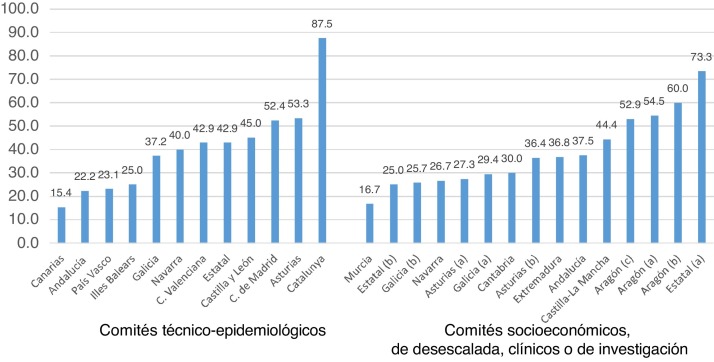
At the regional level, the composition of eleven advisory boards was identified, with a mean representation of women of 39.2%; 42.9% at the national level. 75% of all boards represented women below the parity threshold.
There is a significant under-representation of women in the advisory boards for the COVID-19 management, which may limit a necessary feminist perspective for the crisis recovery.
分析西班牙在新冠疫情期间为管理和政策决策设立的咨询委员会的性别构成。
进行同行评审,以确定自治区和西班牙参与新冠疫情管理的咨询委员会。收集了委员会名称、成员数量、性别和信息来源,并计算了女性所占百分比。
在地区层面,确定了11个咨询委员会的构成,女性平均占比为39.2%;在国家层面为42.9%。所有委员会中有75%的女性占比未达到平等阈值。
在新冠疫情管理咨询委员会中,女性代表比例明显不足,这可能会限制危机恢复过程中必要的女性主义视角。