Lun Ronda, Yogendrakumar Vignan, Ramsay Tim, Shamy Michel, Fahed Robert, Selim Magdy H, Dowlatshahi Dar
Department of Medicine, Division of Neurology, Stroke Program, Ottawa Hospital, Ottawa, Ontario, Canada
Clinical Epidemiology Program, School of Epidemiology, Public Health and Preventative Medicine, Ottawa Hospital Research Institute, Ottawa University, Ottawa, Ontario, Canada.
Stroke Vasc Neurol. 2021 Dec;6(4):536-541. doi: 10.1136/svn-2020-000656. Epub 2021 Mar 23.
The concept of the 'self-fulfilling prophecy' is well established in intracerebral haemorrhage (ICH). The ability to improve prognostication and prediction of long-term outcomes during the first days of hospitalisation is important in guiding conversations around goals of care. We previously demonstrated that incorporating delayed imaging into various prognostication scores for ICH improves the predictive accuracy of 90-day mortality. However, delayed prognostication scores have not been used to predict long-term functional outcomes beyond 90 days.
DESIGN, SETTING AND PARTICIPANTS: We analysed data from the ICH Deferoxamine trial to see if delaying the use of prognostication scores to 96 hours after ICH onset will improve performance to predict outcomes at 180 days. 276 patients were included.
We calculated the original ICH score (oICH), modified-ICH score (MICH), max-ICH score and the FUNC score on presentation (baseline), and on day 4 (delayed). Outcomes assessed were mortality and poor functional outcome in survivors (defined as modified Rankin Scale of 4-5) at 180 days. We generated receiver operating characteristic curves, and measured the area under the curve values (AUC) for mortality and functional outcome. We compared baseline and delayed AUCs with non-parametric methods.
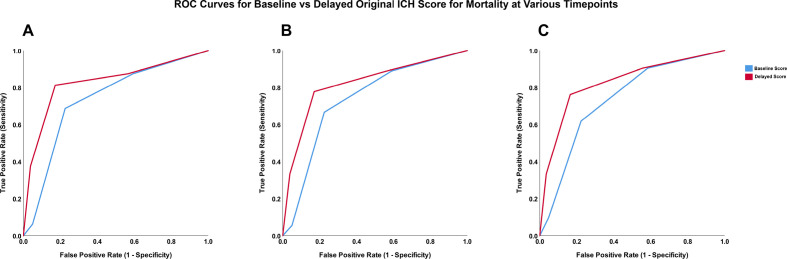
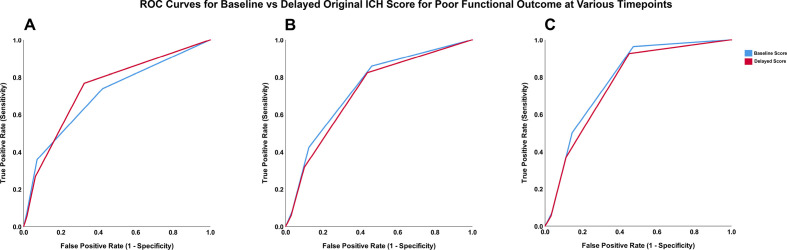
At 180 days, 21 of 276 (7.6%) died. Out of the survivors, 54 of 255 had poor functional outcome (21.2%). The oICH, MICH and max-ICH performed significantly better at predicting 180-day mortality when calculated 4 days later compared with their baseline equivalents ((0.74 vs 0.83, p=0.005), (0.73 vs 0.80, p=0.036), (0.74 vs 0.83, p=0.008), respectively). The delayed calculation of these scores did not significantly improve our accuracy for predicting poor functional outcomes.
Delaying the calculation of prognostication scores in acute ICH until day 4 improved prediction of 6-month mortality but not functional outcomes.
ClinicalTrials.gov Registry (NCT02175225).
“自我实现预言”的概念在脑出血(ICH)中已得到充分确立。在住院的头几天提高对长期预后的预测能力对于围绕治疗目标的沟通指导很重要。我们之前证明,将延迟成像纳入各种ICH预后评分可提高90天死亡率的预测准确性。然而,延迟预后评分尚未用于预测90天以上的长期功能结局。
设计、背景和参与者:我们分析了ICH去铁胺试验的数据,以了解将预后评分的使用延迟至ICH发病后96小时是否会提高预测180天结局的性能。纳入了276名患者。
我们在就诊时(基线)和第4天(延迟)计算了原始ICH评分(oICH)、改良ICH评分(MICH)、最大ICH评分和FUNC评分。评估的结局是180天时的死亡率和幸存者的不良功能结局(定义为改良Rankin量表评分为4 - 5分)。我们生成了受试者工作特征曲线,并测量了死亡率和功能结局的曲线下面积值(AUC)。我们使用非参数方法比较了基线和延迟的AUC。
在180天时,276名患者中有21名(7.6%)死亡。在幸存者中,255名中有54名功能结局不良(21.2%)。与基线时相比,在第4天计算时,oICH、MICH和最大ICH评分在预测180天死亡率方面表现明显更好(分别为(0.74对0.83,p = 0.005)、(0.73对0.80,p = 0.036)、(0.74对0.83,p = 0.008))。这些评分的延迟计算并未显著提高我们预测不良功能结局的准确性。
将急性ICH预后评分的计算延迟至第4天可改善6个月死亡率的预测,但不能改善功能结局。
ClinicalTrials.gov注册库(NCT02175225)。