Department of Gastric Surgery, Cancer Hospital of China Medical University, Liaoning Cancer Hospital and Institute, Shenyang, Liaoning, China (mainland).
Med Sci Monit. 2021 Mar 24;27:e929558. doi: 10.12659/MSM.929558.
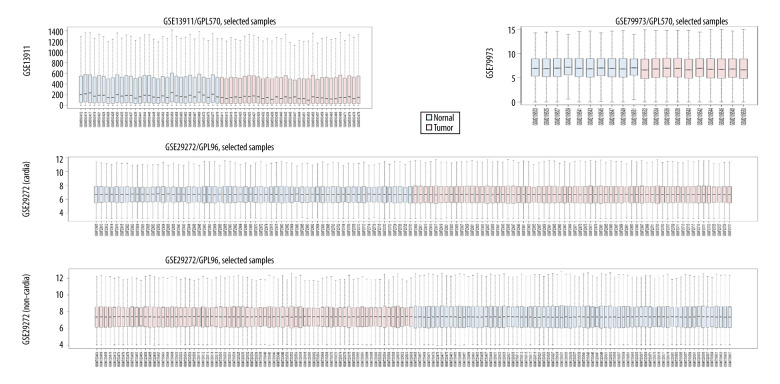
BACKGROUND Gastric cancer is the most common gastrointestinal tumor, and the rates of recurrence and metastasis are high. Research results on molecular biomarkers used for prognosis of gastric cancer remain inconclusive. This study aimed to explore the gene expression module of gastric cancer and to determine potential prognostic biomarkers. MATERIAL AND METHODS Three microarray datasets (GSE13911, GSE79973, and GSE29272) from Gene Expression Omnibus (GEO), including 206 pairs of gastric tumors and adjacent normal samples, were used for analysis of differentially expressed genes (DEGs). The 3 microarray datasets yielded 144 genes associated with the progression and prognosis of gastric cancer. After this, a risk score model was developed for result validation using an independent dataset from The Cancer Genome Atlas. RESULTS The validation of the independent dataset showed significantly increased NID2, SPARC, and MFAP2 expression in gastric tumor tissues, which were associated with poor outcomes in gastric cancer patients. Moreover, the high risk score obtained was associated with poor overall survival (HR: 1.787; 1.069-2.986; P=0.027). Subgroup analyses revealed that these significant prognostic values were detected in patients aged <65.0 years, tumors in the antrum/distal colon, grade 3 tumors, or TNM-M0 stages of cancer. CONCLUSIONS The findings of this study show that NID2, SPARC, and MFAP2 are upregulated in gastric tumor tissues and are significantly associated with poor overall survival. Therefore, the predictive values of the risk score model employed for the prognosis of gastric cancer could be improved by using these 3 upregulated DEGs.
胃癌是最常见的胃肠道肿瘤,其复发和转移率较高。用于预测胃癌的分子生物标志物的研究结果仍存在争议。本研究旨在探索胃癌的基因表达模块,并确定潜在的预后生物标志物。
从基因表达综合数据库(GEO)中使用三个微阵列数据集(GSE13911、GSE79973 和 GSE29272),包括 206 对胃癌肿瘤和相邻正常样本,分析差异表达基因(DEGs)。这三个微阵列数据集产生了 144 个与胃癌进展和预后相关的基因。之后,使用来自癌症基因组图谱(TCGA)的独立数据集开发风险评分模型进行结果验证。
独立数据集的验证表明,在胃癌肿瘤组织中 NID2、SPARC 和 MFAP2 的表达显著增加,与胃癌患者的不良预后相关。此外,获得的高风险评分与总体生存率差相关(HR:1.787;1.069-2.986;P=0.027)。亚组分析表明,这些显著的预后价值在年龄<65.0 岁、肿瘤位于胃窦/远端结肠、3 级肿瘤或癌症 TNM-M0 分期的患者中检测到。
本研究的结果表明,NID2、SPARC 和 MFAP2 在胃癌肿瘤组织中上调,并与总体生存率显著相关。因此,通过使用这 3 个上调的 DEGs,风险评分模型对胃癌预后的预测值可以得到改善。