Nanoscience Department, Institute of Basic and Applied Sciences, Egypt-Japan University of Science and Technology, New Borg El-Arab City, Alexandria, 21934, Egypt.
Environment and Natural Materials Research Institute (ENMRI), City of Scientific Research and Technological Applications (SRTA-City), New Borg El-Arab City, Alexandria, 21934, Egypt.
Sci Rep. 2021 Mar 23;11(1):6619. doi: 10.1038/s41598-021-86140-2.
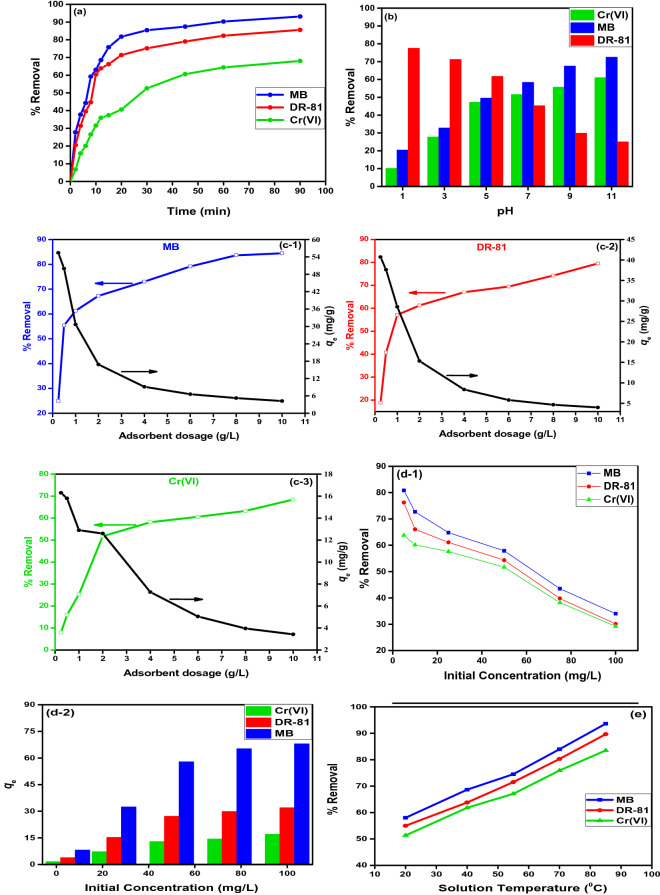
This reported work aims to fabricate an eco-friendly Zr bio-based MOF and assessment its adsorption efficiency towards the cationic and anionic dye pollutants including methylene blue (MB) and direct red 81 (DR-81), respectively. Also, its adsorption tendency for the highly toxic heavy metal of hexavalent chromium (Cr(VI)) was compared with dyes. The adsorption performance of bio-MOF showed that the maximum monolayer adsorption capacities were recorded as 79.799 mg/g for MB, 36.071 mg/g for DR-81, and 19.012 mg/g for Cr(VI). Meanwhile, the optimum dosage of as-synthesized MIP-202 bio-MOF was 0.5, 1, and 2 g L for MB, DR-81, and Cr(VI), respectively. Thermodynamic analysis demonstrated the spontaneous, thermodynamically, and endothermic nature of the decontamination processes onto the fabricated Zr bio-based MOF. The adsorption data were fitted by Langmuir isotherm model compared with Freundlich and Temkin models for all studied water pollutants. Pseudo-second-order kinetic model was a fit model for description of the adsorption kinetics of the different cationic and anionic pollutants onto Zr bio-based MOF. These outcomes indicated that Zr bio-based MOF has potential application for adsorption of different types of industrial water pollutants including cationic and anionic dyes and heavy metals.
本研究旨在制备一种环保型 Zr 生物基 MOF,并评估其对阳离子和阴离子染料污染物(包括亚甲基蓝(MB)和直接红 81(DR-81))的吸附效率。此外,还比较了其对六价铬(Cr(VI))这种高毒性重金属的吸附倾向与染料的情况。生物 MOF 的吸附性能表明,其对 MB、DR-81 和 Cr(VI)的最大单层吸附容量分别为 79.799、36.071 和 19.012 mg/g。同时,合成的 MIP-202 生物 MOF 的最佳剂量分别为 0.5、1 和 2 g/L,用于 MB、DR-81 和 Cr(VI)。热力学分析表明,制备的 Zr 生物基 MOF 对各种水污染物的去除过程是自发的、热力学的和吸热的。吸附数据符合 Langmuir 等温线模型,与 Freundlich 和 Temkin 模型相比,更适合描述所有研究的水污染物的吸附动力学。准二级动力学模型是描述不同阳离子和阴离子污染物在 Zr 生物基 MOF 上吸附动力学的拟合模型。这些结果表明,Zr 生物基 MOF 具有应用于吸附不同类型工业水污染物(包括阳离子和阴离子染料以及重金属)的潜力。