Agronomy Department, Faculty of Agriculture, Benha University, Benha 13511, Egypt.
Department of Pharmacy, Faculty of Pharmacy, The University of Mashreq, Baghdad 10023, Iraq.
Molecules. 2022 Sep 1;27(17):5640. doi: 10.3390/molecules27175640.
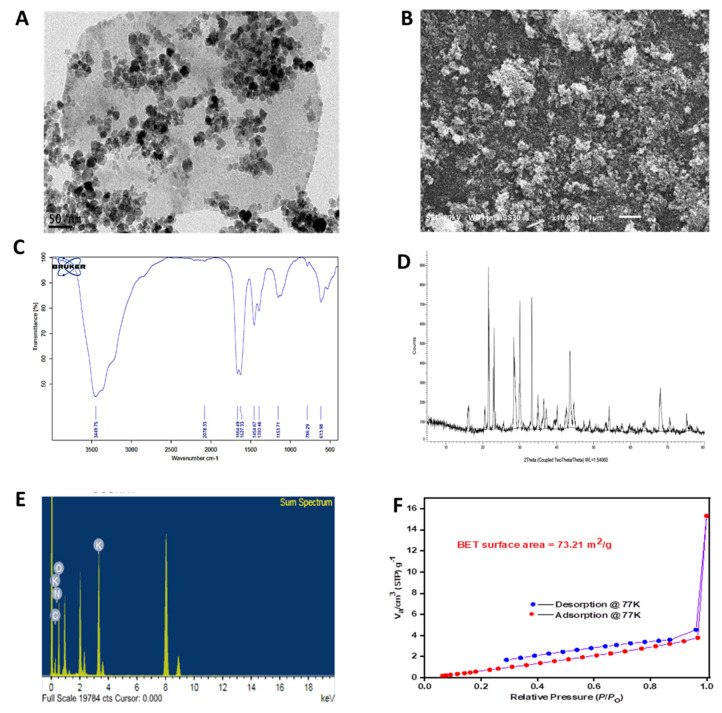
Waste from crustaceans has adverse effects on the environment. In this respect, shrimp waste was valorized for producing chitosan nanoparticles as a source for eco-friendly nano-nitrogen fertilizer. The application of nano-nitrogen fertilizers is a valuable alternative approach in agriculture due to its potential for reducing the application of mineral nitrogen fertilizers and increasing yield quality and quantity, thereby helping to reduce the worldwide food shortage. Chitosan nanoparticles were foliar sprayed at three volumes (0, 7, and 14 L/ha) and compared with mineral nitrogen fertilizer (M-N) sprayed at three volumes (0, 120, and 240 kg N/ha) and their combination on two wheat cultivars (Misr-1 and Gemaiza-11) during two consecutive seasons (2019/2020 and 2020/2021) in order to evaluate the agronomic response. The synthesized chitosan nanoparticles displayed characteristic bands of both Nan-N and urea/chitosan from 500-4000 cm. They are stable and have a huge surface area of 73.21 m g. The results revealed significant differences among wheat cultivars, fertilization applications, individual or combined, and their interactions for yield-contributing traits. Foliar application of nano-nitrogen fertilizer at 14 L/ha combined with mineral fertilizer at 240 kg/ha significantly increased total chlorophyll content by 41 and 31% compared to control; concerning plant height, the two cultivars recorded the tallest plants (86.2 and 86.5 cm) compared to control. On the other hand, the heaviest 1000-grain weight (55.8 and 57.4 g) was recorded with treatment of 120 kg Mn-N and 14 L Nan-N/ha compared to the control (47.6 and 45.5 g). The Misr-1 cultivar achieved the highest values for grain yield and nitrogen (1.30 and 1.91 mg/L) and potassium (9.87 and 9.81 mg/L) in the two studied seasons when foliarly sprayed with the combination of 120 kg Mn-N/ha + 14 L Nan-N/ha compared to the Gemaiza-11 cultivar. It can be concluded that Misr-1 exhibited higher levels of total chlorophyll content, spike length, 100-grain weight, grain yield in kg/ha, and nitrogen and potassium. However, Gemaiza-11 displayed higher biomass and straw yield values, plant height, and sodium concentration values. It could be economically recommended to use the application of 120 kg Mn-N/ha + 14 L Nan-N/ha on the Misr-1 cultivar to achieve the highest crop yield.
甲壳类动物废物对环境有不良影响。在这方面,虾废物被增值为生产壳聚糖纳米粒子,作为环保纳米氮肥的来源。纳米氮肥的应用是农业中一种有价值的替代方法,因为它有可能减少矿物氮肥的应用,提高产量的质量和数量,从而有助于减少全球粮食短缺。壳聚糖纳米粒子以三种体积(0、7 和 14 L/ha)叶面喷施,并与三种体积(0、120 和 240 kg N/ha)的矿物氮肥(M-N)和它们的组合进行比较在两个小麦品种(Misr-1 和 Gemaiza-11)上连续两个季节(2019/2020 和 2020/2021),以评估农艺响应。合成的壳聚糖纳米粒子在 500-4000 cm 处显示出纳米-N 和尿素/壳聚糖的特征带。它们是稳定的,具有巨大的表面积为 73.21 m g。结果表明,小麦品种、施肥应用、单独或组合以及它们的相互作用对产量贡献性状有显著差异。叶面喷施纳米氮肥 14 L/ha 与矿物肥 240 kg/ha 结合,与对照相比,总叶绿素含量分别显著增加 41%和 31%;就株高而言,两个品种的植株最高(86.2 和 86.5 cm),高于对照。另一方面,用 120 kg Mn-N 和 14 L Nan-N/ha 处理,1000 粒重最重(55.8 和 57.4 g),高于对照(47.6 和 45.5 g)。在两个研究季节中,叶面喷施 120 kg Mn-N/ha + 14 L Nan-N/ha 组合时,Misr-1 品种的籽粒产量和氮(1.30 和 1.91 mg/L)和钾(9.87 和 9.81 mg/L)最高。可以得出结论,Misr-1 表现出更高水平的总叶绿素含量、穗长、百粒重、公顷产量和氮、钾。然而,Gemaiza-11 表现出更高的生物量和秸秆产量、株高和钠浓度值。经济上可以推荐在 Misr-1 品种上使用 120 kg Mn-N/ha + 14 L Nan-N/ha 的应用,以达到最高的作物产量。