Amiri Arshia
Department of Nursing Science, University of Turku, Turku, Finland.
School of Health and Social Studies, JAMK University of Applied Sciences, Jyväskylä, Finland.
Int J Nurs Sci. 2021 Apr 10;8(2):145-151. doi: 10.1016/j.ijnss.2021.03.010. Epub 2021 Mar 19.
To measure the effect of social distancing on reducing daily deaths, infections and hospital resources needed for coronavirus disease 2019 (COVID-19) patients during the first wave of the pandemic in Nordic countries.
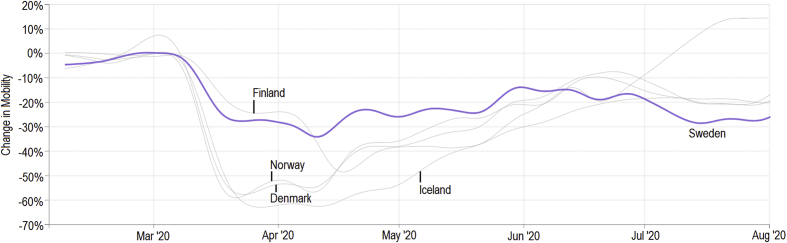
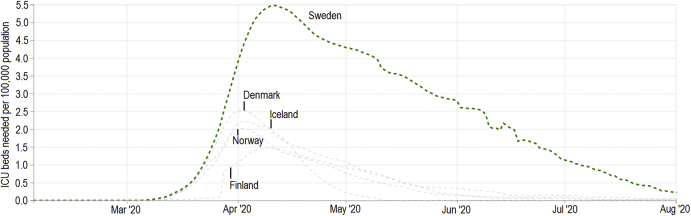
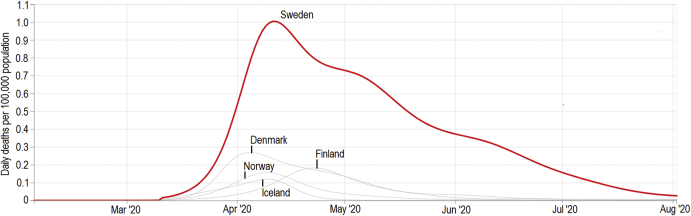
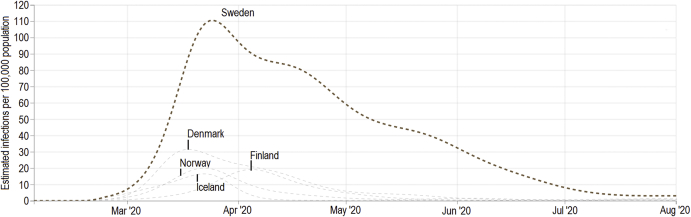
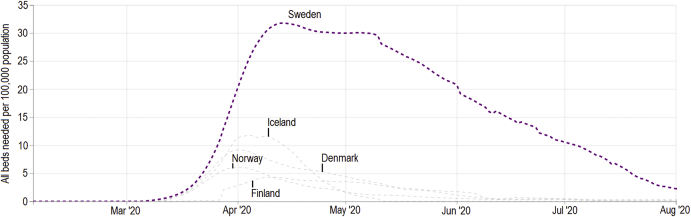
The observations of social distancing, daily deaths, infections along with the needed hospital resources for COVID-19 patient hospitalizations including the numbers of all hospital beds, beds needed in ICUs and infection wards, nursing staffs needed in ICUs and infection wards were collected from the Institute for Health Metrics and Evaluation (IHME) by the University of Washington. The observations of social distancing were based on the reduction in human contact relative to background levels for each location quantified by cell phone mobility data collected from IHME. The weighted data per 100,000 population gathered in a 40-day period of the first wave of the pandemic in Denmark, Finland, Iceland, Norway and Sweden. Statistical technique of panel data analysis is used to measure the associations between social distancing and COVID-19 indicators in long-run.
Results of dynamic long-run models confirm that a 1% rise in social distancing by reducing human contacts may decline daily deaths, daily infections, all hospital beds needed, beds/nurses needed in ICUs and beds/nurses needed in infection wards due COVID-19 pandemic by 1.13%, 15.26%, 1.10%, 1.17% and 1.89%, respectively. Moreover, results of error correction models verify that if the equilibriums between these series are disrupted by a sudden change in social distancing, the lengths of restoring back to equilibrium are 67, 62, 40, 22 and 49 days for daily deaths, daily infections, all hospital beds needed, nurses/beds needed in ICUs and nurses/beds needed in infection wards, respectively.
Proper social distancing was a successful policy for tackling COVID-19 with falling mortality and infection rates as well as the needed hospital resources for patient hospitalizations in Nordic countries. The results alert governments of the need for continuously implementing social distancing policies while using vaccines to prevent national lockdowns and reduce the burden of patient hospitalizations.
评估在北欧国家新冠疫情第一波期间,社交距离措施对减少2019冠状病毒病(COVID-19)每日死亡人数、感染人数以及所需医院资源的影响。
华盛顿大学从健康指标与评估研究所(IHME)收集了社交距离、每日死亡人数、感染人数以及COVID-19患者住院所需医院资源的观测数据,包括所有医院病床数量、重症监护病房(ICU)和感染病房所需病床数量、ICU和感染病房所需护理人员数量。社交距离的观测基于通过从IHME收集的手机移动数据量化的每个地点相对于背景水平的人际接触减少情况。收集了丹麦、芬兰、冰岛、挪威和瑞典在疫情第一波40天期间每10万人口的加权数据。采用面板数据分析的统计技术来长期衡量社交距离与COVID-19指标之间的关联。
动态长期模型的结果证实,通过减少人际接触使社交距离增加1%,可能会使因COVID-19大流行导致的每日死亡人数、每日感染人数、所需医院病床总数、ICU所需病床/护士数量以及感染病房所需病床/护士数量分别下降1.13%、15.26%、1.10%、1.17%和1.89%。此外,误差修正模型的结果表明,如果这些序列之间的平衡因社交距离的突然变化而被打破,每日死亡人数、每日感染人数、所需医院病床总数、ICU所需护士/病床数量以及感染病房所需护士/病床数量恢复到平衡的时间分别为67天、62天、40天、22天和49天。
在北欧国家,适当的社交距离措施是应对COVID-19的一项成功政策,可降低死亡率和感染率,以及减少患者住院所需的医院资源。研究结果提醒各国政府,在使用疫苗预防全国封锁并减轻患者住院负担的同时,需要持续实施社交距离政策。