The Generation R Study Group, Erasmus MC, University Medical Center, Rotterdam, The Netherlands.
Department of Pediatrics, Erasmus MC, University Medical Center, Rotterdam, The Netherlands.
J Nutr. 2021 Jul 1;151(7):1965-1975. doi: 10.1093/jn/nxab047.
Higher maternal cow-milk intake during pregnancy is associated with higher fetal growth measures and higher birth weight.
The aim of this study was to assess the associations of maternal milk intake during pregnancy with body fat measures and cardiometabolic risk factors at the age of 10 y.
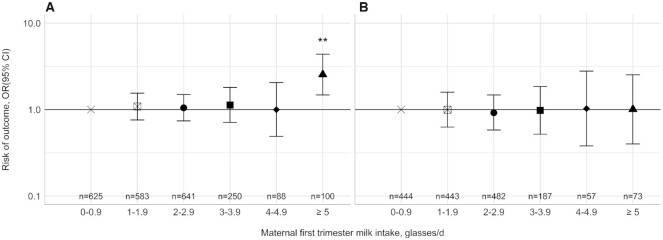
In a population-based cohort of Dutch mothers and their children (n = 2466) followed from early pregnancy onwards, we assessed maternal first-trimester milk intake (milk and milk drinks) by food-frequency questionnaire. Maternal milk intake was categorized into 0-0.9, 1-1.9, 2-2.9, 3-3.9, 4-4.9, and ≥5 glasses/d, with 1 glass equivalent to 150 mL milk. For children at the age of 10 y, we calculated BMI and obtained detailed measures of body and organ fat by DXA and MRI. We also measured blood pressure and lipid, insulin, and glucose concentrations. Data were analyzed using linear and logistic regression models.
Compared with children whose mothers consumed 0-0.9 glass of milk/d during their pregnancy, those whose mothers consumed ≥5 glasses of milk/d had a 0.29 SD (95% CI: 0.10, 0.48) higher BMI, 0.27 SD (95% CI: 0.08, 0.47) higher fat mass, 0.26 SD (95% CI: 0.07, 0.46) higher lean mass, 0.30 SD (95% CI: 0.09, 0.50) higher android-to-gynoid fat mass ratio and 0.38 SD (95% CI: 0.09, 0.67) higher abdominal visceral fat mass. After correction for multiple comparisons, groups of maternal milk intake were not associated with pericardial fat mass index, liver fat fraction, blood pressure, or lipid, insulin, or glucose concentrations (P values >0.0125).
Our results suggest that maternal first-trimester milk intake is positively associated with childhood general and abdominal visceral fat mass and lean mass, but not with other cardiometabolic risk factors.
孕期母亲摄入较高的牛奶与胎儿生长指标和出生体重增加有关。
本研究旨在评估孕期母亲的牛奶摄入量与 10 岁时体脂肪测量值和心血管代谢危险因素之间的相关性。
在一项基于人群的荷兰母亲及其子女队列研究中(n=2466),我们通过食物频率问卷评估了母亲在妊娠早期的牛奶摄入量(牛奶和奶制品)。将母亲的牛奶摄入量分为 0-0.9、1-1.9、2-2.9、3-3.9、4-4.9 和≥5 杯/天,其中 1 杯相当于 150 mL 牛奶。对于 10 岁的儿童,我们通过 DXA 和 MRI 计算 BMI,并获得详细的体脂肪和器官脂肪测量值。我们还测量了血压和血脂、胰岛素和血糖浓度。使用线性和逻辑回归模型进行数据分析。
与孕期母亲摄入 0-0.9 杯牛奶/天的儿童相比,孕期母亲摄入≥5 杯牛奶/天的儿童 BMI 高 0.29 SD(95%CI:0.10,0.48),体脂质量高 0.27 SD(95%CI:0.08,0.47),瘦体质高 0.26 SD(95%CI:0.07,0.46),男性脂肪质量与女性脂肪质量比高 0.30 SD(95%CI:0.09,0.50),腹部内脏脂肪质量高 0.38 SD(95%CI:0.09,0.67)。经多次比较校正后,母亲牛奶摄入量组与心包脂肪质量指数、肝脂肪分数、血压或血脂、胰岛素或血糖浓度均无相关性(P 值>0.0125)。
我们的研究结果表明,孕期母亲的牛奶摄入量与儿童的全身和腹部内脏脂肪质量和瘦体质呈正相关,但与其他心血管代谢危险因素无关。