Department of Epidemiology, Erasmus MC, 3000 CA Rotterdam, The Netherlands.
Department of Obstetrics and Gynecology, 3000 CA Erasmus MC, Rotterdam, The Netherlands.
Nutrients. 2020 May 8;12(5):1341. doi: 10.3390/nu12051341.
We aimed to validate a food-frequency questionnaire (FFQ) for Dutch pregnant women, against three 24 h-recalls and blood concentrations of B-vitamins and fatty acids, using the method of triads.
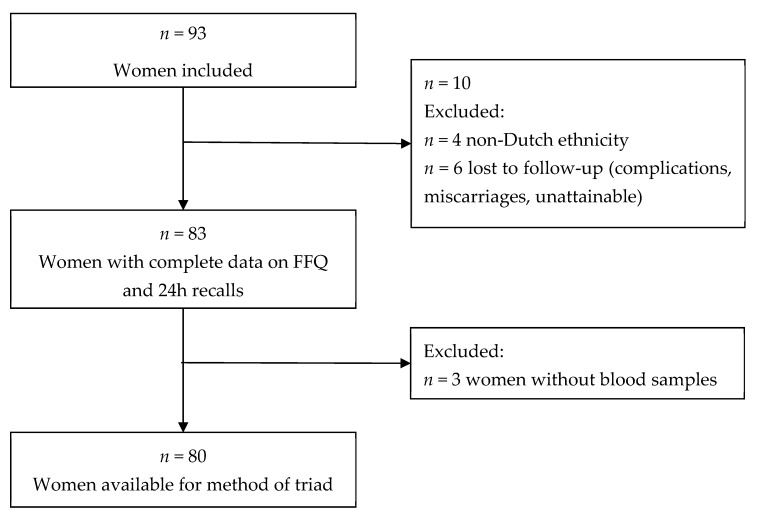
We included 83 pregnant women from the general population of Rotterdam, the Netherlands, at a median gestational age of 15.6 weeks. Participants completed three non-consecutive 24 h-recalls, and subsequently filled out the 293-item FFQ. Participants provided blood samples from which we analyzed serum folate and vitamin B12, as well as red blood cell folate, linoleic acid, and total saturated, monounsaturated, and polyunsaturated fatty acids.
Estimated energy intake did not differ between the FFQ and 24 h-recalls. Deattenuated Pearson's correlation coefficients, between energy-adjusted nutrient intake estimates from the FFQ and the 24 h-recalls, ranged from 0.41 (fat) to 0.88 (fiber) for macronutrients, and were around 0.6 for most micronutrients, except for vitamin E (0.27). Using the triad method, we obtained validity coefficients of 0.86 (95% Confidence Interval (CI) 0.36, 1.00) for serum folate, 0.86 (95% CI 0.18, 1.00) for red blood cell folate, and 1.00 (95% CI 0.42, 1.00) for vitamin B12. Validity coefficients for serum fatty acids ranged from 0.22 to 0.67.
This FFQ is a reliable tool for estimating intake of energy, macronutrients, folate and vitamin B12 among women in mid-pregnancy.
我们旨在通过三联体方法验证适用于荷兰孕妇的食物频率问卷(FFQ),并将其与三种 24 小时回顾法和血液维生素 B 族和脂肪酸浓度进行比较。
我们纳入了来自荷兰鹿特丹普通人群的 83 名孕妇,中位妊娠 15.6 周。参与者完成了三次非连续的 24 小时回顾法,随后填写了 293 项 FFQ。参与者提供了血液样本,我们从中分析了血清叶酸和维生素 B12 以及红细胞叶酸、亚油酸以及总饱和、单不饱和和多不饱和脂肪酸。
FFQ 和 24 小时回顾法之间的估计能量摄入量没有差异。从 FFQ 和 24 小时回顾法得出的能量校正营养素摄入量估计值之间的去相关 Pearson 相关系数,从宏量营养素的 0.41(脂肪)到 0.88(纤维)不等,对于大多数微量营养素,除了维生素 E(0.27)之外,约为 0.6。使用三联体方法,我们获得了血清叶酸的 0.86(95%置信区间(CI)0.36,1.00)、红细胞叶酸的 0.86(95%CI 0.18,1.00)和维生素 B12 的 1.00(95%CI 0.42,1.00)的有效性系数。血清脂肪酸的有效性系数范围为 0.22 至 0.67。
该 FFQ 是一种可靠的工具,可用于估计妊娠中期妇女的能量、宏量营养素、叶酸和维生素 B12 的摄入量。