Department of Epidemiology, Brown University School of Public Health, Providence, RI, USA.
Center for Primary Care, Prevention, Brown University, Providence, RI, USA.
Nephrol Dial Transplant. 2022 Jan 25;37(2):382-389. doi: 10.1093/ndt/gfab068.
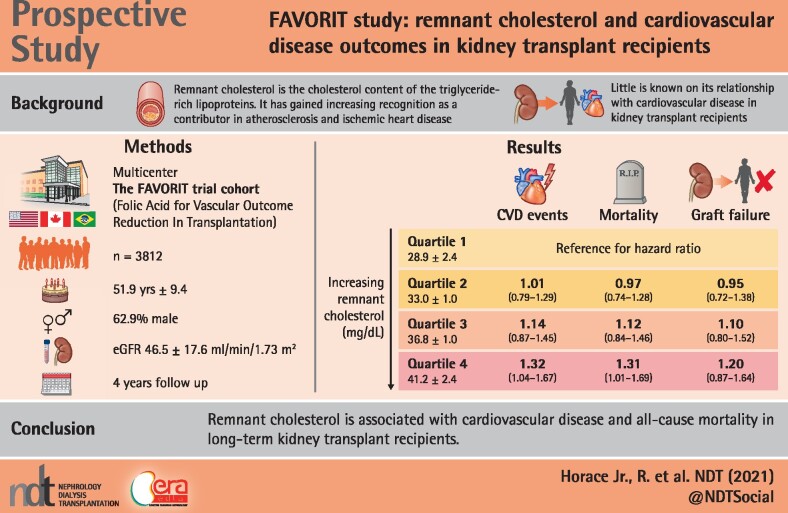
The cholesterol content of circulating triglyceride-rich lipoproteins is characterized as remnant cholesterol, although little is known about its role in the development of cardiovascular disease (CVD) outcomes, all-cause mortality or transplant failure in kidney transplant recipients (KTRs). Our primary aim was to investigate the prospective association of remnant cholesterol and the risk of CVD events in renal transplant recipients with secondary aims evaluating remnant cholesterol and renal graft failure and all-cause mortality among participants in the Folic Acid for Vascular Outcome Reduction in Transplantation (FAVORIT) trial.
Among 4110 enrolled participants, 98 were excluded for missing baseline remnant cholesterol levels and covariates. Nonfasting remnant cholesterol levels were calculated based on the lipid profiles in 3812 FAVORIT trial participants at randomization. A Wilcoxon-type test for trend was used to compare baseline characteristics across remnant cholesterol quartiles. Cox proportional hazards regression was used to evaluate the association of baseline remnant cholesterol levels with time to primary and secondary study outcomes.
During a median follow-up of 4.0 years we documented 548 CVD incident events, 343 transplant failures and 452 all-cause deaths. When comparing the highest quartile (quartile 4) to quartile 1, proportional hazard modeling revealed a significant increase in CVD risk {hazard ratio [HR] 1.32 [95% confidence interval (CI) 1.04-1.67]} and all-cause mortality risk [HR 1.34 (95% CI 1.01-1.69)]. A nonsignificant increase in transplant failure was seen as well [HR 1.20 (95% CI 0.87-1.64)].
Remnant cholesterol is associated with CVD and all-cause mortality in long-term KTRs. A randomized controlled clinical trial in KTRs that assesses the potential impact of remnant cholesterol-lowering therapy on these outcomes may be warranted.
循环中富含甘油三酯的脂蛋白的胆固醇含量被认为是残余胆固醇,尽管人们对其在心血管疾病(CVD)结局、全因死亡率或肾移植受者(KTR)移植失败中的作用知之甚少。我们的主要目的是研究残余胆固醇与肾移植受者 CVD 事件风险的前瞻性关联,并评估次要目的中残余胆固醇与肾移植物衰竭和 FAVORIT 试验参与者的全因死亡率之间的关系。
在纳入的 4110 名参与者中,有 98 名因基线残余胆固醇水平和协变量缺失而被排除。根据 3812 名 FAVORIT 试验参与者随机分组时的血脂谱计算非空腹残余胆固醇水平。采用 Wilcoxon 型检验趋势比较残余胆固醇四分位组间的基线特征。Cox 比例风险回归用于评估基线残余胆固醇水平与主要和次要研究结局的时间关系。
在中位随访 4.0 年期间,我们记录了 548 例 CVD 事件、343 例移植失败和 452 例全因死亡。与最高四分位(四分位 4)相比,四分位 1 显示 CVD 风险显著增加[风险比(HR)1.32(95%置信区间(CI)1.04-1.67)]和全因死亡率风险增加[HR 1.34(95% CI 1.01-1.69)]。也观察到移植失败的风险略有增加[HR 1.20(95% CI 0.87-1.64)]。
残余胆固醇与长期 KTR 中的 CVD 和全因死亡率相关。在 KTR 中进行随机对照临床试验,评估残余胆固醇降低治疗对这些结局的潜在影响可能是必要的。