Department of Public Health, Brody School of Medicine, East Carolina University, Greenville, NC, 27834, USA.
Department of Biostatistics, East Carolina University, Greenville, NC, 27834, USA.
Int J Behav Nutr Phys Act. 2021 Mar 24;18(1):44. doi: 10.1186/s12966-021-01109-8.
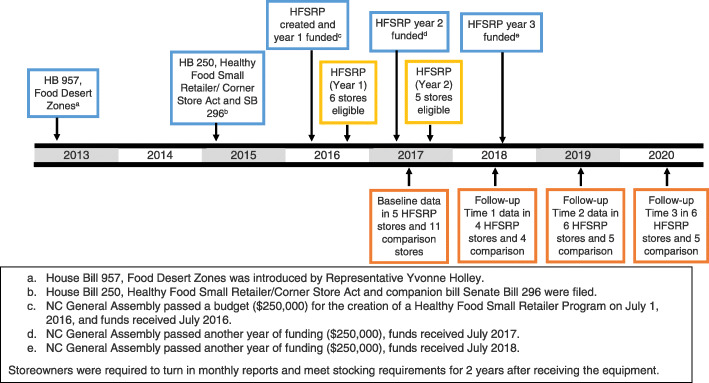
The North Carolina (NC) Healthy Food Small Retailer Program (HFSRP) was passed into law with a $250,000 appropriation (2016-2018) providing up to $25,000 in funding to small food stores for equipment to stock healthier foods and beverages. This paper describes an observational natural experiment documenting the impact of the HFSRP on store food environments, customers' purchases and diets.
Using store observations and intercept surveys from cross-sectional, convenience customer samples (1261 customers in 22 stores, 2017-2020; 499 customers in 7 HFSRP stores, and 762 customers in 15 Comparison stores), we examined differences between HFSRP and comparison stores regarding: (1) change in store-level availability, quality, and price of healthy foods/beverages; (2) change in healthfulness of observed food and beverage purchases ("bag checks"); and, (3) change in self-reported and objectively-measured (Veggie Meter®-assessed skin carotenoids) customer dietary behaviors. Differences (HFSRP vs. comparison stores) in store-level Healthy Food Supply (HFS) and Healthy Eating Index-2010 scores were assessed using repeated measure ANOVA. Intervention effects on diet were assessed using difference-in-difference models including propensity scores.
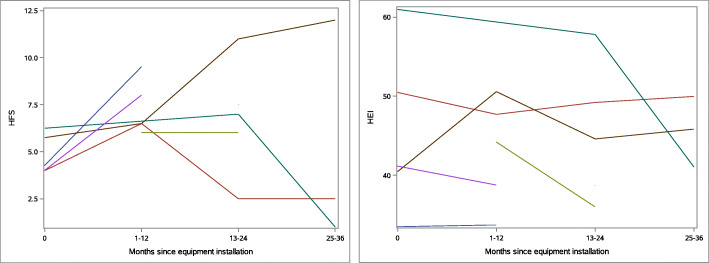
There were improvements in store-level supply of healthier foods/beverages within 1 year of program implementation (0 vs. 1-12 month HFS scores; p = 0.055) among HFSRP stores only. Comparing 2019 to 2017 (baseline), HFSRP stores' HFS increased, but decreased in comparison stores (p = 0.031). Findings indicated a borderline significant effect of the intervention on self-reported fruit and vegetable intake (servings/day), though in the opposite direction expected, such that fruit and vegetable intake increased more among comparison store than HFSRP store customers (p = 0.05). There was no significant change in Veggie Meter®-assessed fruit and vegetable intake by customers shopping at the intervention versus comparison stores.
Despite improvement in healthy food availability, there was a lack of apparent impact on dietary behaviors related to the HFSRP, which could be due to intervention dose or inadequate statistical power due to the serial cross-sectional study design. It may also be that individuals buy most of their food at larger stores; thus, small store interventions may have limited impact on overall eating patterns. Future healthy retail policies should consider how to increase intervention dose to include more product marketing, consumer messaging, and technical assistance for store owners.
北卡罗来纳州(NC)健康食品小零售商计划(HFSRP)获得 25 万美元的拨款(2016-2018 年),为小型食品店提供了高达 25000 美元的资金,用于购买库存更健康的食品和饮料的设备。本文描述了一项观察性自然实验,记录了 HFSRP 对商店食品环境、顾客购买和饮食的影响。
利用 2017-2020 年横断面便利顾客样本中的商店观察和拦截调查(22 家商店 1261 名顾客,2017-2020 年;HFSRP 商店 499 名顾客,比较商店 762 名顾客),我们比较了 HFSRP 商店和比较商店之间以下方面的差异:(1)健康食品/饮料的商店层面供应的变化,包括数量、质量和价格;(2)观察到的食品和饮料购买的健康程度(“袋装检查”);以及,(3)自我报告和客观测量(Veggie Meter®评估的皮肤类胡萝卜素)的顾客饮食行为的变化。使用重复测量方差分析评估健康食品供应(HFS)和健康饮食指数-2010 评分的 HFSRP 商店与比较商店之间的差异(HFSRP 与比较商店)。使用倾向评分包括差异模型评估饮食干预的效果。
仅在 HFSRP 商店中,在实施计划后的 1 年内,商店层面更健康的食品/饮料供应有所改善(0 与 1-12 个月 HFS 评分;p=0.055)。与 2017 年(基线)相比,HFSRP 商店的 HFS 增加,而比较商店的 HFS 减少(p=0.031)。研究结果表明,该干预措施对自我报告的水果和蔬菜摄入量(份/天)有边缘显著影响,尽管与预期相反,即比较商店顾客的水果和蔬菜摄入量增加更多(p=0.05)。在干预商店和比较商店购物的顾客中,Veggie Meter®评估的水果和蔬菜摄入量没有显著变化。
尽管健康食品的供应有所改善,但与 HFSRP 相关的饮食行为似乎没有明显变化,这可能是由于干预剂量或由于连续横断面研究设计导致的统计能力不足。也可能是因为个人在较大的商店购买大部分食物;因此,对小商店的干预可能对整体饮食模式影响有限。未来的健康零售政策应考虑如何增加干预剂量,包括更多的产品营销、消费者信息传递以及为店主提供技术援助。