Department of Family Medicine and Community Health, Program in Health Disparities Research, University of Minnesota, 717 Delaware St. SE, Minneapolis, MN, USA.
Division of Epidemiology and Community Health, Suite 300, University of Minnesota, 1300 South 2nd St, Minneapolis, MN, USA.
BMC Public Health. 2020 Feb 4;20(1):172. doi: 10.1186/s12889-020-8174-2.
Policies to improve healthy food retail have been recognized as a potential means of reducing diet-related health disparities. The revised 2014 Minneapolis Staple Foods Ordinance instituted minimum stocking standards for healthy, staple foods. The objective of this study was to examine retailer compliance with the policy, and whether compliance varied by neighborhood and store characteristics.
In this natural experiment, audits were conducted annually pre- and post-ordinance (2014-2017) in 155 small/nontraditional stores in Minneapolis, MN and a comparison city (St. Paul, MN). Compliance measures for 10 product categories included: (1) met requirements for ≥8 categories; (2) 10-point scale (one point for each requirement met); and (3) carried any item in each category. Store characteristics included store size and ownership status. Neighborhood characteristics included census-tract socioeconomic status and low-income/low-access status. Analyses were conducted in 2018.
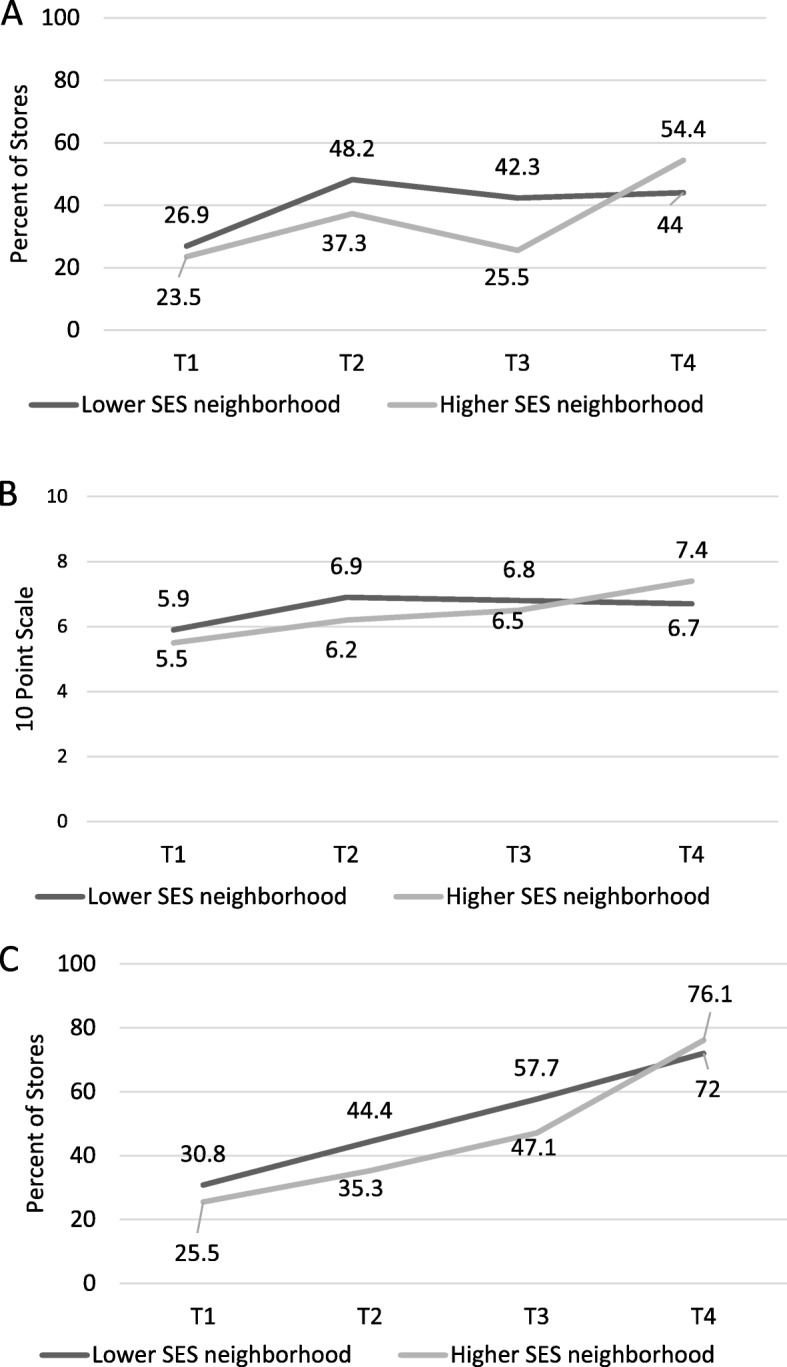
All compliance measures increased in both Minneapolis and St. Paul from pre- to post-policy; Minneapolis increases were greater only for carrying any item in each category (p < 0.01). In Minneapolis, corporate (vs. independent) stores were generally more compliant. No differences were found by neighborhood characteristics.
Overall trends suggest broad movement among Minneapolis stores towards providing a minimum level of staple foods. Increases were greater in corporate stores. Trends do not suggest neighborhood-level disparities in compliance.
ClinicalTrials.gov NCT02774330, retrospectively registered May 17, 2016.
改善健康食品零售的政策已被认为是减少与饮食相关的健康差距的一种潜在手段。修订后的 2014 年明尼阿波利斯主食食品条例规定了健康主食食品的最低库存标准。本研究的目的是检验零售商对该政策的遵守情况,以及遵守情况是否因社区和商店特征而异。
在这项自然实验中,在明尼阿波利斯(MN)和比较城市(圣保罗,MN)的 155 家小型/非传统商店中,在条例颁布前后(2014-2017 年)每年进行一次审计。10 种产品类别的合规性衡量标准包括:(1)满足≥8 类要求;(2)10 分制(满足每个要求得 1 分);(3)每种产品类别携带任何一种产品。商店特征包括商店规模和所有权状况。社区特征包括普查区社会经济地位和低收入/低机会地位。分析于 2018 年进行。
明尼阿波利斯和圣保罗的所有合规性衡量标准都从政策前到政策后有所增加;明尼阿波利斯的增长仅在每种产品类别中携带任何产品方面更为明显(p < 0.01)。在明尼阿波利斯,公司(与独立)商店通常更遵守规定。社区特征没有发现差异。
总体趋势表明,明尼阿波利斯的商店普遍朝着提供最低水平的主食食品迈进。公司商店的增长幅度更大。趋势并未表明合规方面存在邻里差异。
ClinicalTrials.gov NCT02774330,2016 年 5 月 17 日回顾性注册。