Molecular Biology Laboratory, Vorarlberg Institute for Vascular Investigation and Treatment, Stadtstraße 33, 6850, Dornbirn, Austria.
Medical Central Laboratories, 6800, Feldkirch, Austria.
Sci Rep. 2021 Mar 24;11(1):6761. doi: 10.1038/s41598-021-86238-7.
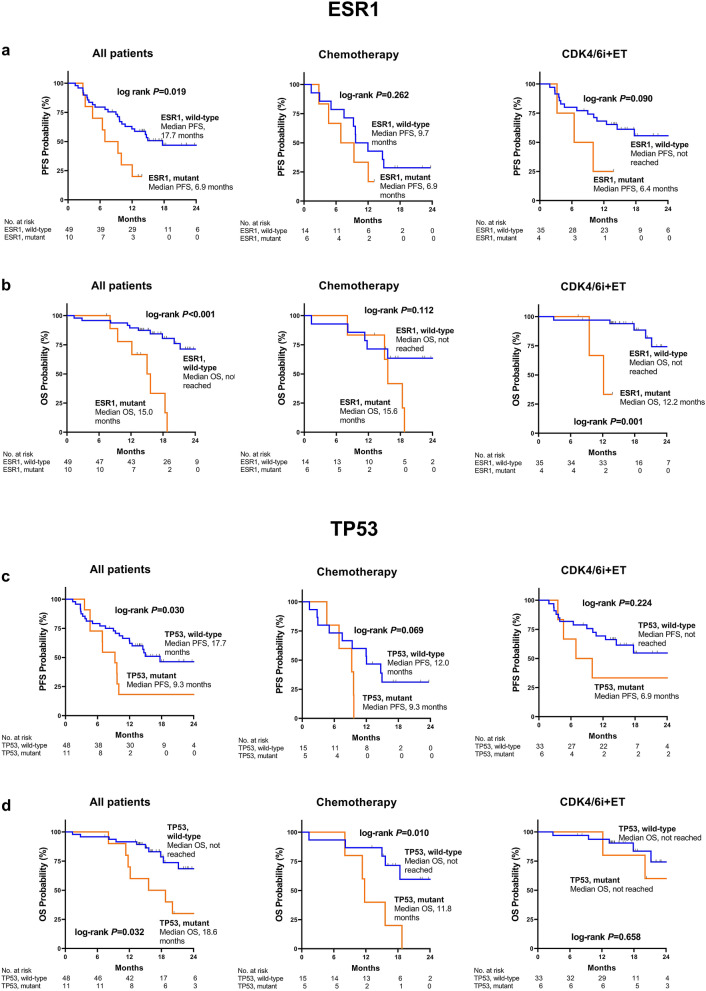
Mutational analysis of circulating tumour (ct) DNA holds promise as an effective tool to predict the course of metastatic breast cancer (MBC). In the present study we used targeted next generation sequencing of ctDNA to evaluate the impact of cancer driven mutations on the prognosis of MBC. The study included 59 oestrogen receptor-positive (ER+), HER2-negative MBC patients. Sequencing analysis was performed in ESR1, PIK3CA, ERBB2, PTEN, TP53, KRAS, HRAS, NRAS, and AR. At baseline, patients started receiving either chemotherapy (34%; n = 20) or cyclin-dependent kinase 4/6 inhibitor therapy in combination with endocrine therapy (CDK4/6i+ET; 66%; n = 39). Overall, 64.4% (n = 38) of the patients carried at least one pathogenic or likely-pathogenic mutation. Number of ctDNA mutations was significantly linked with worse progression free survival (PFS; p = 0.003) and overall survival (OS; p = 0.007). Furthermore, ctDNA load, defined by the number of mutant ctDNA molecules per mL plasma, significantly correlated with PFS (p < 0.001) and OS (p = 0.001). Furthermore, mutational status of ESR1 and TP53 significantly predicted PFS (p = 0.024 and p = 0.035, respectively) and OS (p < 0.001 and p = 0.035, respectively). These results emphasizes the clinical value of ctDNA mutational analysis in the management of advanced breast cancer.
循环肿瘤 (ct) DNA 的突变分析有望成为预测转移性乳腺癌 (MBC) 病程的有效工具。本研究采用 ctDNA 靶向二代测序评估癌症驱动突变对 MBC 预后的影响。该研究纳入了 59 例雌激素受体阳性 (ER+)、HER2 阴性 MBC 患者。测序分析在 ESR1、PIK3CA、ERBB2、PTEN、TP53、KRAS、HRAS、NRAS 和 AR 中进行。基线时,患者开始接受化疗 (34%,n=20) 或 CDK4/6 抑制剂联合内分泌治疗 (CDK4/6i+ET;66%,n=39)。总体而言,64.4% (n=38) 的患者携带至少一种致病性或可能致病性突变。ctDNA 突变数量与无进展生存期 (PFS;p=0.003) 和总生存期 (OS;p=0.007) 显著相关。此外,ctDNA 负荷,定义为每毫升血浆中突变 ctDNA 分子的数量,与 PFS (p<0.001) 和 OS (p=0.001) 显著相关。此外,ESR1 和 TP53 的突变状态显著预测 PFS (p=0.024 和 p=0.035) 和 OS (p<0.001 和 p=0.035)。这些结果强调了 ctDNA 突变分析在晚期乳腺癌管理中的临床价值。