Faculty of Medicine, University of Saskatchewan, Saskatoon, SK, Canada.
Robson DNA Science Centre, Departments of Biochemistry and Molecular Biology and Oncology, Charbonneau Cancer Institute, Cumming School of Medicine, University of Calgary, Calgary, AB, Canada.
Sci Rep. 2021 Mar 24;11(1):6724. doi: 10.1038/s41598-021-86096-3.
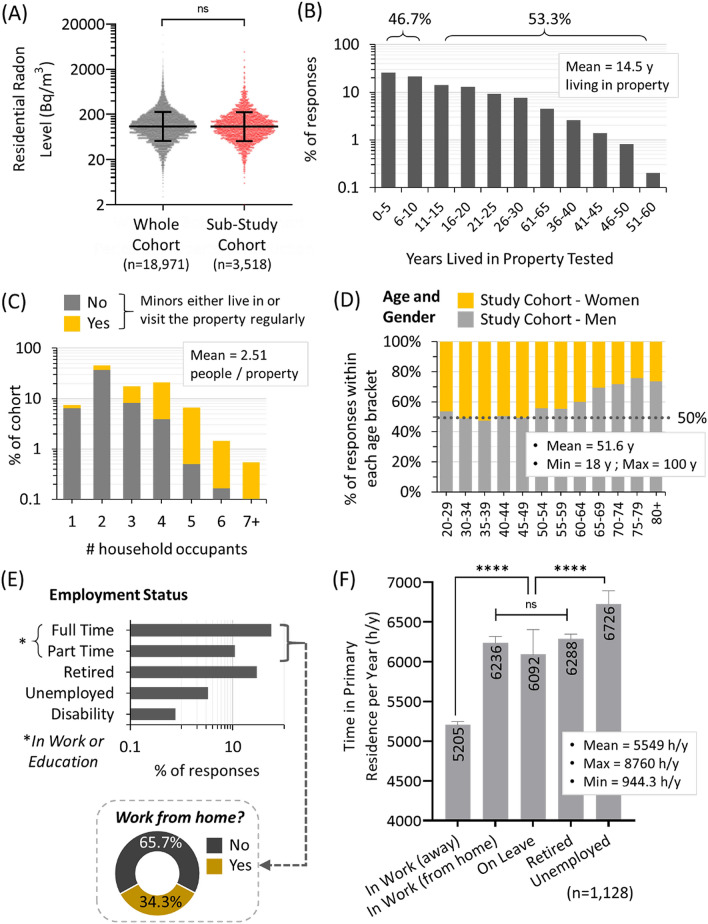
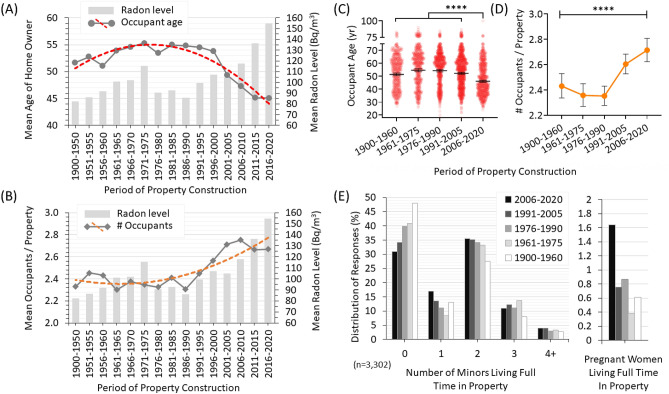
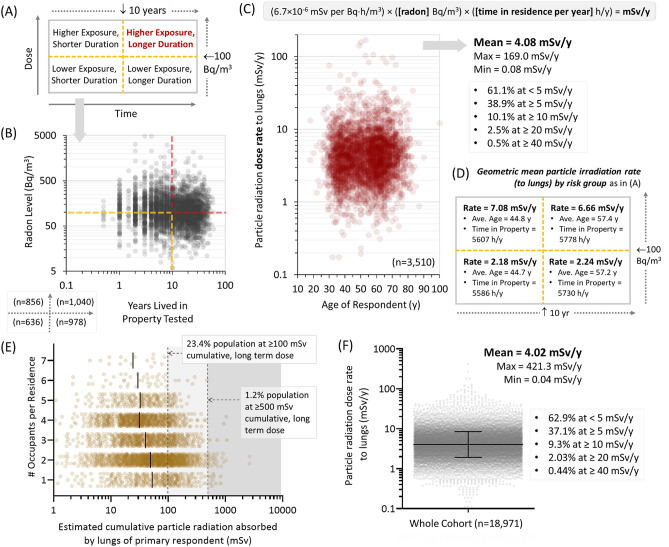
Residential buildings can concentrate radioactive radon gas, exposing occupants to particle radiation that increases lung cancer risk. This has worsened over time in North America, with newer residences containing greater radon. Using data from 18,971 Canadian households, we calculated annual particle radiation dose rates due to long term residential radon exposure, and examined this as a function of occupant demographics. The current particle radiation dose rate to lungs from residential radon in Canada is 4.08 mSv/y from 108.2 Bq/m, with 23.4% receiving 100-2655 mSv doses that are known to elevate human cancer risk. Notably, residences built in the twenty-first century are occupied by significantly younger people experiencing greater radiation dose rates from radon (mean age of 46 at 5.01 mSv/y), relative to older groups more likely to occupy twentieth century-built properties (mean age of 53 at 3.45-4.22 mSv/y). Newer, higher radon-containing properties are also more likely to have minors, pregnant women and an overall higher number of occupants living there full time. As younger age-of-exposure to radon equates to greater lifetime lung cancer risk, these data reveal a worst case scenario of exposure bias. This is of concern as, if it continues, it forecasts serious future increases in radon-induced lung cancer in younger people.
住宅建筑可能会集中放射性氡气,使居住者暴露在增加肺癌风险的粒子辐射下。随着时间的推移,这种情况在北美地区变得更加严重,新住宅中的氡含量更高。我们利用来自 18971 户加拿大家庭的数据,计算了由于长期居住氡暴露而导致的肺部年粒子辐射剂量率,并研究了其与居住者人口统计学特征的关系。目前,加拿大住宅氡导致的肺部粒子辐射剂量率为 108.2 Bq/m3 时为 4.08 mSv/y,其中 23.4%的人接受的剂量在 100-2655 mSv 之间,已知会增加人类癌症风险。值得注意的是,建于 21 世纪的住宅居住的是年龄更小的人群,他们受到的氡辐射剂量率更高(5.01 mSv/y 时平均年龄为 46 岁),而年龄更大的人群更有可能居住在 20 世纪建造的房产中(3.45-4.22 mSv/y 时平均年龄为 53 岁)。含有更高氡含量的较新住宅也更有可能有未成年人、孕妇和更多全职居住者。由于接触氡的年龄越小,患肺癌的终身风险越大,这些数据揭示了暴露偏差的最坏情况。这令人担忧,因为如果这种情况持续下去,预计年轻人的氡诱发肺癌会在未来严重增加。