Dun Yaoshan, Ripley-Gonzalez Jeffrey W, Zhou Nanjiang, Li Qiuxia, Chen Meijuan, Hu Zihang, Zhang Wenliang, Thomas Randal J, Olson Thomas P, Liu Jie, Dong Yuchen, Liu Suixin
Division of Cardiac Rehabilitation, Department of Physical Medicine & Rehabilitation, Xiangya Hospital of Central South University, Changsha, Hunan, China.
National Clinical Research Center for Geriatric Disorders, Xiangya Hospital of Central South University, Changsha, Hunan, China.
PeerJ. 2021 Mar 11;9:e11091. doi: 10.7717/peerj.11091. eCollection 2021.
The COVID-19 pandemic has led to a spike in deleterious mental health. This dual-center retrospective cross-sectional study assessed the prevalence of depression in young adults during this pandemic and explored its association with various physical fitness measures.
This study enrolled 12,889 (80% female) young adults (mean age 20 ± 1) who performed a National Student Physical Fitness battery from December 1st, 2019, to January 20th, 2020, and completed a questionnaire including Beck's Depression Inventory in May 2020. Independent associations between prior physical fitness and depression during the pandemic were assessed using multivariable linear and binary logistic regressions accordingly, covariates including age, dwelling location, economic level, smoking, alcohol, living status, weight change, and exercise volume during the pandemic. Sex- and baseline stress-stratified analyses were performed.
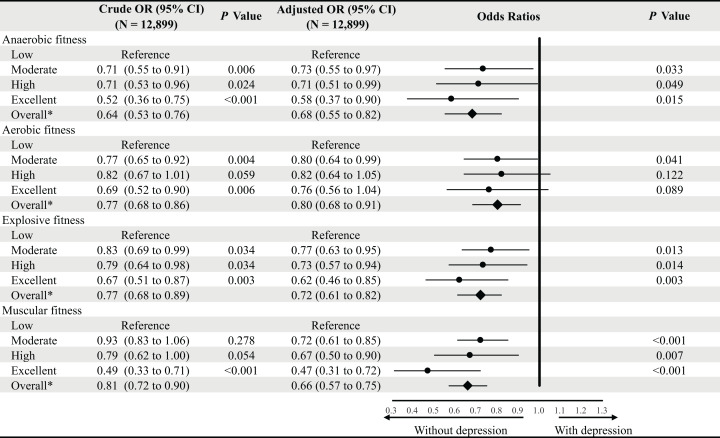
Of the study population 13.9% of men and 15.0% of women sampled qualified for a diagnosis of depression. After multivariable adjustment, anaerobic (mean change 95% CI -3.3 [-4.8 to 1.8]) aerobic (-1.5 [-2.64 to -0.5]), explosive (-1.64 [-2.7 to -0.6]) and muscular (-1.7 [-3.0 to -0.5]) fitness were independently and inversely associated with depression for the overall population. These remained consistent after sex- and baseline stress-stratification. In binary logistic regression, the combined participants with moderate, high or excellent fitness also showed a much lower risk compared to those least fit in anaerobic (odd ratio (OR) 95% CI 0.68 [0.55-0.82]), aerobic (0.80 [0.68-0.91]), explosive (0.72 [0.61-0.82]), and muscular (0.66 [0.57-0.75]) fitness.
These findings suggest that prior physical fitness may be inversely associated with depression in young adults during a pandemic.
新冠疫情导致有害心理健康状况激增。这项双中心回顾性横断面研究评估了疫情期间年轻人中抑郁症的患病率,并探讨了其与各种身体素质指标的关联。
本研究纳入了12,889名(80%为女性)年轻人(平均年龄20±1岁),他们在2019年12月1日至2020年1月20日期间进行了全国学生身体素质测试,并于2020年5月完成了一份包括贝克抑郁量表的问卷。相应地,使用多变量线性回归和二元逻辑回归评估疫情期间先前的身体素质与抑郁症之间的独立关联,协变量包括年龄、居住地点、经济水平、吸烟、饮酒、生活状况、体重变化以及疫情期间的运动量。进行了性别和基线压力分层分析。
在研究人群中,抽样的男性中有13.9%、女性中有15.0%符合抑郁症诊断标准。经过多变量调整后,无氧(平均变化95%CI -3.3[-4.8至1.8])、有氧(-1.5[-2.64至-0.5])、爆发力(-1.64[-2.7至-0.6])和肌肉力量(-1.7[-3.0至-0.5])素质与总体人群的抑郁症呈独立的负相关。在性别和基线压力分层后,这些结果保持一致。在二元逻辑回归中,与无氧(优势比(OR)95%CI 0.68[0.55 - 0.82])、有氧(0.80[0.68 - 0.91])、爆发力(0.72[0.61 - 0.82])和肌肉力量(0.66[0.57 - 0.75])素质最差的参与者相比,身体素质为中等、高或优秀组合的参与者患抑郁症的风险也低得多。
这些发现表明,疫情期间年轻人先前的身体素质可能与抑郁症呈负相关。