Department of Medicinal Chemistry, College of Pharmacy, University of Utah, 2000 East 30 South Skaggs 306, Salt Lake City, UT 84112, USA.
Nucleic Acids Res. 2021 Apr 19;49(7):3735-3747. doi: 10.1093/nar/gkab143.
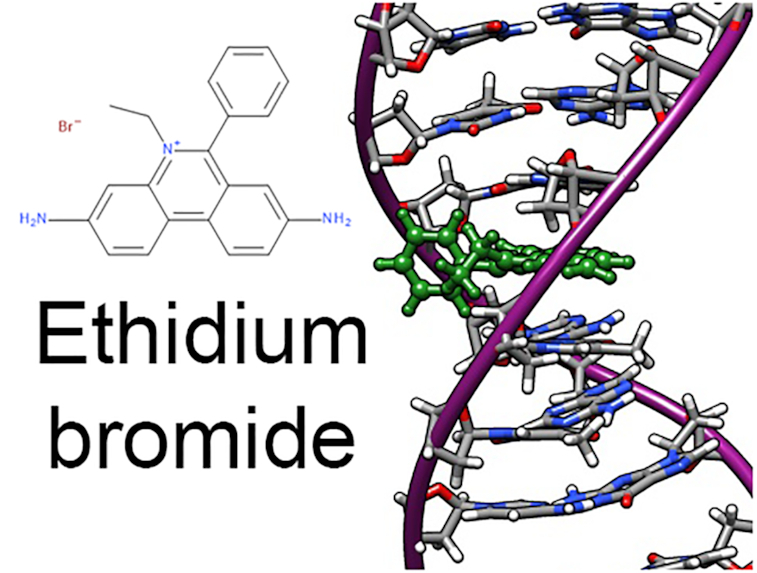
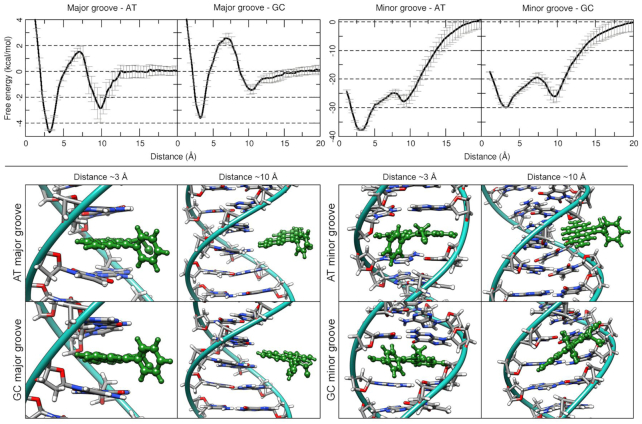
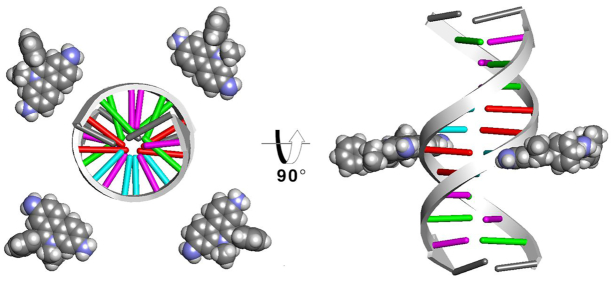
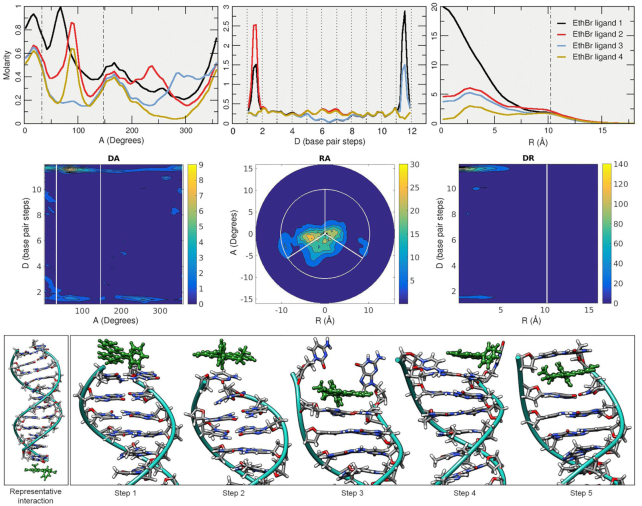
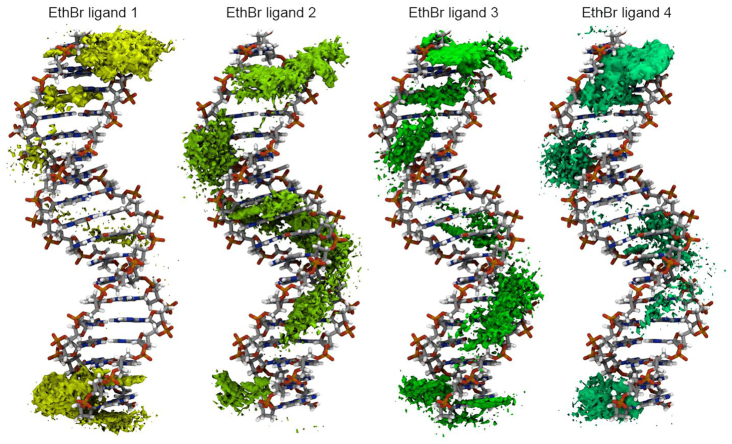
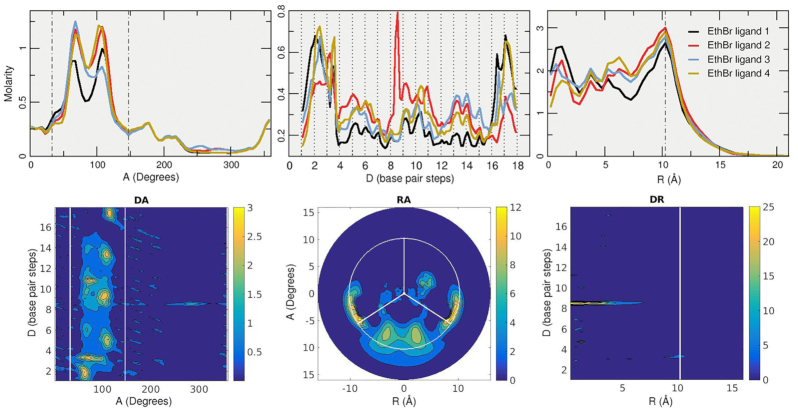
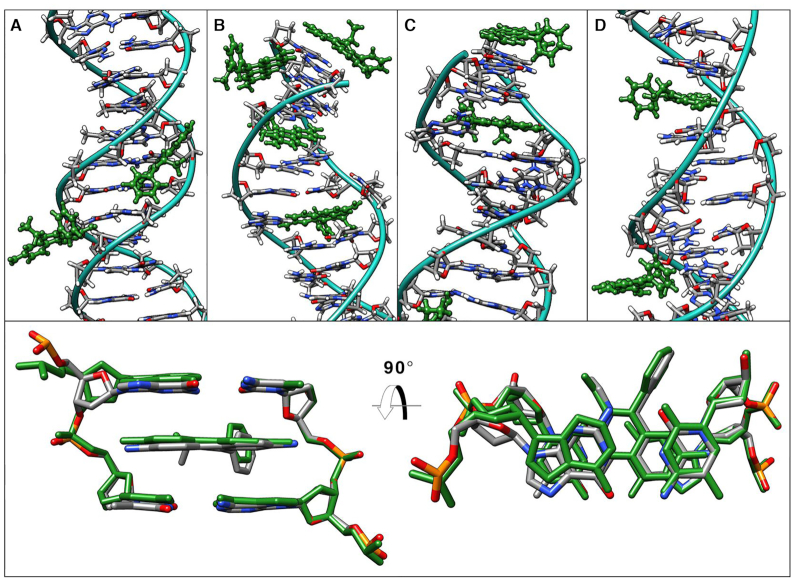
Visualization of double stranded DNA in gels with the binding of the fluorescent dye ethidium bromide has been a basic experimental technique in any molecular biology laboratory for >40 years. The interaction between ethidium and double stranded DNA has been observed to be an intercalation between base pairs with strong experimental evidence. This presents a unique opportunity for computational chemistry and biomolecular simulation techniques to benchmark and assess their models in order to see if the theory can reproduce experiments and ultimately provide new insights. We present molecular dynamics simulations of the interaction of ethidium with two different double stranded DNA models. The first model system is the classic sequence d(CGCGAATTCGCG)2 also known as the Drew-Dickerson dodecamer. We found that the ethidium ligand binds mainly stacked on, or intercalated between, the terminal base pairs of the DNA with little to no interaction with the inner base pairs. As the intercalation at the terminal CpG steps is relatively rapid, the resultant DNA unwinding, rigidification, and increased stability of the internal base pair steps inhibits further intercalation. In order to reduce these interactions and to provide a larger groove space, a second 18-mer DNA duplex system with the sequence d(GCATGAACGAACGAACGC) was tested. We computed molecular dynamics simulations for 20 independent replicas with this sequence, each with ∼27 μs of sampling time. Results show several spontaneous intercalation and base-pair eversion events that are consistent with experimental observations. The present work suggests that extended MD simulations with modern DNA force fields and optimized simulation codes are allowing the ability to reproduce unbiased intercalation events that we were not able to previously reach due to limits in computing power and the lack of extensively tested force fields and analysis tools.
用荧光染料溴化乙锭(ethidium bromide)结合双链 DNA 在凝胶中的可视化,是任何分子生物学实验室 40 多年来的基本实验技术。已经观察到 ethidium 与双链 DNA 的相互作用是碱基对之间的嵌入,具有强有力的实验证据。这为计算化学和生物分子模拟技术提供了一个独特的机会,可以对其模型进行基准测试和评估,以观察理论是否可以重现实验,最终提供新的见解。我们展示了 ethidium 与两种不同双链 DNA 模型相互作用的分子动力学模拟。第一个模型系统是经典序列 d(CGCGAATTCGCG)2,也称为 Drew-Dickerson 十二聚体。我们发现 ethidium 配体主要结合在 DNA 的末端碱基对上,或嵌入在 DNA 的末端碱基对之间,与内部碱基对几乎没有相互作用。由于末端 CpG 步的嵌入相对较快,因此导致 DNA 解旋、刚性化和内部碱基对步骤的稳定性增加,从而抑制进一步的嵌入。为了减少这些相互作用并提供更大的沟空间,我们测试了第二个具有序列 d(GCATGAACGAACGAACGC)的 18 碱基对 DNA 双链系统。我们对该序列进行了 20 次独立副本的分子动力学模拟,每次模拟的采样时间约为 27 μs。结果显示了几个自发的嵌入和碱基对反转事件,这些事件与实验观察结果一致。目前的工作表明,使用现代 DNA 力场和优化的模拟代码进行扩展的 MD 模拟,使得能够重现无偏嵌入事件,而由于计算能力的限制以及缺乏经过广泛测试的力场和分析工具,我们之前无法达到这一目标。