Department of Neurology, Laboratory of Neurodegenerative Disorders, National Clinical Research Center for Geriatrics, West China Hospital, Sichuan University, Chengdu, Sichuan, China.
Ann Clin Transl Neurol. 2021 Apr;8(4):887-897. doi: 10.1002/acn3.51343. Epub 2021 Mar 25.
To evaluate whether the control status of type 2 diabetes mellitus (DM) influences the progression of Parkinson's disease (PD).
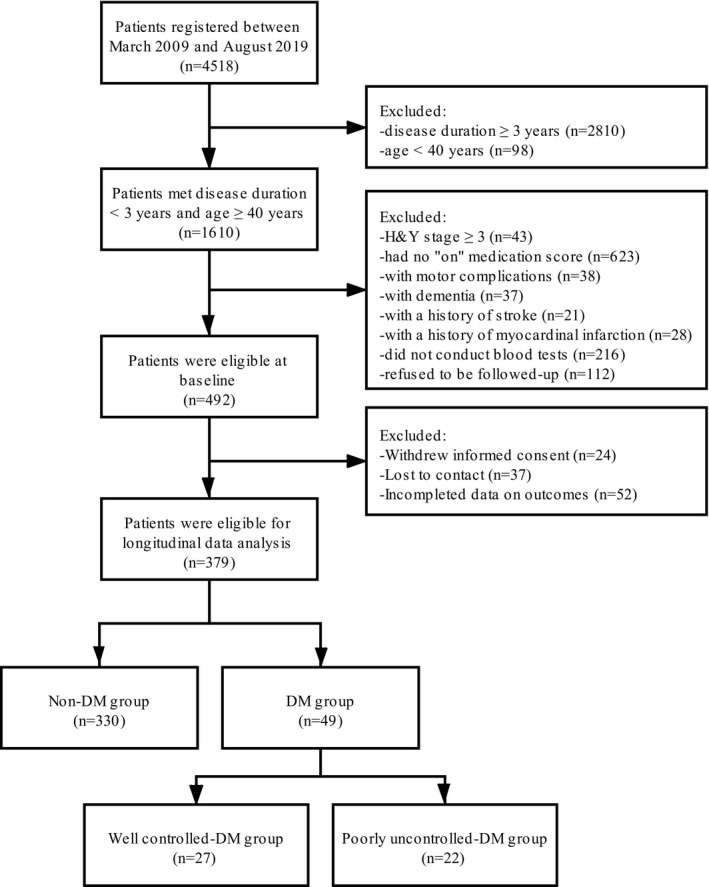
We conducted a prospective cohort study from March 2009 to August 2020. Patients at baseline were categorized into DM and non-DM groups, and those with DM were further classified into the well and poorly controlled DM groups based on the 7.0% of glycated hemoglobin (HbA1C) levels. Multivariate Cox proportional hazards regression models were used to explore the predictors for PD-related outcomes by hazard ratios (HRs) and 95% confidence intervals (CIs).
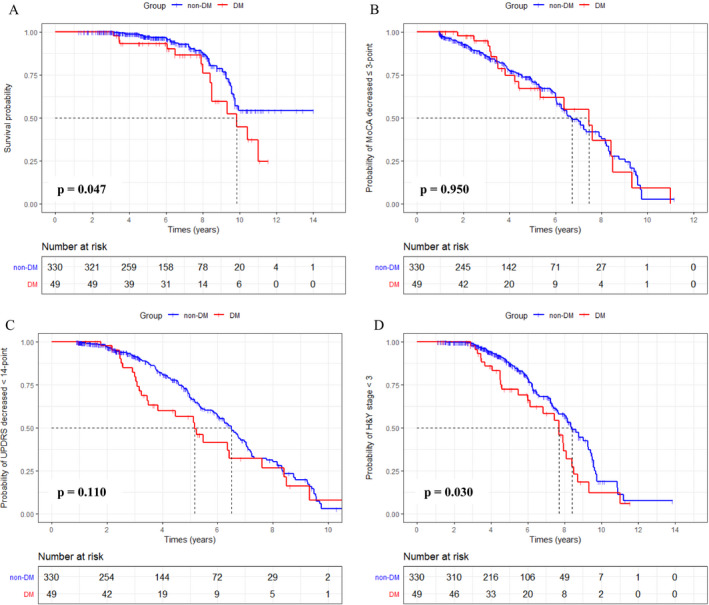
Of the 379 patients enrolled, 49 (12.9%) had DM, and 22 of DM (44.9%) were poorly controlled. The adjusted HRs were 2.060 (95% CI 1.165-3.641) for United Rating Scale (UPDRS) III score increased ≥14 in the poorly controlled-DM group, and 1.066 (95% CI 0.572-1.986) in the well-controlled DM group, relative to the non-DM group (p trend = 0.025), after adjusting for sex, age, age of onset, body mass index, and UPDRS III and Montreal Cognitive Assessment (MoCA) scores at baseline. The adjusted HRs were 2.079 (95% CI 1.212-3.566) for reaching Hoehn & Yahr stage ≥3 in the poorly controlled DM group, and 0.879 (95% CI 0.413-1.871) in the well-controlled DM group, compared with the non-DM group (p trend = 0.021). Time to death or time to MoCA 3-point decrease were not significantly different among the three groups.
Poorly controlled DM is an independent risk factor contributing to motor progression in PD. Our study highlights the importance of adequate control of diabetes in PD.
评估 2 型糖尿病(DM)的控制状况是否会影响帕金森病(PD)的进展。
我们进行了一项从 2009 年 3 月至 2020 年 8 月的前瞻性队列研究。基线时的患者被分为 DM 和非 DM 组,根据糖化血红蛋白(HbA1C)水平的 7.0%,DM 患者进一步分为 DM 控制良好和控制不佳两组。使用多变量 Cox 比例风险回归模型,通过风险比(HR)和 95%置信区间(CI)探索 PD 相关结局的预测因素。
在纳入的 379 名患者中,有 49 名(12.9%)患有 DM,其中 22 名(44.9%)DM 控制不佳。调整性别、年龄、发病年龄、体重指数以及基线时 UPDRS III 评分和蒙特利尔认知评估(MoCA)评分后,与非 DM 组相比,控制不佳 DM 组的 UPDRS III 评分增加≥14 的调整 HR 为 2.060(95%CI 1.165-3.641),控制良好 DM 组为 1.066(95%CI 0.572-1.986)(p 趋势=0.025)。调整性别、年龄、发病年龄、体重指数以及基线时 UPDRS III 评分和 MoCA 评分后,与非 DM 组相比,控制不佳 DM 组的 Hoehn & Yahr 分期≥3 的调整 HR 为 2.079(95%CI 1.212-3.566),控制良好 DM 组为 0.879(95%CI 0.413-1.871)(p 趋势=0.021)。三组患者的死亡时间或 MoCA 评分下降 3 分的时间无显著差异。
控制不佳的 DM 是 PD 运动进展的独立危险因素。我们的研究强调了在 PD 中充分控制糖尿病的重要性。