• 文献检索
  • 文档翻译
  • 深度研究
  • 学术资讯
  • Suppr Zotero 插件Zotero 插件
  • 邀请有礼
  • 套餐&价格
  • 历史记录
应用&插件
Suppr Zotero 插件Zotero 插件浏览器插件Mac 客户端Windows 客户端微信小程序
定价
高级版会员购买积分包购买API积分包
服务
文献检索文档翻译深度研究API 文档MCP 服务
关于我们
关于 Suppr公司介绍联系我们用户协议隐私条款
关注我们

Suppr 超能文献

核心技术专利:CN118964589B侵权必究
粤ICP备2023148730 号-1Suppr @ 2026

文献检索

告别复杂PubMed语法,用中文像聊天一样搜索,搜遍4000万医学文献。AI智能推荐,让科研检索更轻松。

立即免费搜索

文件翻译

保留排版,准确专业,支持PDF/Word/PPT等文件格式,支持 12+语言互译。

免费翻译文档

深度研究

AI帮你快速写综述,25分钟生成高质量综述,智能提取关键信息,辅助科研写作。

立即免费体验

利用数字图像的人工智能在筛查新冠肺炎患者中的应用:荟萃分析。

Application of Artificial Intelligence for Screening COVID-19 Patients Using Digital Images: Meta-analysis.

作者信息

Poly Tahmina Nasrin, Islam Md Mohaimenul, Li Yu-Chuan Jack, Alsinglawi Belal, Hsu Min-Huei, Jian Wen Shan, Yang Hsuan-Chia

机构信息

Graduate Institute of Biomedical Informatics, College of Medical Science and Technology, Taipei Medical University, Taipei, Taiwan.

International Center for Health Information Technology, Taipei Medical University, Taipei, Taiwan.

出版信息

JMIR Med Inform. 2021 Apr 29;9(4):e21394. doi: 10.2196/21394.

DOI:10.2196/21394
PMID:33764884
原文链接:https://pmc.ncbi.nlm.nih.gov/articles/PMC8086786/
Abstract

BACKGROUND

The COVID-19 outbreak has spread rapidly and hospitals are overwhelmed with COVID-19 patients. While analysis of nasal and throat swabs from patients is the main way to detect COVID-19, analyzing chest images could offer an alternative method to hospitals, where health care personnel and testing kits are scarce. Deep learning (DL), in particular, has shown impressive levels of performance when analyzing medical images, including those related to COVID-19 pneumonia.

OBJECTIVE

The goal of this study was to perform a systematic review with a meta-analysis of relevant studies to quantify the performance of DL algorithms in the automatic stratification of COVID-19 patients using chest images.

METHODS

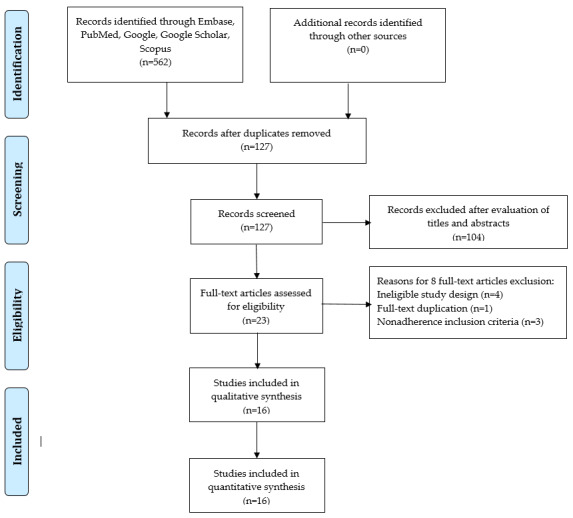
A search strategy for use in PubMed, Scopus, Google Scholar, and Web of Science was developed, where we searched for articles published between January 1 and April 25, 2020. We used the key terms "COVID-19," or "coronavirus," or "SARS-CoV-2," or "novel corona," or "2019-ncov," and "deep learning," or "artificial intelligence," or "automatic detection." Two authors independently extracted data on study characteristics, methods, risk of bias, and outcomes. Any disagreement between them was resolved by consensus.

RESULTS

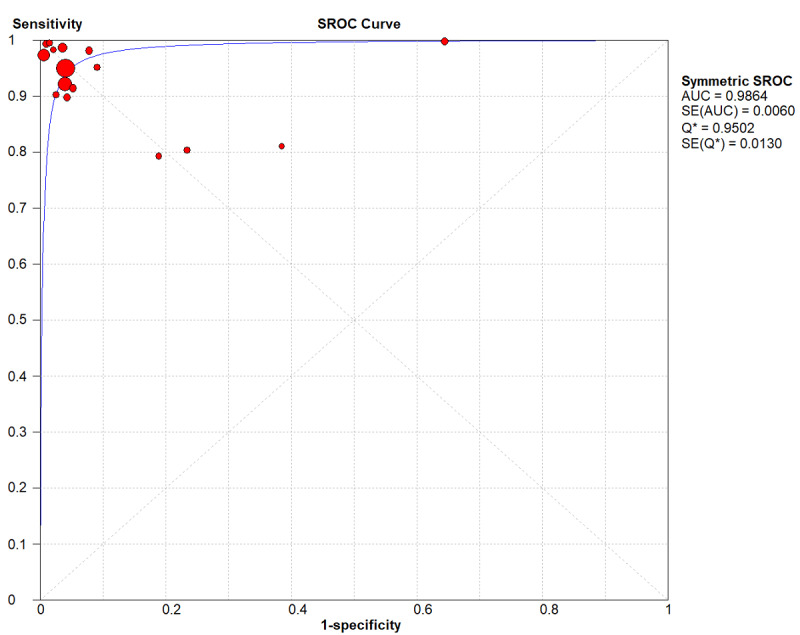
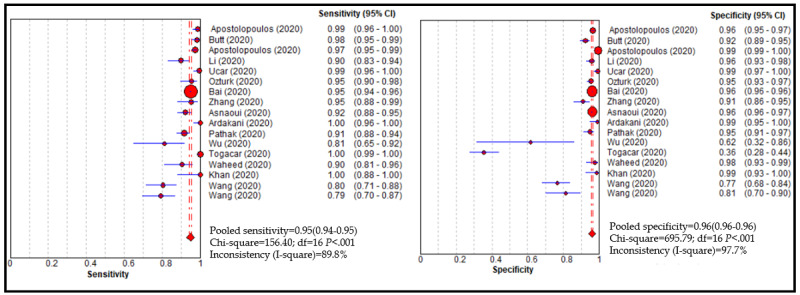
A total of 16 studies were included in the meta-analysis, which included 5896 chest images from COVID-19 patients. The pooled sensitivity and specificity of the DL models in detecting COVID-19 were 0.95 (95% CI 0.94-0.95) and 0.96 (95% CI 0.96-0.97), respectively, with an area under the receiver operating characteristic curve of 0.98. The positive likelihood, negative likelihood, and diagnostic odds ratio were 19.02 (95% CI 12.83-28.19), 0.06 (95% CI 0.04-0.10), and 368.07 (95% CI 162.30-834.75), respectively. The pooled sensitivity and specificity for distinguishing other types of pneumonia from COVID-19 were 0.93 (95% CI 0.92-0.94) and 0.95 (95% CI 0.94-0.95), respectively. The performance of radiologists in detecting COVID-19 was lower than that of the DL models; however, the performance of junior radiologists was improved when they used DL-based prediction tools.

CONCLUSIONS

Our study findings show that DL models have immense potential in accurately stratifying COVID-19 patients and in correctly differentiating them from patients with other types of pneumonia and normal patients. Implementation of DL-based tools can assist radiologists in correctly and quickly detecting COVID-19 and, consequently, in combating the COVID-19 pandemic.

摘要

背景

新型冠状病毒肺炎(COVID-19)疫情迅速蔓延,医院里COVID-19患者数量激增,不堪重负。虽然对患者的鼻咽拭子分析是检测COVID-19的主要方法,但对于医疗人员和检测试剂盒稀缺的医院而言,分析胸部影像可能提供一种替代方法。尤其是深度学习(DL)在分析医学影像(包括与COVID-19肺炎相关的影像)时表现出了令人瞩目的性能水平。

目的

本研究的目的是进行一项系统评价,并对相关研究进行荟萃分析,以量化DL算法在使用胸部影像对COVID-19患者进行自动分层方面的性能。

方法

制定了在PubMed、Scopus、谷歌学术和科学网中使用的检索策略,检索2020年1月1日至4月25日期间发表的文章。我们使用了关键词“COVID-19”、“冠状病毒”、“严重急性呼吸综合征冠状病毒2(SARS-CoV-2)”、“新型冠状病毒”、“2019新型冠状病毒(2019-ncov)”以及“深度学习”、“人工智能”、“自动检测”。两名作者独立提取关于研究特征、方法、偏倚风险和结果的数据。他们之间的任何分歧都通过协商解决。

结果

荟萃分析共纳入16项研究,其中包括来自COVID-19患者的5896张胸部影像。DL模型检测COVID-19的合并敏感度和特异度分别为0.95(95%CI 0.94 - 0.95)和0.96(95%CI 0.96 - 0.97),受试者工作特征曲线下面积为0.98。阳性似然比、阴性似然比和诊断比值比分别为19.02(95%CI 12.83 - 28.19)、0.06(95%CI 0.04 - 0.10)和368.07(95%CI 162.30 - 834.75)。区分其他类型肺炎与COVID-19的合并敏感度和特异度分别为0.93(95%CI 0.92 - 0.94)和0.95(95%CI 0.94 - 0.95)。放射科医生检测COVID-19的性能低于DL模型;然而,初级放射科医生使用基于DL的预测工具时,其性能有所提高。

结论

我们的研究结果表明,DL模型在准确分层COVID-19患者以及将其与其他类型肺炎患者和正常患者正确区分方面具有巨大潜力。基于DL的工具的应用可以帮助放射科医生正确、快速地检测COVID-19,从而对抗COVID-19疫情。
https://cdn.ncbi.nlm.nih.gov/pmc/blobs/ccb6/8086786/9f6f3c9cc9f7/medinform_v9i4e21394_fig3.jpg
https://cdn.ncbi.nlm.nih.gov/pmc/blobs/ccb6/8086786/8345a2565658/medinform_v9i4e21394_fig1.jpg
https://cdn.ncbi.nlm.nih.gov/pmc/blobs/ccb6/8086786/4386e6e49f7a/medinform_v9i4e21394_fig2.jpg
https://cdn.ncbi.nlm.nih.gov/pmc/blobs/ccb6/8086786/9f6f3c9cc9f7/medinform_v9i4e21394_fig3.jpg
https://cdn.ncbi.nlm.nih.gov/pmc/blobs/ccb6/8086786/8345a2565658/medinform_v9i4e21394_fig1.jpg
https://cdn.ncbi.nlm.nih.gov/pmc/blobs/ccb6/8086786/4386e6e49f7a/medinform_v9i4e21394_fig2.jpg
https://cdn.ncbi.nlm.nih.gov/pmc/blobs/ccb6/8086786/9f6f3c9cc9f7/medinform_v9i4e21394_fig3.jpg

相似文献

1
Application of Artificial Intelligence for Screening COVID-19 Patients Using Digital Images: Meta-analysis.利用数字图像的人工智能在筛查新冠肺炎患者中的应用:荟萃分析。
JMIR Med Inform. 2021 Apr 29;9(4):e21394. doi: 10.2196/21394.
2
Diagnostic performance of corona virus disease 2019 chest computer tomography image recognition based on deep learning: Systematic review and meta-analysis.基于深度学习的 2019 年冠状病毒病胸部计算机断层扫描图像识别的诊断性能:系统评价和荟萃分析。
Medicine (Baltimore). 2022 Oct 21;101(42):e31346. doi: 10.1097/MD.0000000000031346.
3
Diagnostic performance of deep learning models versus radiologists in COVID-19 pneumonia: A systematic review and meta-analysis.深度学习模型与放射科医生对新冠肺炎肺炎的诊断性能:一项系统评价和荟萃分析
Clin Imaging. 2024 Mar;107:110092. doi: 10.1016/j.clinimag.2024.110092. Epub 2024 Jan 26.
4
Folic acid supplementation and malaria susceptibility and severity among people taking antifolate antimalarial drugs in endemic areas.在流行地区,服用抗叶酸抗疟药物的人群中,叶酸补充剂与疟疾易感性和严重程度的关系。
Cochrane Database Syst Rev. 2022 Feb 1;2(2022):CD014217. doi: 10.1002/14651858.CD014217.
5
Accuracy of deep learning for automated detection of pneumonia using chest X-Ray images: A systematic review and meta-analysis.使用胸部X光图像的深度学习自动检测肺炎的准确性:系统评价与荟萃分析。
Comput Biol Med. 2020 Aug;123:103898. doi: 10.1016/j.compbiomed.2020.103898. Epub 2020 Jul 14.
6
Artificial intelligence model on chest imaging to diagnose COVID-19 and other pneumonias: A systematic review and meta-analysis.用于诊断新冠肺炎及其他肺炎的胸部影像人工智能模型:一项系统评价与荟萃分析。
Eur J Radiol Open. 2022;9:100438. doi: 10.1016/j.ejro.2022.100438. Epub 2022 Aug 18.
7
Artificial Intelligence Augmentation of Radiologist Performance in Distinguishing COVID-19 from Pneumonia of Other Origin at Chest CT.人工智能增强放射科医生在胸部 CT 上区分 COVID-19 与其他病因肺炎的性能。
Radiology. 2020 Sep;296(3):E156-E165. doi: 10.1148/radiol.2020201491. Epub 2020 Apr 27.
8
Deep learning algorithms for detection of diabetic retinopathy in retinal fundus photographs: A systematic review and meta-analysis.深度学习算法在眼底视网膜照片糖尿病性视网膜病变检测中的应用:系统评价和荟萃分析。
Comput Methods Programs Biomed. 2020 Jul;191:105320. doi: 10.1016/j.cmpb.2020.105320. Epub 2020 Jan 16.
9
Deep-learning algorithms for the interpretation of chest radiographs to aid in the triage of COVID-19 patients: A multicenter retrospective study.深度学习算法在解读胸部 X 光片中对 COVID-19 患者分诊的辅助作用:一项多中心回顾性研究。
PLoS One. 2020 Nov 24;15(11):e0242759. doi: 10.1371/journal.pone.0242759. eCollection 2020.
10
Signs and symptoms to determine if a patient presenting in primary care or hospital outpatient settings has COVID-19.在基层医疗或医院门诊环境中,出现症状和体征来确定患者是否患有 COVID-19。
Cochrane Database Syst Rev. 2021 Feb 23;2(2):CD013665. doi: 10.1002/14651858.CD013665.pub2.

引用本文的文献

1
Improving the accuracy of emergency department clinicians in detecting SARS-COV-2 on chest X-rays using a bespoke virtual training platform.使用定制的虚拟培训平台提高急诊科临床医生通过胸部X光检测新型冠状病毒的准确性。
BMC Med Educ. 2025 Aug 6;25(1):1147. doi: 10.1186/s12909-025-07672-z.
2
Comprehensive analysis of prognostic significance of cadherin (CDH) gene family in breast cancer.乳腺癌中钙黏蛋白(CDH)基因家族预后意义的综合分析。
Aging (Albany NY). 2022 Oct 30;14(20):8498-8567. doi: 10.18632/aging.204357.
3
Prognostic Model of ICU Admission Risk in Patients with COVID-19 Infection Using Machine Learning.

本文引用的文献

1
RETRACTED ARTICLE: Deep learning system to screen coronavirus disease 2019 pneumonia.撤稿文章:用于筛查2019冠状病毒病肺炎的深度学习系统。
Appl Intell (Dordr). 2023;53(4):4874. doi: 10.1007/s10489-020-01714-3. Epub 2020 Apr 22.
2
The Epidemiological Characteristics of an Outbreak of 2019 Novel Coronavirus Diseases (COVID-19) - China, 2020.2019新型冠状病毒病(COVID-19)疫情的流行病学特征 - 中国,2020年
China CDC Wkly. 2020 Feb 21;2(8):113-122.
3
CovidGAN: Data Augmentation Using Auxiliary Classifier GAN for Improved Covid-19 Detection.
使用机器学习的新型冠状病毒肺炎感染患者入住重症监护病房风险的预后模型
Diagnostics (Basel). 2022 Sep 3;12(9):2144. doi: 10.3390/diagnostics12092144.
4
Comparison of Transcriptomic Signatures between Monkeypox-Infected Monkey and Human Cell Lines.猴痘感染的猴和人细胞系转录组特征比较。
J Immunol Res. 2022 Sep 1;2022:3883822. doi: 10.1155/2022/3883822. eCollection 2022.
5
Telemedicine and virtual respiratory care in the era of COVID-19.COVID-19时代的远程医疗与虚拟呼吸护理
ERJ Open Res. 2022 Jul 25;8(3). doi: 10.1183/23120541.00111-2022. eCollection 2022 Jul.
CovidGAN:使用辅助分类器生成对抗网络进行数据增强以改进新冠病毒检测
IEEE Access. 2020 May 14;8:91916-91923. doi: 10.1109/ACCESS.2020.2994762. eCollection 2020.
4
Self-Collected Oral Fluid and Nasal Swabs Demonstrate Comparable Sensitivity to Clinician Collected Nasopharyngeal Swabs for Coronavirus Disease 2019 Detection.自我采集的口腔液和鼻腔拭子与临床医生采集的鼻咽拭子在检测 2019 年冠状病毒病方面具有相当的敏感性。
Clin Infect Dis. 2021 Nov 2;73(9):e3106-e3109. doi: 10.1093/cid/ciaa1589.
5
Clinically Applicable AI System for Accurate Diagnosis, Quantitative Measurements, and Prognosis of COVID-19 Pneumonia Using Computed Tomography.使用计算机断层扫描对新冠肺炎肺炎进行准确诊断、定量测量和预后评估的临床适用人工智能系统
Cell. 2020 Sep 3;182(5):1360. doi: 10.1016/j.cell.2020.08.029.
6
Deep Transfer Learning Based Classification Model for COVID-19 Disease.基于深度迁移学习的新冠肺炎疾病分类模型
Ing Rech Biomed. 2022 Apr;43(2):87-92. doi: 10.1016/j.irbm.2020.05.003. Epub 2020 May 20.
7
COVID-19 detection using deep learning models to exploit Social Mimic Optimization and structured chest X-ray images using fuzzy color and stacking approaches.利用深度学习模型进行 COVID-19 检测,利用模糊颜色和堆叠方法挖掘社会模拟优化和结构化胸部 X 射线图像。
Comput Biol Med. 2020 Jun;121:103805. doi: 10.1016/j.compbiomed.2020.103805. Epub 2020 May 6.
8
Application of deep learning technique to manage COVID-19 in routine clinical practice using CT images: Results of 10 convolutional neural networks.深度学习技术在 CT 图像指导下常规临床管理 COVID-19:10 个卷积神经网络的结果。
Comput Biol Med. 2020 Jun;121:103795. doi: 10.1016/j.compbiomed.2020.103795. Epub 2020 Apr 30.
9
Automated detection of COVID-19 cases using deep neural networks with X-ray images.使用 X 射线图像的深度学习神经网络自动检测 COVID-19 病例。
Comput Biol Med. 2020 Jun;121:103792. doi: 10.1016/j.compbiomed.2020.103792. Epub 2020 Apr 28.
10
CoroNet: A deep neural network for detection and diagnosis of COVID-19 from chest x-ray images.CoroNet:一种用于从胸部 X 光图像中检测和诊断 COVID-19 的深度神经网络。
Comput Methods Programs Biomed. 2020 Nov;196:105581. doi: 10.1016/j.cmpb.2020.105581. Epub 2020 Jun 5.