Department of Pediatrics, School of Medicine, College of Medicine, Taipei Medical University, Taipei, Taiwan.
Department of Clinical Pathology, Taipei Medical University Hospital, Taipei, Taiwan.
PLoS One. 2021 Mar 25;16(3):e0249050. doi: 10.1371/journal.pone.0249050. eCollection 2021.
Prescriptions for gastric acid-suppressive agents, including proton-pump inhibitors (PPIs) and histamine type-2 receptor antagonists (H2RAs), are rising. However, little data exist regarding their association with dementia in the Asian population. The objective of this study was thus to investigate the impact of the use of PPIs and H2RAs on the risk of dementia in an Asian population with upper gastrointestinal disease (UGID).
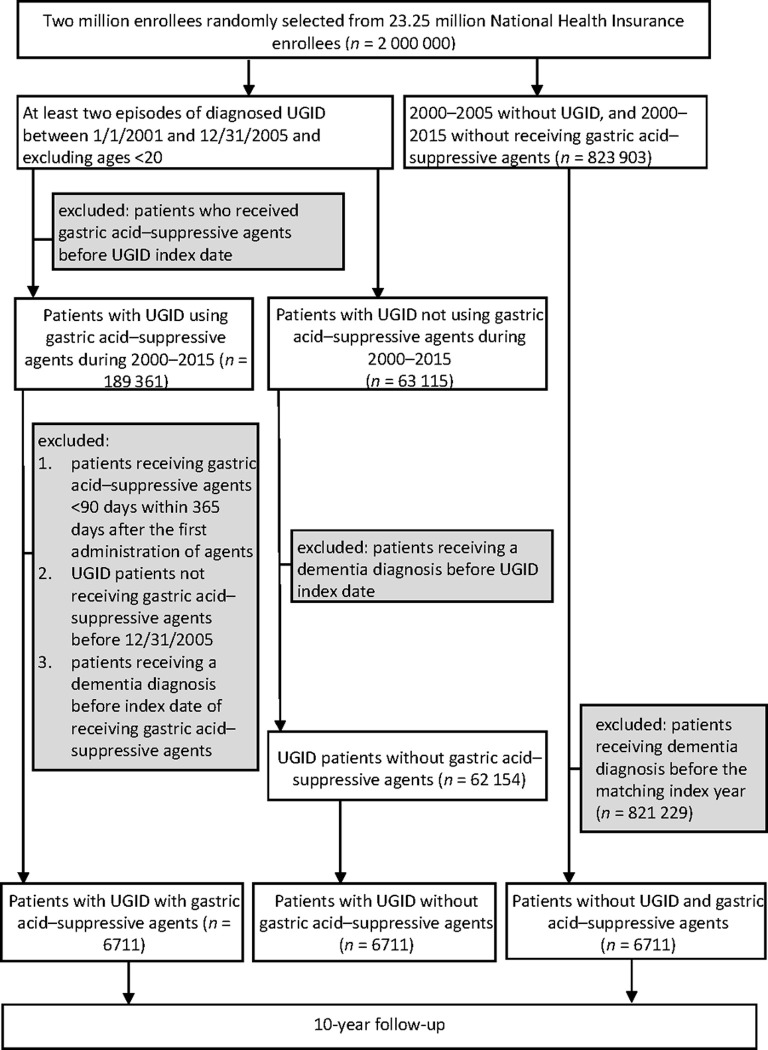
We conducted a population-based retrospective cohort study with a 10-year follow-up using data from 2000 to 2015 derived from Taiwan's Longitudinal Health Insurance Database. We included 6711 patients with UGID receiving gastric acid-suppressive agents, 6711 patients with UGID not receiving agents, and 6711 patients without UGID or treatment thereof, all at least 20 years of age. Groups were matched for age, sex, and index date. The association between gastric acid-suppressive agent use and dementia was analyzed using a Cox proportional hazards regression model adjusted for potential confounders.
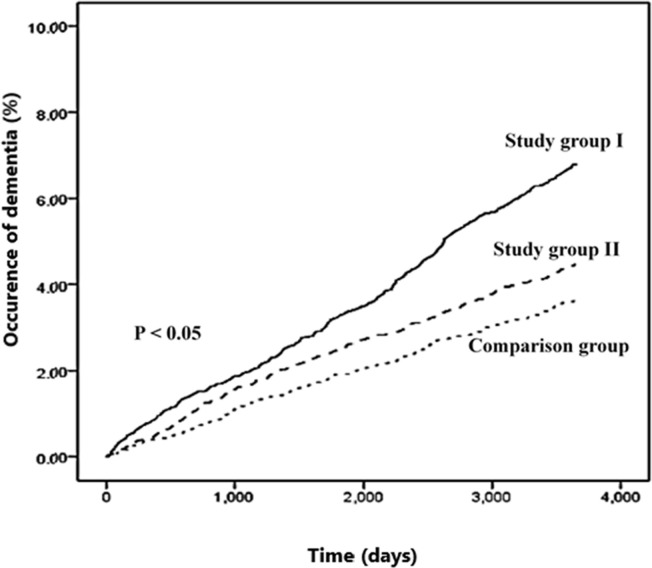
The adjusted hazard ratio (aHR) of dementia for patients with UGID receiving gastric acid-suppressive agents compared with patients with UGID without gastric acid-suppressive agents was 1.470 (95% confidence interval [CI] 1.267-1.705, p < 0.001). Both PPIs and H2RAs increase the risk of dementia (PPIs: aHR 1.886 [95% CI 1.377-2.582], p < 0.001; H2RAs: aHR 1.357 [95% CI 1.098-1.678], p < 0.01), with PPIs exhibiting significantly greater risk (aHR 1.456 [95% CI 1.022-2.075], p < 0.05).
Our results demonstrate an increased risk of dementia in patients with UGID receiving gastric acid-suppressive agents, including PPIs and H2RAs, and the use of PPIs was associated with a significantly greater risk than H2RA use.
抑制胃酸的药物处方,包括质子泵抑制剂(PPIs)和组胺 2 型受体拮抗剂(H2RAs),正在上升。然而,关于它们在亚洲人群中与痴呆的关系的数据很少。因此,本研究的目的是调查在患有上消化道疾病(UGID)的亚洲人群中,使用 PPI 和 H2RA 对痴呆风险的影响。
我们进行了一项基于人群的回顾性队列研究,使用来自 2000 年至 2015 年的台湾纵向健康保险数据库的数据进行了 10 年的随访。我们纳入了 6711 名接受胃酸抑制药物治疗的 UGID 患者、6711 名未接受药物治疗的 UGID 患者和 6711 名无 UGID 或未接受治疗的患者,所有患者年龄均至少为 20 岁。各组按年龄、性别和索引日期进行匹配。使用 Cox 比例风险回归模型调整潜在混杂因素后,分析胃酸抑制药物使用与痴呆之间的关联。
与未接受胃酸抑制药物治疗的 UGID 患者相比,接受胃酸抑制药物治疗的 UGID 患者痴呆的调整后危险比(aHR)为 1.470(95%置信区间 [CI] 1.267-1.705,p<0.001)。PPIs 和 H2RAs 均增加痴呆的风险(PPIs:aHR 1.886 [95% CI 1.377-2.582],p<0.001;H2RAs:aHR 1.357 [95% CI 1.098-1.678],p<0.01),PPIs 的风险显著更高(aHR 1.456 [95% CI 1.022-2.075],p<0.05)。
我们的研究结果表明,接受胃酸抑制药物治疗的 UGID 患者,包括 PPI 和 H2RA,痴呆的风险增加,并且使用 PPI 与使用 H2RA 相比,风险显著更高。