Yeo Hyeonjung, Lee Dongkyu, Kim Jin Soo, Eo Pil Seon, Kim Dong Kyu, Lee Joon Seok, Kwon Ki Tae, Lee Jeeyeon, Park Ho Yong, Yang Jung Dug
Department of Plastic and Reconstructive Surgery, Daegu Fatima Hospital, Daegu, Korea.
Department of Plastic and Reconstructive Surgery, Kyungpook National University, Daegu, Korea.
Arch Plast Surg. 2021 Mar;48(2):165-174. doi: 10.5999/aps.2020.01578. Epub 2021 Mar 15.
In recent years, implant-based breast reconstruction has been performed because of its simplicity, short operation time, and rapid recovery of patients. Several studies have reported treatment methods for implant surgery-related infection, which is a serious complication. The aim of this study was to introduce our strategy for salvaging infected implants and to evaluate its effectiveness.
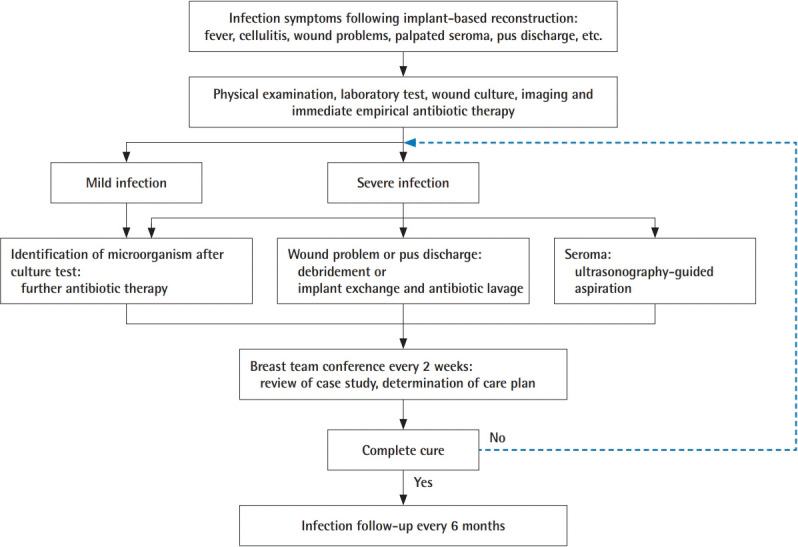
The authors performed a retrospective study of 145 cases from 132 patients who underwent implant-based breast reconstruction from January 2012 to December 2018. Empirical antibiotics were immediately administered to patients with suspected infections. The patients then underwent salvage treatment including appropriate antibiotics, ultrasonography-guided aspiration, debridement, antibiotic lavage, and implant exchange through a multidisciplinary approach. Patient demographics, operative data, duration until drain removal, adjuvant treatment, and complications were analyzed.
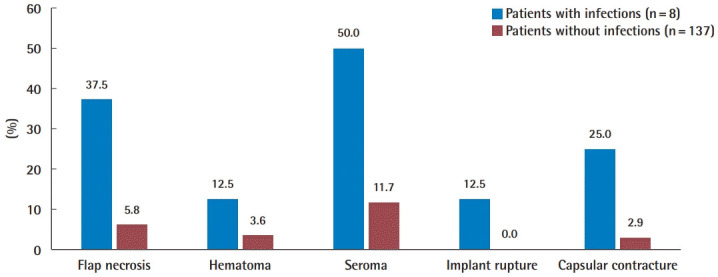
The total infection rate was 5.5% (8/145). A longer indwelling catheter period and adjuvant treatment were significantly associated with infection. The salvage treatment showed a success rate of 87.5% (7/8). Seven patients who received early aggressive salvage treatment recovered from infection. One patient with methicillin-resistant Staphylococcus aureus, who received salvage treatment 11 days after symptom onset, did not respond to drainage and antibiotic treatment. That patient subsequently underwent explantation.
In implant-based breast reconstruction, prevention of infection is of the utmost importance. However, if an infection is suspected, proactive empirical antibiotic therapy and collaboration with the necessary departments are required. Through a multidisciplinary approach and proactive early management, swift and appropriate salvage should be performed.
近年来,基于植入物的乳房重建因其操作简单、手术时间短以及患者恢复快而得以开展。多项研究报道了植入物手术相关感染的治疗方法,这是一种严重的并发症。本研究的目的是介绍我们挽救感染植入物的策略并评估其有效性。
作者对2012年1月至2018年12月期间132例接受基于植入物乳房重建的患者中的145例进行了回顾性研究。对疑似感染的患者立即给予经验性抗生素治疗。然后患者接受包括适当抗生素、超声引导下抽吸、清创、抗生素灌洗以及通过多学科方法进行植入物置换的挽救治疗。分析了患者的人口统计学数据、手术数据、引流管拔除前的持续时间、辅助治疗以及并发症情况。
总感染率为5.5%(8/145)。较长的留置导管时间和辅助治疗与感染显著相关。挽救治疗的成功率为87.5%(7/8)。7例接受早期积极挽救治疗的患者感染得到治愈。1例耐甲氧西林金黄色葡萄球菌感染患者在症状出现11天后接受挽救治疗,对引流和抗生素治疗无反应。该患者随后接受了植入物取出术。
在基于植入物的乳房重建中,预防感染至关重要。然而,如果怀疑发生感染,则需要积极的经验性抗生素治疗并与必要科室协作。通过多学科方法和积极的早期管理,应迅速进行适当的挽救治疗。