Department of Nephrology, University Clinic Hospital, INCLIVA, University of Valencia, Av Blasco Ibañez 17, 46010, Valencia, Spain.
Department of Nephrology, Hospital General Universitario Gregorio Marañón, Madrid, Spain.
BMC Nephrol. 2021 Mar 25;22(1):110. doi: 10.1186/s12882-021-02313-1.
Autosomal dominant polycystic kidney disease (ADPKD) is the most frequent hereditary renal disease. There is an increased rate of cardiovascular disease (CVD) in ADPKD. In this study, we evaluate the prevalence of cardiovascular risk factors, the achievement rates for treatment goals and cardiovascular events (CVE) in ADPKD and their relations with asymptomatic CVD in CKD from other etiologies (CKDoe) and controls.
We evaluated 2445 CKD patients (2010-2012). The information collected was: clinical, anthropometric and analytical parameters, treatments and CVD evaluation (intima-media thickness (IMT), atheromatous plaque presence and ankle-brachial index (ABI)). Laboratory, vital status, CVE and hospitalizations were collected for 4 years.
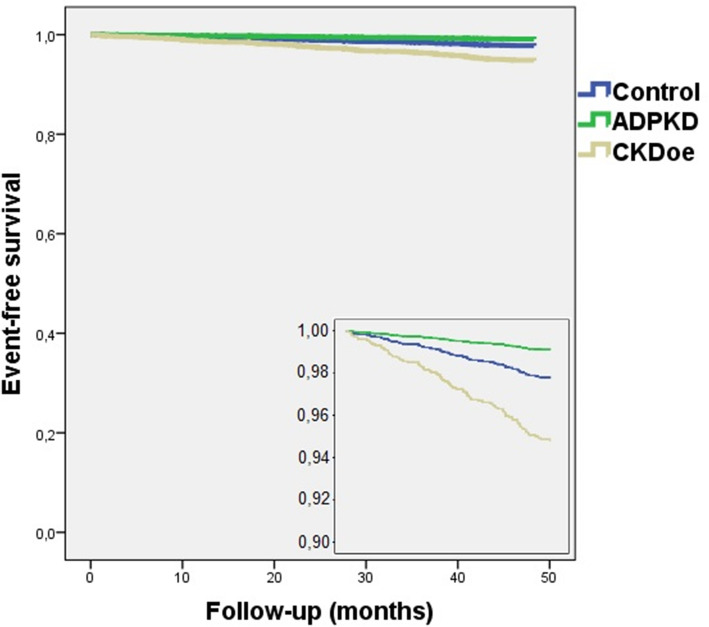
ADPKD patients had a worse renal function and worst achievement of blood pressure, higher parathormone levels but lower proteinuria compared to CKDoe. ADPKD patients presented lower IMT values than other groups, however, an intermediate rate of pathologic ABI and atheromatous plaque was present. More than half of the patients received statins, achieving LDL-c levels < 100 only in 50 and 39.8% of them (ADPKD and CKDoe respectively). The number of CVE during the follow-up period was low. In adjusted Cox regression model, ADPDK had the lowest occurrence of CVE of all three groups (HR:0.422, 95%CI 0.221-0.808, p = 0.009).
ADPKD patients show intermediate control rates of CVD. A better control of CVD risk seems to be related with a lower load of CVD compared to other groups, which may lead in the long term to a better prognosis. Further investigation is necessary to determine cardiovascular prognosis in ADPKD.
常染色体显性多囊肾病(ADPKD)是最常见的遗传性肾脏疾病。ADPKD 患者心血管疾病(CVD)的发病率增加。本研究评估了 ADPKD 患者心血管危险因素的流行率、治疗目标的达标率和心血管事件(CVE),并与其他病因引起的慢性肾脏病(CKDoe)和对照组的无症状 CVD 进行了比较。
我们评估了 2445 例 CKD 患者(2010-2012 年)。收集的信息包括:临床、人体测量和分析参数、治疗方法和 CVD 评估(内-中膜厚度(IMT)、动脉粥样硬化斑块的存在和踝臂指数(ABI))。实验室、生命体征、CVE 和住院情况在 4 年内进行了收集。
与 CKDoe 相比,ADPKD 患者的肾功能更差,血压控制更差,甲状旁腺激素水平更高,但蛋白尿水平更低。与其他两组相比,ADPKD 患者的 IMT 值较低,但存在中等程度的病理性 ABI 和动脉粥样硬化斑块。超过一半的患者接受了他汀类药物治疗,但只有 50%和 39.8%的患者(ADPKD 和 CKDoe 分别)的 LDL-c 水平<100mg/dL。在随访期间,CVE 的数量较少。在调整后的 Cox 回归模型中,ADPKD 组的 CVE 发生率在三组中最低(HR:0.422,95%CI 0.221-0.808,p=0.009)。
ADPKD 患者 CVD 的控制率处于中等水平。与其他两组相比,更好地控制 CVD 风险似乎与较低的 CVD 负荷有关,这可能导致长期预后更好。需要进一步研究以确定 ADPKD 的心血管预后。