Faculty of Medicine, Federal University of Uberlandia, Av. Para, 1720, Bloco 2U, Sala 20, Campus Umuarama, Uberlândia, MG, 38405-320, Brazil.
Federal University of Minas Gerais, Belo Horizonte, MG, Brazil.
Sci Rep. 2021 Mar 25;11(1):6919. doi: 10.1038/s41598-021-86299-8.
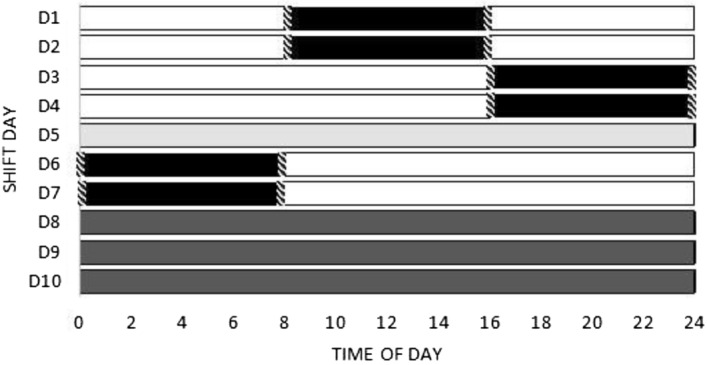
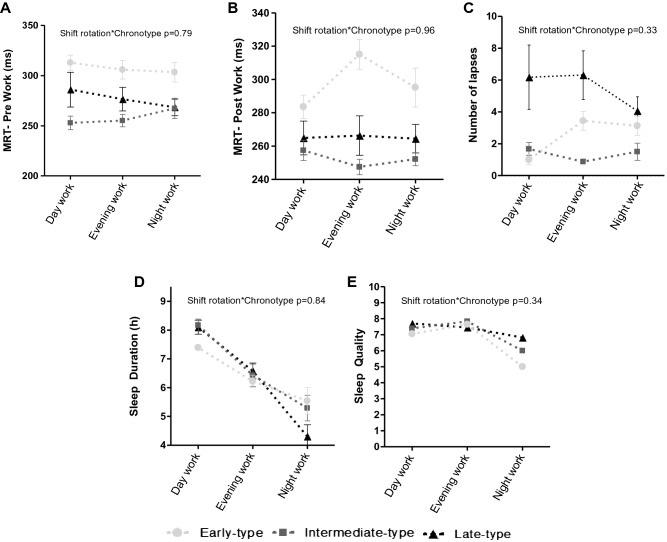
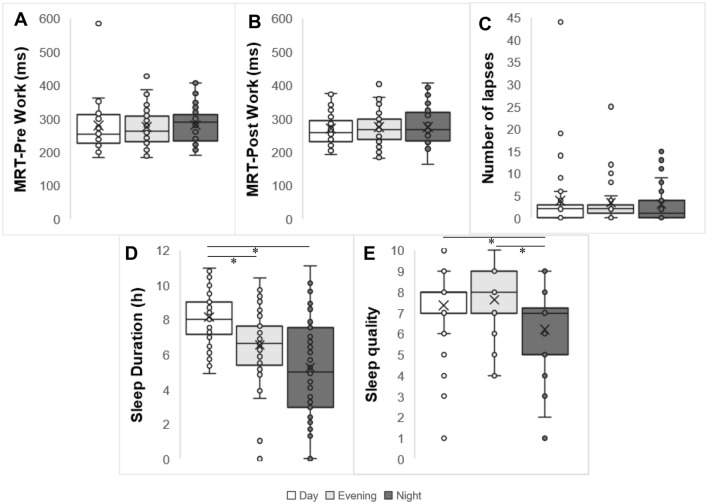
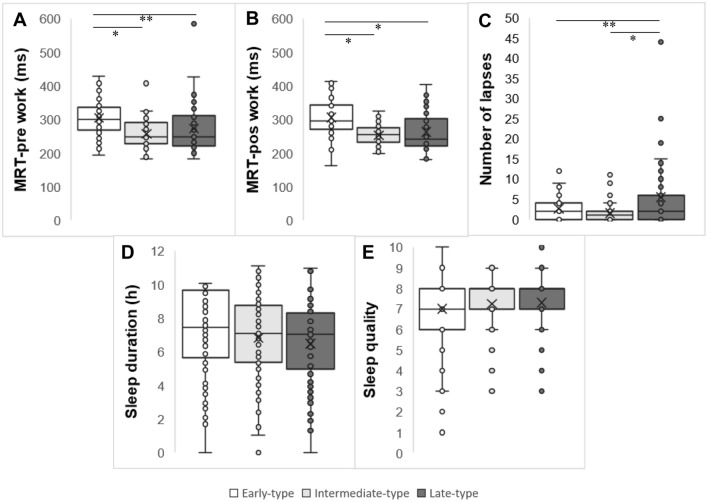
It is known that the chronotype potentially mediates the performance and tolerance to work in shifts and that shift rotation is associated with negative effects on psychomotor performance. This study aimed to evaluate the effect of chronotype on psychomotor performance throughout a complete shift rotation schedule. Thirty males working in clockwise rotating shifts from a mining company were evaluated under a real-life condition over the following shift schedule: 2 days of day work, 2 days of evening work and 2 days of night work. The chronotype was determined using the Munich Chronotype Questionnaire adapted for shift workers and the obtained scores were categorized by tertiles (early-type, intermediate-type and late-type). Work performance was evaluated by Psychomotor Vigilance Test (PVT) daily just before shift starts and after shift ends. Sleep duration was evaluated by actigraphy over the whole shift. No isolated effect of the shift or interaction between shift and chronotype was found in the performance variables evaluated. A significant isolated effect of the chronotype showed that the early-type individuals had higher values of pre- and post-work Mean of Reaction Time (MRT) (308.77 ± 10.03 ms and 306.37 ± 8.53 ms, respectively) than the intermediate-type (257.61 ± 6.63 ms and 252.91 ± 5.97 ms, respectively, p < 0.001) and the late-type (273.35 ± 6.96 ms and 262.88 ± 6.05 ms, respectively, p < 0.001). In addition, late individuals presented a greater number of lapses of attention (5.00 ± 0.92; p < 0.05) than early (1.94 ± 0.50, p < 0.05) and intermediate (1.33 ± 0.30, p < 0.001) ones. We concluded that, compared with intermediates, late-type workers had a greater number of lapses of attention on the shift schedule as a whole, while early-type workers showed the highest pre- and post-work MRT. These findings show that the psychomotor performance of rotating shift workers seems to be influenced by the chronotype, but not by the shift rotation.
众所周知,昼夜时型可能会影响轮班工作的表现和适应能力,而轮班倒转与精神运动表现的负面效应有关。本研究旨在评估昼夜时型对整个轮班倒转时间表内精神运动表现的影响。30 名男性矿工在真实条件下,按照以下轮班时间表进行评估:2 天白班、2 天晚班和 2 天夜班。昼夜时型通过适应轮班工人的慕尼黑昼夜时型问卷确定,根据三分位数(早型、中型和晚型)进行分类。使用精神运动警觉性测试(PVT)在每日轮班前和轮班结束后评估工作表现。通过活动记录仪评估整个轮班期间的睡眠时间。在评估的表现变量中,未发现轮班或轮班与昼夜时型之间的孤立效应。昼夜时型的孤立效应显著表明,早型个体的预工作和后工作平均反应时间(MRT)值较高(分别为 308.77 ± 10.03ms 和 306.37 ± 8.53ms),而中型(分别为 257.61 ± 6.63ms 和 252.91 ± 5.97ms,p<0.001)和晚型(分别为 273.35 ± 6.96ms 和 262.88 ± 6.05ms,p<0.001)。此外,晚型个体的注意力不集中次数(5.00 ± 0.92)多于早型(1.94 ± 0.50,p<0.05)和中型(1.33 ± 0.30,p<0.001)。我们得出结论,与中型相比,晚型工人在整个轮班时间表上的注意力不集中次数更多,而早型工人的预工作和后工作 MRT 最高。这些发现表明,轮班倒转工人的精神运动表现似乎受到昼夜时型的影响,而不受轮班倒转的影响。